



 Chat with AI
Exam 10: Gases

Exam 1: Introduction: Matter and Measurement151 Questions
Exam 2: Atoms, Molecules, and Ions230 Questions
Exam 3: Stoichiometry: Calculations With Chemical Formulas and Equations170 Questions
Exam 4: Aqueous Reactions and Solution Stoichiometry177 Questions
Exam 5: Thermochemistry148 Questions
Exam 6: Electronic Structure of Atoms180 Questions
Exam 7: Periodic Properties of the Elements171 Questions
Exam 8: Basic Concepts of Chemical Bonding141 Questions
Exam 9: Molecular Geometry and Bonding Theories177 Questions
Exam 10: Gases172 Questions
Exam 11: Liquids and Intermolecular Forces119 Questions
Exam 12: Solids and Modern Materials78 Questions
Exam 13: Properties of Solutions151 Questions
Exam 14: Chemical Kinetics130 Questions
Exam 15: Chemical Equilibrium92 Questions
Exam 16: Acid-Base Equilibria134 Questions
Exam 17: Additional Aspects of Aqueous Equilibria111 Questions
Exam 18: Chemistry of the Environment121 Questions
Exam 19: Chemical Thermodynamics120 Questions
Exam 20: Electrochemistry110 Questions
Exam 21: Nuclear Chemistry158 Questions
Exam 22: Chemistry of the Nonmetals192 Questions
Exam 23: Transition Metals and Coordination Chemistry147 Questions
Exam 24: The Chemistry of Life: Organic and Biological Chemistry124 Questions
Select questions type


SO2 (5.00 g)and CO2 (5.00 g)were placed in a 750.0 mL container at 50.0°C. The total pressure in the container was __________ atm.
(Multiple Choice)
4.8/5  (68)
(68) Molecular compounds of low molecular weight tend to be gases at room temperature. Which of the following is most likely not a gas at room temperature?
(Multiple Choice)
4.8/5 (93)
(93) A mixture of Xe, Kr, and Ar has a total pressure of 6.70 atm. What is the mole fraction of Kr if the partial pressures of Xe and Ar are 1.60 atm and 2.80 atm, respectively.
(Multiple Choice)
4.9/5 (77)
(77) A balloon originally had a volume of 4.39 L at 44°C and a pressure of 729 torr. The balloon must be cooled to __________°C to reduce its volume to 3.78 L (at constant pressure).
(Multiple Choice)
4.8/5 (68)
(68) Zinc reacts with aqueous sulfuric acid to form hydrogen gas: Zn (s)+ H2SO4 (aq)→ ZnSO4 (aq)+ H2 (g)
In an experiment, 201 mL of wet H2 is collected over water at 27°C and a barometric pressure of 733 torr. The vapor pressure of water at 27°C is 26.74 torr. The partial pressure of hydrogen in this experiment is __________ atm.
(Multiple Choice)
4.8/5 (101)
(101) At STP, the ratio of the root-mean-square speed of CO2 to that of SO2 is __________.
(Multiple Choice)
4.8/5 (92)
(92) Of the following gases, __________ has density of 2.104 g/L at 303 K and 1.31 atm.
(Multiple Choice)
4.9/5 (76)
(76) A mixture of two gases was allowed to effuse from a container. One of the gases escaped from the container 1.43 times as fast as the other one. The two gases could have been __________.
(Multiple Choice)
4.9/5 (77)
(77) In a Torricelli barometer, a pressure of one atmosphere supports a 760 mm column of mercury. If the original tube containing the mercury is replaced with a tube having twice the diameter of the original, the height of the mercury column at one atmosphere pressure is __________ mm.
(Multiple Choice)
5.0/5 (68)
(68) How many moles of gas are there in a 45.0 L container at 25.0°C and 500.0 mm Hg?
(Multiple Choice)
4.9/5 (71)
(71) A 0.325 L flask filled with gas at 0.851 atm and 19°C contains __________ mol of gas.
(Multiple Choice)
4.8/5 (76)
(76) The volume of HCl gas required to react with excess magnesium metal to produce 6.82 L of hydrogen gas at 2.19 atm and 35.0°C is __________ L.
(Multiple Choice)
5.0/5 (68)
(68) Using the van der Waals equation, the pressure in a 22.4 L vessel containing 1.50 mol of chlorine gas at 0.00°C is __________ atm. (a = 6.49 L2-atm/mol2, b = 0.0562 L/mol)
(Multiple Choice)
4.8/5 (77)
(77) A gas vessel is attached to an open-end manometer containing a nonvolatile liquid of density 0.791 g/mL as shown below. 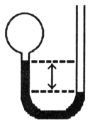 The difference in heights of the liquid in the two sides of the manometer is 43.4 cm when the atmospheric pressure is 755 mm Hg. Given that the density of mercury is 13.6 g/mL, the pressure of the enclosed gas is __________ atm.
 (Multiple Choice)
4.9/5 (91)
(91) A sample of a gas originally at 29°C and 1.25 atm pressure in a 3.0 L container is allowed to contract until the volume is 2.2 L and the temperature is 11°C. The final pressure of the gas is __________ atm.
(Multiple Choice)
4.9/5 (81)
(81) The volume of hydrogen gas at 45.0°C and 699 torr that can be produced by the reaction of 5.66 g of zinc with excess sulfuric acid is __________ L.
(Multiple Choice)
4.7/5 (84)
(84) The volume of 1.20 mol of gas at 61.3 kPa and 25.0°C is __________ L.
(Multiple Choice)
4.8/5 (74)
(74) A sample of He gas (2.35 mol)occupies 57.9 L at 300.0 K and 1.00 atm. The volume of this sample is __________ L at 423 K and 1.00 atm.
(Multiple Choice)
4.9/5 (88)
(88) The volume of 0.65 mol of an ideal gas at 365 torr and 97°C is __________ L.
(Multiple Choice)
4.8/5 (81)
(81) 
Filters
- Essay(0)
- Multiple Choice(0)
- Short Answer(0)
- True False(0)
- Matching(0)