



 Chat with AI
Exam 2: Atoms, Molecules, and Ions

Exam 1: Introduction: Matter and Measurement151 Questions
Exam 2: Atoms, Molecules, and Ions230 Questions
Exam 3: Stoichiometry: Calculations With Chemical Formulas and Equations170 Questions
Exam 4: Aqueous Reactions and Solution Stoichiometry177 Questions
Exam 5: Thermochemistry148 Questions
Exam 6: Electronic Structure of Atoms180 Questions
Exam 7: Periodic Properties of the Elements171 Questions
Exam 8: Basic Concepts of Chemical Bonding141 Questions
Exam 9: Molecular Geometry and Bonding Theories177 Questions
Exam 10: Gases172 Questions
Exam 11: Liquids and Intermolecular Forces119 Questions
Exam 12: Solids and Modern Materials78 Questions
Exam 13: Properties of Solutions151 Questions
Exam 14: Chemical Kinetics130 Questions
Exam 15: Chemical Equilibrium92 Questions
Exam 16: Acid-Base Equilibria134 Questions
Exam 17: Additional Aspects of Aqueous Equilibria111 Questions
Exam 18: Chemistry of the Environment121 Questions
Exam 19: Chemical Thermodynamics120 Questions
Exam 20: Electrochemistry110 Questions
Exam 21: Nuclear Chemistry158 Questions
Exam 22: Chemistry of the Nonmetals192 Questions
Exam 23: Transition Metals and Coordination Chemistry147 Questions
Exam 24: The Chemistry of Life: Organic and Biological Chemistry124 Questions
Select questions type


Cathode rays are deflected away from a negatively charged plate because __________.
(Multiple Choice)
4.7/5  (83)
(83) Element X has three naturally occurring isotopes. The masses (amu)and % abundances of the isotopes are given in the table below. The average atomic mass of the element is __________ amu. 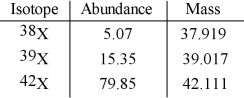
(Multiple Choice)
4.8/5 (83)
(83) Formulas that show how atoms are attached in a molecule are called __________.
(Multiple Choice)
4.8/5 (69)
(69) The atomic mass unit is presently based on assigning an exact integral mass (in amu)to an isotope of __________.
(Multiple Choice)
4.8/5 (80)
(80) The element __________ is the most similar to chlorine in chemical and physical properties.
(Multiple Choice)
4.9/5 (94)
(94) Element M reacts with fluorine to form an ionic compound with the formula MF3. The M-ion has 22 electrons. Element M is __________.
(Multiple Choice)
4.9/5 (59)
(59) Which metal is not required to have its charge specified in the names of ionic compounds it forms?
(Multiple Choice)
4.8/5 (82)
(82) The formula for the compound formed between aluminum ions and phosphate ions is __________.
(Multiple Choice)
4.9/5 (76)
(76) An ion has 8 protons, 9 neutrons, and 10 electrons. The symbol for the ion is __________.
(Multiple Choice)
4.8/5 (91)
(91) When a metal and a nonmetal react, the __________ tends to lose electrons and the __________ tends to gain electrons.
(Multiple Choice)
4.9/5 (64)
(64) A molecule of water contains hydrogen and oxygen in a 1:8 ratio by mass. This is a statement of __________.
(Multiple Choice)
4.8/5 (72)
(72) Magnesium reacts with a certain element to form a compound with the general formula MgX. What would the most likely formula be for the compound formed between potassium and element X?
(Multiple Choice)
4.8/5 (76)
(76) 
Filters
- Essay(0)
- Multiple Choice(0)
- Short Answer(0)
- True False(0)
- Matching(0)