



 Chat with AI
Exam 11: The Billingaccounts Receivable Cash Receipts Barcr Process

Exam 1: Introduction to Accounting Information Systems115 Questions
Exam 2: Enterprise Systems140 Questions
Exam 3: Electronic Business E-Business Systems113 Questions
Exam 4: Documenting Information Systems108 Questions
Exam 5: Database Management Systems180 Questions
Exam 6: Relational Databases and Sql93 Questions
Exam 7: Controlling Information Systems: Introduction to Enterprise Risk Management and Internal Control161 Questions
Exam 8: Controlling Information Systems: Introduction to Pervasive Controls157 Questions
Exam 9: Controlling Information Systems: Business Process and Application Controls126 Questions
Exam 10: The Order Entrysales Oes Process128 Questions
Exam 11: The Billingaccounts Receivable Cash Receipts Barcr Process134 Questions
Exam 12: The Purchasing Process131 Questions
Exam 13: Accounts Payablecash Disbursements Apcd Process104 Questions
Exam 14: The Human Resources Process HR Management and Payroll Processes118 Questions
Exam 15: Integrated Production Processes IPP106 Questions
Exam 16: General Ledger and Business Reporting Glbr Process78 Questions
Exam 17: Acquiring and Implementing Accounting Information Systems206 Questions
Select questions type


The two types of accounts receivable systems discussed in the text are the balance-forward and ____________________ systems.
(Short Answer)
4.9/5  (80)
(80) To reduce the cost of collecting its accounts receivable, a company sells its accounts receivable to a financial organization.The service is called:
(Multiple Choice)
4.7/5 (83)
(83) Which of the following segregation of duties is not required for the B/AR/CR business process controls to be effective:
(Multiple Choice)
4.8/5 (76)
(76) Which of the following control plans is most likely to appear in the ensure input validity and ensure input completeness columns, but not in the ensure input accuracy column of a control matrix for the billing process?
(Multiple Choice)
4.9/5 (82)
(82) The ___________________________________ process supports the repetitive work routines of the credit department, the cashier, and the accounts receivable department.
(Short Answer)
4.8/5 (85)
(85) The acronym EFT stands for ________________________________________.
(Short Answer)
4.9/5 (74)
(74) The __________________________________________________ is created as sales returns, bad debt write-offs, estimated doubtful accounts, or similar adjustments are processed.
(Short Answer)
4.8/5 (76)
(76) _____________________________________________ systems are B2C systems that use a Web site to post customer bills and to receive their electronic payments.
(Essay)
4.9/5 (75)
(75) A(n) ____________________ is a business document used to notify the customer of an obligation to pay the seller for merchandise which was ordered and shipped.
(Short Answer)
4.9/5 (64)
(64) A credit card system is better at reducing float time than a debit card system.
(True/False)
4.8/5 (89)
(89) Which of the following is most commonly associated with the treasury function?
(Multiple Choice)
4.9/5 (81)
(81) The B/AR/CR system supports the repetitive work routines of the credit department, the cashier, and the accounts receivable department.
(True/False)
4.9/5 (74)
(74) A(n) _____________________________________ is an information systems extension that allows a customer to complete an inquiry or perform a task within an organization's business process without the aid of the organization's employees.
(Short Answer)
4.8/5 (70)
(70) When customers pay with a _____________ card, float is eliminated.
(Short Answer)
4.9/5 (92)
(92) A(n) ______________________________ is a business document designed to inform the payee of the invoices or other items being paid.
(Short Answer)
4.8/5 (86)
(86) Which of the following normally would trigger the B/AR/CR process to record a customer payment?
(Multiple Choice)
4.8/5 (85)
(85) Which of the following process bubbles (i.e., activities) would you not expect to see in the logical DFD for a B/AR/CR process?
(Multiple Choice)
4.8/5 (81)
(81) The three types of accounts receivable systems discussed in the text are the lockbox, balance-forward, and open-item systems.
(True/False)
4.8/5 (84)
(84) Below is the narrative of the "Perform billing" portion of the B/AR/CR process.Narrative Description
When the OE/S process produces a sales order, it notifies the B/AR/CR process to that effect.This is the flow "Sales order notification." When triggered by the data flow, "Shipping's billing notification" (i.e., the shipping notice), process 1.1 validates the sale by comparing the details on the sales order
notification to those shown on shipping's billing notification.If discrepancies are noted, the request is rejected, i.e.a reject stub.Rejected requests are later processed through a separate exception routine.If the data flows match, process 1.1 sends a validated shipping notification to process 1.2.Process 1.2 then performs the following actions:
-Obtains from the customer master data containing certain standing data which is needed to produce the invoice.-Creates the invoice and sends it to the customer.-Updates the accounts receivable master data.-Adds an invoice to the sales event data (i.e., the sales journal).-Notifies the general ledger process that a sale has occurred (GL invoice update).Required:
From the DFD in TB Figure 11.1 and the narrative description above, explode bubble 1.0 into a lower-level diagram showing the details of that process. 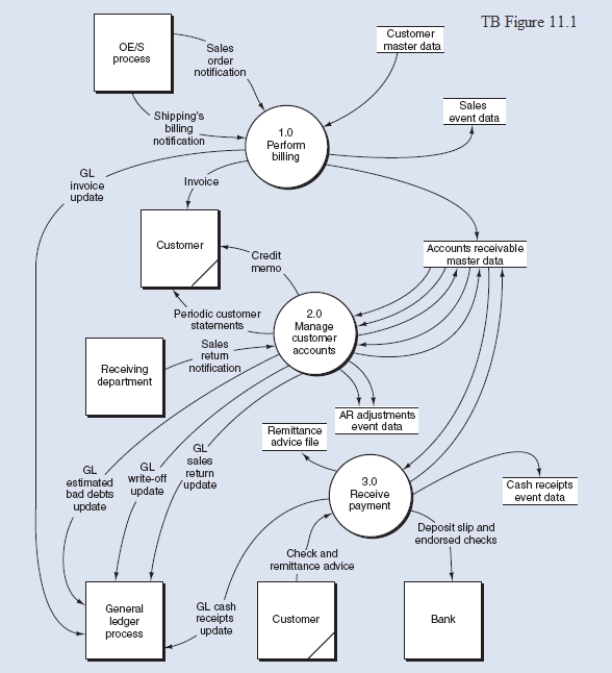
(Essay)
4.8/5 (79)
(79) 
Filters
- Essay(0)
- Multiple Choice(0)
- Short Answer(0)
- True False(0)
- Matching(0)