



 Chat with AI
Exam 27: Accounting for Group Structures

Exam 1: An Overview of the Australian External Reporting Environment70 Questions
Exam 2: The Conceptual Framework of Accounting and Its Relevance to Financial Reporting72 Questions
Exam 3: Theories of Accounting76 Questions
Exam 4: An Overview of Accounting for Assets77 Questions
Exam 5: Depreciation of Property, plant and Equipment77 Questions
Exam 6: Revaluations and Impairment Testing of Non-Current Assets76 Questions
Exam 7: Inventory75 Questions
Exam 8: Accounting for Intangibles77 Questions
Exam 9: Accounting for Heritage Assets and Biological Assets76 Questions
Exam 10: An Overview of Accounting for Liabilities78 Questions
Exam 11: Accounting for Leases81 Questions
Exam 12: Accounting for Employee Benefits84 Questions
Exam 13: Share Capital and Reserves85 Questions
Exam 14: Accounting for Financial Instruments90 Questions
Exam 15: Revenue Recognition Issues79 Questions
Exam 16: The Statement of Comprehensive Income and Statement of Changes in Equity77 Questions
Exam 17: Accounting for Share-Based Payments77 Questions
Exam 18: Accounting for Income Taxes80 Questions
Exam 19: The Statement of Cash Flows77 Questions
Exam 20: Accounting for the Extractive Industries75 Questions
Exam 21: Accounting for General Insurance Contracts73 Questions
Exam 22: Accounting for Superannuation Plans77 Questions
Exam 23: Events Occurring After the End of the Reporting Period77 Questions
Exam 24: Segment Reporting77 Questions
Exam 25: Related Party Disclosures77 Questions
Exam 26: Earnings Per Share76 Questions
Exam 27: Accounting for Group Structures87 Questions
Exam 28: Further Consolidation Issues I: Accounting for Intragroup Transactions60 Questions
Exam 29: Further Consolidation Issues II: Accounting for Non-Controlling Interests44 Questions
Exam 30: Further Consolidation Issues IV: Accounting for Changes in the Degree of Ownership of a Subsidiary49 Questions
Exam 31: Accounting for Equity Investments,including Investments in Associates and Joint Arrangements70 Questions
Exam 32: Accounting for Foreign Currency Transactions78 Questions
Exam 33: Translating the Financial Statements of Foreign Operations52 Questions
Exam 34: Accounting for Corporate Social Responsibility73 Questions
Select questions type


'Control' exists when the parent owns less than half of the voting power of an entity when:
(Multiple Choice)
4.8/5  (90)
(90) When group members do not apply the same accounting methods,the consolidation process requires which of the following to be done?
(Multiple Choice)
4.9/5 (77)
(77) When an acquirer makes a bargain purchase in a business combination,the excess that remains is recognised in profit or loss of the acquirer on acquisition date.
(True/False)
4.9/5 (69)
(69) A subsidiary is an entity that is controlled by a parent entity.
(True/False)
4.9/5 (80)
(80) Explain the circumstances when a bargain purchase may occur and discuss the accounting treatment prescribed in AASB 3 Business Combinations for bargain purchases.
(Essay)
4.8/5 (91)
(91) AASB 10 identifies a number of factors that may indicate the existence of control.These include:
(Multiple Choice)
4.9/5 (85)
(85) After initial recognition,goodwill is measured in which of the following ways?
(Multiple Choice)
4.9/5 (68)
(68) Candle Ltd acquires all the issued capital of Wick Ltd for a cash payment of $4 500 000 on 30 June 2014.The statement of financial position of Wick Ltd at purchase date is: 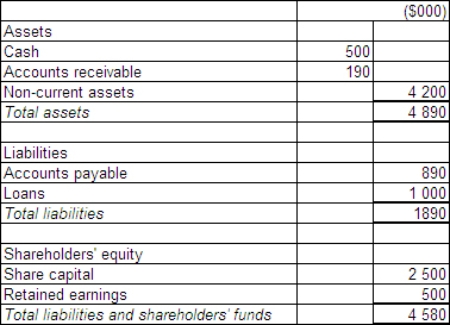 The fair value of the net assets of Wick Ltd as at 30 June 2014 is $3 800 000.What is the consolidation entry to eliminate the investment in Wick Ltd?
 (Multiple Choice)
4.8/5 (89)
(89) Where separate entities in a group do not apply the same accounting methods,AASB 10 Consolidated Financial Statements prescribes adjustments to be made on consolidation to remove the effects of different accounting policies.
(True/False)
4.9/5 (75)
(75) The partition effect in relation to a group of companies arose when:
(Multiple Choice)
4.8/5 (74)
(74) At acquisition date which of the following is not required to be recognised by the acquirer?
(Multiple Choice)
4.8/5 (70)
(70) Discuss the two approaches that may be taken when the subsidiary's assets are not recorded at fair value at the date of acquisition.What implication does the choice between the two methods have on the consolidation accounting process?
(Essay)
4.9/5 (70)
(70) Jasper Ltd acquires all the issued capital of Carrot Ltd for a cash payment of $2 800 000 on 30 June 2014.The statement of financial position of both entities at purchase date is: 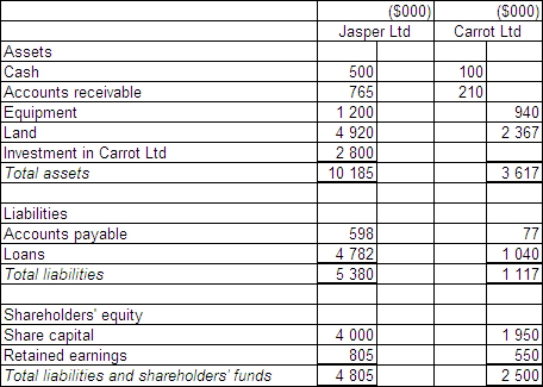 Assuming the assets of Carrot Ltd are recorded at fair value,what is the consolidated statement of financial position at the date of purchase?
 (Multiple Choice)
4.8/5 (75)
(75) Fresco Ltd acquires all the issued capital of Indoor Ltd for a cash payment of $1 000 000 on 30 June 2015.The statement of financial position of Indoor Ltd at purchase date is: 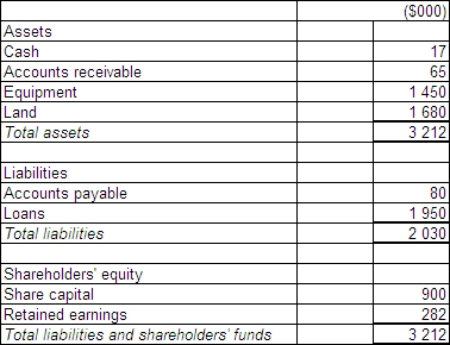 Assuming the assets of Indoor Ltd are at fair value,what is the entry to eliminate the investment in Fresco Ltd?
 (Multiple Choice)
4.8/5 (90)
(90) The degree of control over an investee determines how the investor accounts for the investment.
(True/False)
4.9/5 (69)
(69) Sigmund Ltd acquires all the issued capital of Freud Ltd for a cash payment of $1 900 000 on 30 June 2014.The financial statements of both entities on 30 June 2105 are: 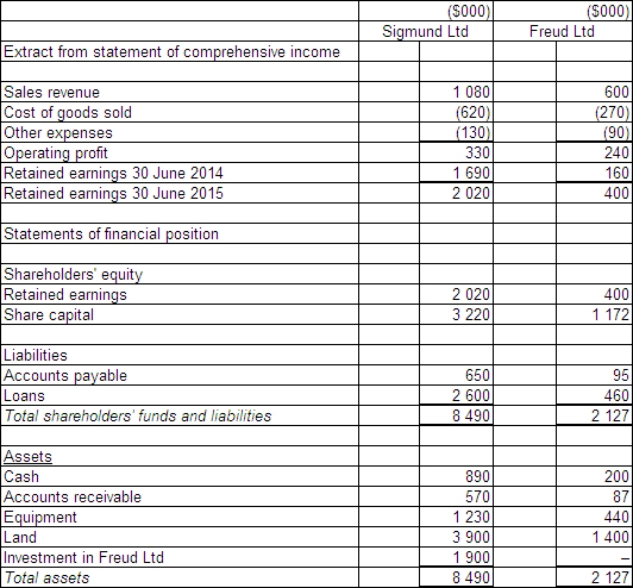 The fair value of the net tangible assets of Freud Ltd on 30 June 2014 was $1 332 000.The equity of Freud at that time was made up of share capital of $1 172 000 and retained earnings of $160 000.Goodwill had been determined to have been impaired by $56 800 during the period.During the period ended 30 June 2015 there were no intragroup transactions.Which of the following consolidated financial statements is correct?
 (Multiple Choice)
4.8/5 (82)
(82) 
Filters
- Essay(0)
- Multiple Choice(0)
- Short Answer(0)
- True False(0)
- Matching(0)