



 Chat with AI
Exam 8: Risk and Rates of Return

Exam 1: An Overview of Financial Management65 Questions
Exam 2: Financial Markets and Institutions33 Questions
Exam 3: Financial Statements, cash Flow, and Taxes130 Questions
Exam 4: Analysis of Financial Statements133 Questions
Exam 5: Time Value of Money163 Questions
Exam 6: Interest Rates82 Questions
Exam 7: Bonds and Their Valuation92 Questions
Exam 8: Risk and Rates of Return146 Questions
Exam 9: Stocks and Their Valuation89 Questions
Exam 10: The Cost of Capital94 Questions
Exam 11: The Basics of Capital Budgeting108 Questions
Exam 12: Cash Flow Estimation and Risk Analysis81 Questions
Exam 13: Real Options and Other Topics in Capital Budgeting41 Questions
Exam 14: Capital Structure and Leverage88 Questions
Exam 15: Distributions to Shareholders: Dividends and Share Repurchases75 Questions
Exam 16: Working Capital Management126 Questions
Exam 17: Financial Planning and Forecasting39 Questions
Exam 18: Derivatives and Risk Management35 Questions
Exam 19: Multinational Financial Management50 Questions
Exam 20: Hybrid Financing: Preferred Stock, leasing, warrants, and Convertibles60 Questions
Exam 21: Mergers and Acquisitions39 Questions
Exam 22: Continuous Compounding and Discounting8 Questions
Exam 23: Zero Coupon Bonds18 Questions
Exam 24: Bankruptcy and Reorganization4 Questions
Exam 25: Calculating Beta Coefficients8 Questions
Exam 26: Using the Capm to Estimate the Risk-Adjusted Cost of Capital5 Questions
Exam 27: Techniques for Measuring Beta Risk3 Questions
Exam 28: Degree of Leverage23 Questions
Select questions type


Managers should under no conditions take actions that increase their firm's risk relative to the market,regardless of how much those actions would increase the firm's expected rate of return.
(True/False)
4.8/5  (80)
(80) Nile Food's stock has a beta of 1.4,while Elba Eateries' stock has a beta of 0.7.Assume that the risk-free rate,rRF,is 5.5% and the market risk premium,(rM − rRF),equals 4%.Which of the following statements is CORRECT?
(Multiple Choice)
4.8/5 (77)
(77) A mutual fund manager has a $40 million portfolio with a beta of 1.00.The risk-free rate is 4.25%,and the market risk premium is 6.00%.The manager expects to receive an additional $60 million which she plans to invest in additional stocks.After investing the additional funds,she wants the fund's required and expected return to be 13.00%.What must the average beta of the new stocks be to achieve the target required rate of return?
(Multiple Choice)
4.9/5 (76)
(76) You have the following data on (1)the average annual returns of the market for the past 5 years and (2)similar information on Stocks A and B.Which of the possible answers best describes the historical betas for A and B?

(Multiple Choice)
4.7/5 (79)
(79) An individual stock's diversifiable risk,which is measured by its beta,can be lowered by adding more stocks to the portfolio in which the stock is held.
(True/False)
4.8/5 (92)
(92) Assume that you manage a $10.00 million mutual fund that has a beta of 1.05 and a 9.50% required return.The risk-free rate is 4.20%.You now receive another $5.00 million,which you invest in stocks with an average beta of 0.65.What is the required rate of return on the new portfolio? (Hint: You must first find the market risk premium,then find the new portfolio beta.)
(Multiple Choice)
4.7/5 (69)
(69) If you plotted the returns on a given stock against those of the market,and if you found that the slope of the regression line was negative,the CAPM would indicate that the required rate of return on the stock should be greater than the risk-free rate for a well-diversified investor,assuming that the observed relationship is expected to continue into the future.
(True/False)
4.9/5 (75)
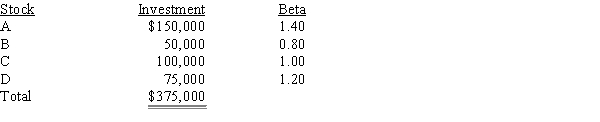
(75) Consider the following information and then calculate the required rate of return for the Global Investment Fund,which holds 4 stocks.The market's required rate of return is 13.25%,the risk-free rate is 7.00%,and the Fund's assets are as follows:

(Multiple Choice)
4.9/5 (67)
(67) Returns for the Dayton Company over the last 3 years are shown below.What's the standard deviation of the firm's returns? (Hint: This is a sample,not a complete population,so the sample standard deviation formula should be used.)

(Multiple Choice)
4.9/5 (72)
(72) Tom Noel holds the following portfolio:
 Tom plans to sell Stock A and replace it with Stock E,which has a beta of 0.75.By how much will the portfolio beta change?
 (Multiple Choice)
4.8/5 (80)
(80) Any change in its beta is likely to affect the required rate of return on a stock,which implies that a change in beta will likely have an impact on the stock's price,other things held constant.
(True/False)
4.8/5 (80)
(80) Bae Inc.is considering an investment that has an expected return of 15% and a standard deviation of 10%.What is the investment's coefficient of variation?
(Multiple Choice)
4.8/5 (80)
(80) According to the Capital Asset Pricing Model,investors are primarily concerned with portfolio risk,not the risks of individual stocks held in isolation.Thus,the relevant risk of a stock is the stock's contribution to the riskiness of a well-diversified portfolio.
(True/False)
4.9/5 (82)
(82) Stock HB has a beta of 1.5 and Stock LB has a beta of 0.5.The market is in equilibrium,with required returns equaling expected returns.Which of the following statements is CORRECT?
(Multiple Choice)
4.8/5 (81)
(81) Stock A has a beta of 0.8 and Stock B has a beta of 1.2.50% of Portfolio P is invested in Stock A and 50% is invested in Stock B.If the market risk premium (rM − rRF)were to increase but the risk-free rate (rRF)remained constant,which of the following would occur?
(Multiple Choice)
4.7/5 (83)
(83) The CAPM is a multi-period model that takes account of differences in securities' maturities,and it can be used to determine the required rate of return for any given level of systematic risk.
(True/False)
4.8/5 (84)
(84) Portfolio A has but one stock,while Portfolio B consists of all stocks that trade in the market,each held in proportion to its market value.Because of its diversification,Portfolio B will by definition be riskless.
(True/False)
4.8/5 (82)
(82) If investors are risk averse and hold only one stock,we can conclude that the required rate of return on a stock whose standard deviation is 0.21 will be greater than the required return on a stock whose standard deviation is 0.10.However,if stocks are held in portfolios,it is possible that the required return could be higher on the stock with the lower standard deviation.
(True/False)
4.9/5 (90)
(90) Variance is a measure of the variability of returns,and since it involves squaring the deviation of each actual return from the expected return,it is always larger than its square root,the standard deviation.
(True/False)
5.0/5 (69)
(69) 
Filters
- Essay(0)
- Multiple Choice(0)
- Short Answer(0)
- True False(0)
- Matching(0)