



 Chat with AI
Exam 14: Capital Structure and Leverage

Exam 1: An Overview of Financial Management65 Questions
Exam 2: Financial Markets and Institutions33 Questions
Exam 3: Financial Statements, cash Flow, and Taxes130 Questions
Exam 4: Analysis of Financial Statements133 Questions
Exam 5: Time Value of Money163 Questions
Exam 6: Interest Rates82 Questions
Exam 7: Bonds and Their Valuation92 Questions
Exam 8: Risk and Rates of Return146 Questions
Exam 9: Stocks and Their Valuation89 Questions
Exam 10: The Cost of Capital94 Questions
Exam 11: The Basics of Capital Budgeting108 Questions
Exam 12: Cash Flow Estimation and Risk Analysis81 Questions
Exam 13: Real Options and Other Topics in Capital Budgeting41 Questions
Exam 14: Capital Structure and Leverage88 Questions
Exam 15: Distributions to Shareholders: Dividends and Share Repurchases75 Questions
Exam 16: Working Capital Management126 Questions
Exam 17: Financial Planning and Forecasting39 Questions
Exam 18: Derivatives and Risk Management35 Questions
Exam 19: Multinational Financial Management50 Questions
Exam 20: Hybrid Financing: Preferred Stock, leasing, warrants, and Convertibles60 Questions
Exam 21: Mergers and Acquisitions39 Questions
Exam 22: Continuous Compounding and Discounting8 Questions
Exam 23: Zero Coupon Bonds18 Questions
Exam 24: Bankruptcy and Reorganization4 Questions
Exam 25: Calculating Beta Coefficients8 Questions
Exam 26: Using the Capm to Estimate the Risk-Adjusted Cost of Capital5 Questions
Exam 27: Techniques for Measuring Beta Risk3 Questions
Exam 28: Degree of Leverage23 Questions
Select questions type


Your firm has $500 million of investor-supplied capital,its return on investors' capital (ROIC)is 15%,and it currently has no debt in its capital structure .The CFO is contemplating a recapitalization where it would issue debt at an after-tax cost of 10% and use the proceeds to buy back some of its common stock,such that the percentage of common equity in the capital structure (wc)is 1 − wd.If the company goes ahead with the recapitalization,its operating income,the size of the firm (i.e.,total assets),total investor-supplied capital,and tax rate would remain unchanged.Which of the following is most likely to occur as a result of the recapitalization?

Free
(Multiple Choice)
4.8/5  (77)
(77) Correct Answer: Verified
E
Some people--including the former chairman of the Federal Reserve Board of Governors (Ben Bernanke)--have argued that one advantage of corporate debt from the stockholders' standpoint is that the existence of debt forces managers to focus on cash flow and to refrain from spending too much of the firm's money on private plane and other "perks." This is one of the factors that led to the rise of LBOs and private equity firms.
Free
(True/False)
4.9/5 (72)
(72) Correct Answer:Verified
VerifiedTrue
You were hired as the CFO of a new company that was founded by three professors at your university.The company plans to manufacture and sell a new product,a cell phone that can be worn like a wrist watch.The issue now is how to finance the company,with equity only or with a mix of debt and equity.The price per phone will be $250.00 regardless of how the firm is financed.The expected fixed and variable operating costs,along with other data,are shown below.How much higher or lower will the firm's expected ROE be if it uses 60% debt rather than only equity,i.e.,what is ROEL − ROEU? 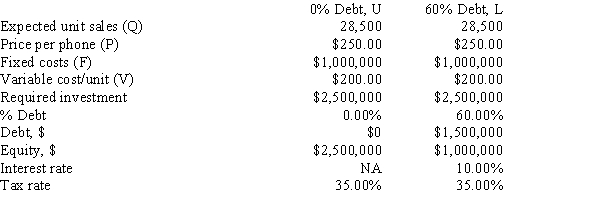
Free
(Multiple Choice)
4.8/5 (76)
(76) Correct Answer:Verified
VerifiedE
Which of the following would tend to increase a firm's target debt ratio,other things held constant?
(Multiple Choice)
4.8/5 (87)
(87) You work for the CEO of a new company that plans to manufacture and sell a new type of laptop computer.The issue now is how to finance the company,with only equity or with a mix of debt and equity.Expected operating income is $600,000.Other data for the firm are shown below.How much higher or lower will the firm's expected EPS be if it uses some debt rather than only equity,i.e.,what is EPSL − EPSU? 
(Multiple Choice)
4.9/5 (75)
(75) A major contribution of the Miller model is that it demonstrates,other things held constant,that
(Multiple Choice)
4.9/5 (86)
(86) Monroe Inc.is an all-equity firm with 500,000 shares outstanding.It has $2,000,000 of EBIT,and EBIT is expected to remain constant in the future.The company pays out all of its earnings,so earnings per share (EPS)equal dividends per shares (DPS),and its tax rate is 40%.The company is considering issuing $5,000,000 of 9.00% bonds and using the proceeds to repurchase stock.The risk-free rate is 4.5%,the market risk premium is 5.0%,and the firm's beta is currently 0.90.However,the CFO believes the beta would rise to 1.10 if the recapitalization occurs.Assuming the shares could be repurchased at the price that existed prior to the recapitalization,what would the price per share be following the recapitalization? (Hint: P0 = EPS/rs because EPS = DPS.)
(Multiple Choice)
4.7/5 (87)
(87) You have been hired by a new firm that is just being started.The CFO wants to finance with 60% debt,but the president thinks it would be better to hold the percentage of debt in the capital structure (wd)to only 10%.Other things held constant,and based on the data below,if the firm uses more debt,by how much would the ROE change,i.e.,what is ROENew − ROEOld? 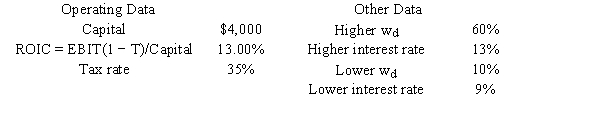
(Multiple Choice)
5.0/5 (83)
(83) A firm's business risk is largely determined by the financial characteristics of its industry,especially by the amount of debt the average firm in the industry uses.
(True/False)
4.9/5 (77)
(77) According to Modigliani and Miller (MM),in a world without corporate income taxes the use of debt has no effect on the firm's value.
(True/False)
4.9/5 (82)
(82) Modigliani and Miller's first article led to the conclusion that capital structure is extremely important,and that every firm has an optimal capital structure that maximizes its value and minimizes its cost of capital.
(True/False)
4.9/5 (87)
(87) An increase in the debt ratio will generally have no effect on which of these items?
(Multiple Choice)
4.8/5 (80)
(80) Modigliani and Miller (MM),in their second article,took account of taxes,bankruptcy,and other factors that were assumed away in their original article.Once they took account of all these assumptions,they concluded that every firm has a unique optimal capital structure.Moreover,a manager can use the second MM model to determine his or her firm's optimal debt ratio.
(True/False)
4.9/5 (80)
(80) The trade-off theory states that capital structure decisions involve a tradeoff between the costs and benefits of debt financing.
(True/False)
4.8/5 (74)
(74) Other things held constant,an increase in financial leverage will increase a firm's market (or systematic)risk as measured by its beta coefficient.
(True/False)
4.8/5 (85)
(85) Which of the following statements is CORRECT? As a firm increases the operating leverage used to produce a given quantity of output,this
(Multiple Choice)
4.9/5 (87)
(87) Companies HD and LD have the same total assets,total investor-supplied capital,operating income (EBIT),tax rate,and business risk.Company HD,however,has a much higher debt ratio than LD.Also,both companies' returns on investors' capital (ROIC)exceed their after-tax costs of debt,rd(1 − T).Which of the following statements is CORRECT?
(Multiple Choice)
4.8/5 (76)
(76) According to Modigliani and Miller (MM),in a world without taxes the optimal capital structure for a firm is approximately 100% debt financing.
(True/False)
4.8/5 (86)
(86) Which of the following statements is CORRECT,holding other things constant?
(Multiple Choice)
4.8/5 (86)
(86) 
Filters
- Essay(0)
- Multiple Choice(0)
- Short Answer(0)
- True False(0)
- Matching(0)