



 Chat with AI
Exam 27: Reactions of Organic Compounds

Exam 1: Matter: Its Properties and Measurement136 Questions
Exam 2: Atoms and the Atomic Theory119 Questions
Exam 3: Chemical Compounds152 Questions
Exam 4: Chemical Reactions170 Questions
Exam 5: Introduction to Reactions in Aqueous Solutions124 Questions
Exam 6: Gases113 Questions
Exam 7: Thermochemistry125 Questions
Exam 8: Electrons in Atoms123 Questions
Exam 9: The Periodic Table and Some Atomic Properties93 Questions
Exam 10: Chemical Bonding I: Basic Concepts107 Questions
Exam 11: Chemical Bonding Ii: Valence Bond and Molecular Orbital Theories104 Questions
Exam 12: Intermolecular Forces: Liquids and Solids121 Questions
Exam 13: Spontaneous Change: Entropy and Gibbs Energy123 Questions
Exam 14: Solutions and Their Physical Properties132 Questions
Exam 15: Principles of Chemical Equilibrium118 Questions
Exam 16: Acids and Bases137 Questions
Exam 17: Additional Aspects of Acidbase Equilibria130 Questions
Exam 18: Solubility and Complex-Ion Equilibria104 Questions
Exam 19: Electrochemistry127 Questions
Exam 20: Chemical Kinetics124 Questions
Exam 21: Chemistry of the Main-Group Elements I: Groups 1,2,13,and 14116 Questions
Exam 22: Chemistry of the Main-Group Elements Ii: Groups 18,17,16,15,and Hydrogen100 Questions
Exam 23: The Transition Elements108 Questions
Exam 24: Complex Ions and Coordination Compounds104 Questions
Exam 25: Nuclear Chemistry116 Questions
Exam 26: Structures of Organic Compounds99 Questions
Exam 27: Reactions of Organic Compounds94 Questions
Exam 28: Chemistry of the Living State104 Questions
Select questions type


Which reagents would you choose to carry out the following transformations?
I. II.
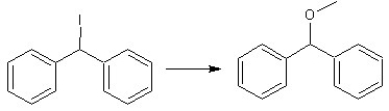 III.
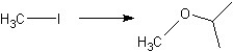
II.
III. (Multiple Choice)
4.9/5  (79)
(79) Synthesis of alkanes from alkyl halides is a typical example of E2 reaction.
(True/False)
4.8/5 (92)
(92) Which of the following are nucleophiles?
I.CH3COCH3
II.CH3Br
III.CH3CH2C≡C-
(Multiple Choice)
4.8/5 (83)
(83) SN2 reactions are nucleophilic substitution reactions for which the rate determining step is bimolecular.
(True/False)
4.8/5 (84)
(84) When (CH3)3CBr reacts with CH3ONa in methanol,two products are formed: a major one is an alkene and minor one is an ether.Identify the two products and by what mechanism(s)they are formed?
(Multiple Choice)
4.9/5 (81)
(81) Predict major products for chlorination of the following three aromatic compounds: 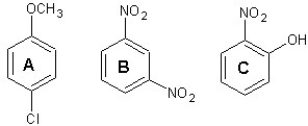
(Multiple Choice)
4.8/5 (64)
(64) Predict the major product for the reaction:
1-butene + HI →
(Multiple Choice)
4.8/5 (84)
(84) Classify the following reaction steps as initiation,propagation or termination.
A: Br-Br → 2 Br∙
B: H3CH2C∙ + Br∙ → CH3CH2Br
C: 2 H3CH2C∙ → CH3CH2CH2CH3
(Multiple Choice)
4.8/5 (82)
(82) 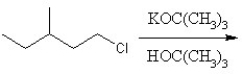
Which of the following steps can be found in any of the polymerization mechanisms you learned?
I.initiation
II.condensation
III.propagation
IV.dehydrohalogenation
V.rearrangement
(Multiple Choice)
5.0/5 (79)
(79) Which of the following groups would be ortho,para directors in electrophilic aromatic substitution?
I.-CN
II.-SO3H
III.-NH2
IV.-OH
V.-Br
(Multiple Choice)
4.7/5 (83)
(83) The rate of E2 reaction between an alkyl halide RX and a base B is given by the following expression (k is a rate constant):
(Multiple Choice)
5.0/5 (67)
(67) 
Filters
- Essay(0)
- Multiple Choice(0)
- Short Answer(0)
- True False(0)
- Matching(0)