



 Chat with AI
Exam 27: Reactions of Organic Compounds

Exam 1: Matter: Its Properties and Measurement136 Questions
Exam 2: Atoms and the Atomic Theory119 Questions
Exam 3: Chemical Compounds152 Questions
Exam 4: Chemical Reactions170 Questions
Exam 5: Introduction to Reactions in Aqueous Solutions124 Questions
Exam 6: Gases113 Questions
Exam 7: Thermochemistry125 Questions
Exam 8: Electrons in Atoms123 Questions
Exam 9: The Periodic Table and Some Atomic Properties93 Questions
Exam 10: Chemical Bonding I: Basic Concepts107 Questions
Exam 11: Chemical Bonding Ii: Valence Bond and Molecular Orbital Theories104 Questions
Exam 12: Intermolecular Forces: Liquids and Solids121 Questions
Exam 13: Spontaneous Change: Entropy and Gibbs Energy123 Questions
Exam 14: Solutions and Their Physical Properties132 Questions
Exam 15: Principles of Chemical Equilibrium118 Questions
Exam 16: Acids and Bases137 Questions
Exam 17: Additional Aspects of Acidbase Equilibria130 Questions
Exam 18: Solubility and Complex-Ion Equilibria104 Questions
Exam 19: Electrochemistry127 Questions
Exam 20: Chemical Kinetics124 Questions
Exam 21: Chemistry of the Main-Group Elements I: Groups 1,2,13,and 14116 Questions
Exam 22: Chemistry of the Main-Group Elements Ii: Groups 18,17,16,15,and Hydrogen100 Questions
Exam 23: The Transition Elements108 Questions
Exam 24: Complex Ions and Coordination Compounds104 Questions
Exam 25: Nuclear Chemistry116 Questions
Exam 26: Structures of Organic Compounds99 Questions
Exam 27: Reactions of Organic Compounds94 Questions
Exam 28: Chemistry of the Living State104 Questions
Select questions type


Which of the following statements correctly describe the step-reaction polymerization?
I.It is also called condensation polymerization.
II.It produces polymers of moderately high molecular masses.
III.It requires that monomers have functional groups that can join together.
IV.This type of polymerization is fast.
V.It is accompanied with the addition of a small molecule.
(Multiple Choice)
4.9/5  (80)
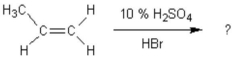
(80) 
Arrange the following radicals in the order of increasing stability: 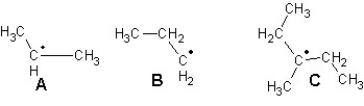
(Multiple Choice)
4.9/5 (78)
(78) Which of the following steps can be found in E1 reaction mechanism?
I.formation of a carbocation
II.attack of the base and removal of a proton from carbocation
III.attack of a nucleophile
IV.formation of a carboanion
(Multiple Choice)
4.9/5 (89)
(89) In which of the following reactions can alcohol participate?
I.oxidation reactions
II.elimination reactions
III.amide synthesis
IV.peptide synthesis
V.ester synthesis
(Multiple Choice)
4.9/5 (89)
(89) Which are the most probable reactions and mechanisms in which tertiary haloalkanes participate?
I.Substitution,SN1
II.Substitution SN2
III.Elimination E1
IV.Elimination E2
V.Addition
(Multiple Choice)
4.9/5 (75)
(75) The common general anesthetic neothyl can be produced by the following dehydration reaction.What is the systematic name of neothyl?
CH3CH2CH2OH + CH3OH  ?
? (Multiple Choice)
4.8/5 (83)
(83) The physical properties of polymers depend on:
I.the average molecular mass of a chain
II.the strength of intermolecular forces between the chains
III.the reaction temperature applied during synthesis
IV.the degree of crystallinity
V.the reaction pressure
(Multiple Choice)
4.7/5 (77)
(77) Identify the product(s)and mechanism for the following reaction: 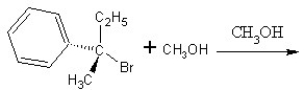
(Multiple Choice)
4.9/5 (69)
(69) In a substitution reaction an atom,an ion or a group in one molecule is replaced by another atom,ion or group.
(True/False)
4.8/5 (78)
(78) Which of the following are electrophiles?
I.CH3CH2NH2
II.Br+
III.CH3OH
(Multiple Choice)
4.9/5 (78)
(78) We can promote SN2 over SN1 reactions if we:
I.use a substrate that gives a primary carbocation and not tertiary carbocation
II.use a sterically hindered substrate
III.use a polar protic solvent
(Multiple Choice)
4.9/5 (78)
(78) Arrange the following in the order of decreasing nucleophilicity:
H2N-,HO-,HCOO-,CH3O-
(Multiple Choice)
4.9/5 (75)
(75) Give the correct mathematical expression for the rate law for E2 reactions (S is a substrate and B is a base).
(Multiple Choice)
4.8/5 (80)
(80) Which reagents would you use for the following transformations? 
(Multiple Choice)
4.7/5 (64)
(64) Find a group that is a ortho,para director in electrophilic aromatic substitution.
(Multiple Choice)
5.0/5 (77)
(77) 
Filters
- Essay(0)
- Multiple Choice(0)
- Short Answer(0)
- True False(0)
- Matching(0)