



 Chat with AI
Exam 19: Electrochemistry

Exam 1: Chemistry and Measurement111 Questions
Exam 2: Atoms, molecules, and Ions149 Questions
Exam 3: Calculations With Chemical Formulas and Equations139 Questions
Exam 4: Chemical Reactions159 Questions
Exam 5: The Gaseous State104 Questions
Exam 6: Thermochemistry119 Questions
Exam 7: Quantum Theory of the Atom68 Questions
Exam 8: Electron Configurations and Periodicity100 Questions
Exam 9: Ionic and Covalent Bonding125 Questions
Exam 10: Molecular Geometry and Chemical Bonding Theory101 Questions
Exam 11: States of Matter; Liquids and Solids123 Questions
Exam 12: Solutions119 Questions
Exam 13: Rates of Reaction113 Questions
Exam 14: Chemical Equilibrium97 Questions
Exam 15: Acids and Bases83 Questions
Exam 16: Acid-Base Equilibria148 Questions
Exam 17: Solubility and Complex-Ion Equilibria115 Questions
Exam 18: Thermodynamics and Equilibrium94 Questions
Exam 19: Electrochemistry122 Questions
Exam 20: Nuclear Chemistry90 Questions
Exam 21: Chemistry of the Main-Group Metals121 Questions
Exam 22: The Transition Elements and Coordination Compounds75 Questions
Exam 23: Organic Chemistry79 Questions
Exam 24: Polymer Materials: Synthetic and Biological56 Questions
Select questions type


What is the half-reaction that occurs at the cathode during electrolysis of an aqueous potassium iodide solution?
Reduction Half-Reaction
E° (V)
K+(aq)+ e-  K(s) -2.93
Mg2+(aq)+ 2e-
 Mg(s) -2.37
2H2O(l)+ 2e-
 H2(g)+ 2OH-(aq) -0.83
2H+(aq)+ 2e-
 H2(g) 0.00
I2(s)+ 2e-
 2I-(aq) 0.54
O2(g)+ 4H+(aq)+ 4e-
 2H2O(l) 1.23
K(s) -2.93
Mg2+(aq)+ 2e- Mg(s) -2.37
2H2O(l)+ 2e- H2(g)+ 2OH-(aq) -0.83
2H+(aq)+ 2e- H2(g) 0.00
I2(s)+ 2e- 2I-(aq) 0.54
O2(g)+ 4H+(aq)+ 4e- 2H2O(l) 1.23 (Multiple Choice)
4.8/5  (82)
(82) What is E°cell for the cell reaction 2Cr(s)+ 3Sn4+ (aq)→ 3Sn2+(aq)+ 2Cr3+ (aq)?
Cr3+ (aq)+ 3e-  Cr(s); E° = -0.74V



Cr(s); E° = -0.74V
(Multiple Choice)
4.7/5 (66)
(66) The cell potential of an electrochemical cell with the cell reaction
Al(s)+ Cr3+(aq)→ Cr(s)+ Al3+(aq)
Is 1.63 V.What is the maximum electrical work obtainable from this cell when 0.50 g of Al is consumed?
(Multiple Choice)
4.7/5 (71)
(71) If an electrolysis plant operates its electrolytic cells at a total current of 1.4 × 10⁶ A,how long will it take to produce one metric ton (one million grams)of Mg(s)from seawater containing Mg2+? (1 faraday = 96,485 coulombs)
(Multiple Choice)
4.9/5 (69)
(69) Molten magnesium chloride is electrolyzed using inert electrodes and reactions represented by the following two half-reactions:
2Cl-(l)→ Cl2(g)+ 2e-
Mg2+(l)+ 2e- → Mg(s)
Concerning this electrolysis,which of the following statements is true?
(Multiple Choice)
4.8/5 (80)
(80) Consider the following cell reaction:
2Cr(s)+ 6H+(aq)→ 2Cr3+(aq)+ 3H2(g); E°cell = 0.74V
Under standard-state conditions,what is E° for the following half-reaction?
Cr3+(aq)+ 3e− → Cr(s)
(Multiple Choice)
4.7/5 (77)
(77) Consider the following reduction potentials:
Cd2+(aq)+ 2e-  Cd(s); E° = -0.40 V
Pb2+(aq)+ 2e-
 Pb(s); E° = -0.13 V
Cu2+(aq)+ 2e-
 Cu(s); E° = 0.34 V
Br2(l)+ 2e-
 2Br-(aq); E° = 1.07 V
Under standard-state conditions,which of the following reactions is spontaneous?
Cd(s); E° = -0.40 V
Pb2+(aq)+ 2e- Pb(s); E° = -0.13 V
Cu2+(aq)+ 2e- Cu(s); E° = 0.34 V
Br2(l)+ 2e- 2Br-(aq); E° = 1.07 V
Under standard-state conditions,which of the following reactions is spontaneous? (Multiple Choice)
4.9/5 (83)
(83) Which reaction would be most likely to occur at the anode of a voltaic cell?
(Multiple Choice)
4.9/5 (85)
(85) Consider the following standard reduction potentials:
2H+(aq)+ 2e-  H2(g); E° = 0.00 V
Sn2+(aq)+ 2e-
 Sn(s); E° = -0.15 V
Cd2+(aq)+ 2e-
 Cd(s); E° = -0.40 V
Which pair of substances will react spontaneously under standard-state conditions?
H2(g); E° = 0.00 V
Sn2+(aq)+ 2e- Sn(s); E° = -0.15 V
Cd2+(aq)+ 2e- Cd(s); E° = -0.40 V
Which pair of substances will react spontaneously under standard-state conditions? (Multiple Choice)
4.7/5 (77)
(77) Which of the following cell reactions would require the use of an inert electrode?
(Multiple Choice)
4.8/5 (87)
(87) Which of the following statements is true about a voltaic cell for which E°cell = 1.00 V?
(Multiple Choice)
4.9/5 (84)
(84) Consider the following standard electrode potentials:
Ag+(aq)+ e-  Ag(s); E° = 0.80 V
Mn2+(aq)+ 2e-
 Mn(s); E° = -1.18 V
Which of the following statements is false concerning the electrochemical cell given below?
Mn(s)| Mn2+(aq)|| Ag+(aq)| Ag(s)
Ag(s); E° = 0.80 V
Mn2+(aq)+ 2e- Mn(s); E° = -1.18 V
Which of the following statements is false concerning the electrochemical cell given below?
Mn(s)| Mn2+(aq)|| Ag+(aq)| Ag(s) (Multiple Choice)
4.8/5 (88)
(88) Copper is electroplated from CuSO4 solution.A constant current of 4.06 A is applied by an external power supply.How long will it take to deposit 1.00 ×10² g of Cu? The atomic weight of copper is 63.546.
(Multiple Choice)
4.8/5 (66)
(66) Consider the following cell reaction:
2Hg2+(aq)+ H2(g)→ 2H+(aq)+ Hg22+(aq); E°cell = 0.92 V
Under standard-state conditions,what is E° for the following half-reaction?
Hg2+(aq)+ 2e- → Hg22+(aq)
(Multiple Choice)
4.8/5 (80)
(80) Which of the following statements is true concerning the electrochemical cell depicted below?
Zn | Zn2+(aq)|| Cu2+(aq)| Cu
Zn2+(aq)+ 2e−  Zn(s); E° = -2.87 V
Cu2+(aq)+ 2e−
 Cu(s); E° = -2.38 V
Zn(s); E° = -2.87 V
Cu2+(aq)+ 2e− Cu(s); E° = -2.38 V (Multiple Choice)
4.9/5 (81)
(81) Which of the following statements is true concerning the voltaic cell shown below? 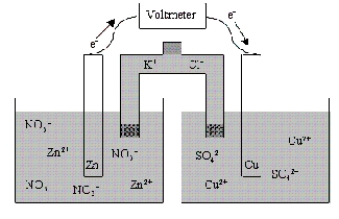
(Multiple Choice)
4.9/5 (76)
(76) How many faradays are involved in the conversion of a mole of Mn2O3 to MnO2 ?
(Multiple Choice)
5.0/5 (83)
(83) What half-reaction occurs at the cathode during the electrolysis of molten potassium bromide?
(Multiple Choice)
4.8/5 (94)
(94) A voltaic cell is made by placing a zinc electrode in a compartment in which the Zn2+ concentration is 2.0 × 10⁻⁵ M and by placing a Pt electrode in the other compartment,in which the H+ concentration is 3.4 M and PH2 = 1.00 atm.The Zn2+/Zn half-cell reduction potential is -0.76 V,and the H+/H2 half-cell reduction potential is 0.00 V.What is the equilibrium constant at 25°C for the spontaneous cell reaction?
(Multiple Choice)
4.8/5 (78)
(78) 
Filters
- Essay(0)
- Multiple Choice(0)
- Short Answer(0)
- True False(0)
- Matching(0)