
Exam 19: Electrochemistry

arrow
  • Select Tags
search iconSearch Question
flashcardsStudy Flashcards
  • Select Tags

A strip of iron is placed in a 1 M solution of iron(II)sulfate,and a strip of copper is placed in a 1 M solution of copper(II)chloride.The two solutions are connected with a salt bridge,and the two metals are connected by a wire. Reduction Half-Reaction E° (V) Fe2+(aq)+ 2e- A strip of iron is placed in a 1 M solution of iron(II)sulfate,and a strip of copper is placed in a 1 M solution of copper(II)chloride.The two solutions are connected with a salt bridge,and the two metals are connected by a wire. Reduction Half-Reaction E° (V) Fe<sup>2+</sup>(aq)+ 2e<sup>-</sup>  Fe(s) -0)41Cu<sup>2+</sup>(aq)+ 2e<sup>-</sup>  Cu(s) 0)34 Which of the following takes place?Fe(s) -0)41Cu2+(aq)+ 2e- A strip of iron is placed in a 1 M solution of iron(II)sulfate,and a strip of copper is placed in a 1 M solution of copper(II)chloride.The two solutions are connected with a salt bridge,and the two metals are connected by a wire. Reduction Half-Reaction E° (V) Fe<sup>2+</sup>(aq)+ 2e<sup>-</sup>  Fe(s) -0)41Cu<sup>2+</sup>(aq)+ 2e<sup>-</sup>  Cu(s) 0)34 Which of the following takes place?Cu(s) 0)34 Which of the following takes place?

(Multiple Choice)
4.7/5
(69)

Given: Hg2+(aq)+ 2e- Given: Hg<sup>2+</sup>(aq)+ 2e<sup>-</sup>  Hg(s); E° = 0.85 V Li<sup>+</sup>(aq)+ e<sup>-</sup>  Li(s); E° = -3.04 V Br<sub>2</sub>(l)+ 2e<sup>-</sup>  2Br<sup>-</sup>(aq); E° = 1.07 V Au<sup>+</sup>(aq)+ e<sup>-</sup>  Au(s); E° = 1.69 V Cl<sub>2</sub>(g)+ 2e<sup>-</sup>  2Cl<sup>-</sup>(aq); E° = 1.36 V Which of the following species is the best reducing agent?Hg(s); E° = 0.85 V Li+(aq)+ e- Given: Hg<sup>2+</sup>(aq)+ 2e<sup>-</sup>  Hg(s); E° = 0.85 V Li<sup>+</sup>(aq)+ e<sup>-</sup>  Li(s); E° = -3.04 V Br<sub>2</sub>(l)+ 2e<sup>-</sup>  2Br<sup>-</sup>(aq); E° = 1.07 V Au<sup>+</sup>(aq)+ e<sup>-</sup>  Au(s); E° = 1.69 V Cl<sub>2</sub>(g)+ 2e<sup>-</sup>  2Cl<sup>-</sup>(aq); E° = 1.36 V Which of the following species is the best reducing agent?Li(s); E° = -3.04 V Br2(l)+ 2e- Given: Hg<sup>2+</sup>(aq)+ 2e<sup>-</sup>  Hg(s); E° = 0.85 V Li<sup>+</sup>(aq)+ e<sup>-</sup>  Li(s); E° = -3.04 V Br<sub>2</sub>(l)+ 2e<sup>-</sup>  2Br<sup>-</sup>(aq); E° = 1.07 V Au<sup>+</sup>(aq)+ e<sup>-</sup>  Au(s); E° = 1.69 V Cl<sub>2</sub>(g)+ 2e<sup>-</sup>  2Cl<sup>-</sup>(aq); E° = 1.36 V Which of the following species is the best reducing agent?2Br-(aq); E° = 1.07 V Au+(aq)+ e- Given: Hg<sup>2+</sup>(aq)+ 2e<sup>-</sup>  Hg(s); E° = 0.85 V Li<sup>+</sup>(aq)+ e<sup>-</sup>  Li(s); E° = -3.04 V Br<sub>2</sub>(l)+ 2e<sup>-</sup>  2Br<sup>-</sup>(aq); E° = 1.07 V Au<sup>+</sup>(aq)+ e<sup>-</sup>  Au(s); E° = 1.69 V Cl<sub>2</sub>(g)+ 2e<sup>-</sup>  2Cl<sup>-</sup>(aq); E° = 1.36 V Which of the following species is the best reducing agent?Au(s); E° = 1.69 V Cl2(g)+ 2e- Given: Hg<sup>2+</sup>(aq)+ 2e<sup>-</sup>  Hg(s); E° = 0.85 V Li<sup>+</sup>(aq)+ e<sup>-</sup>  Li(s); E° = -3.04 V Br<sub>2</sub>(l)+ 2e<sup>-</sup>  2Br<sup>-</sup>(aq); E° = 1.07 V Au<sup>+</sup>(aq)+ e<sup>-</sup>  Au(s); E° = 1.69 V Cl<sub>2</sub>(g)+ 2e<sup>-</sup>  2Cl<sup>-</sup>(aq); E° = 1.36 V Which of the following species is the best reducing agent?2Cl-(aq); E° = 1.36 V Which of the following species is the best reducing agent?

(Multiple Choice)
4.8/5
(84)

When the following oxidation-reduction reaction in acidic solution is balanced,what is the lowest whole-number coefficient for H+,and on which side of the balanced equation should it appear? MnO4-(aq)+ I-(aq)→ Mn2+(aq)+ I2(s)

(Multiple Choice)
4.9/5
(87)

What is the value of the reaction quotient,Q,for the voltaic cell constructed from the following two half-reactions when the Zn2+ concentration is 0.0120 M and the Ag+ concentration is 1.27 M? What is the value of the reaction quotient,Q,for the voltaic cell constructed from the following two half-reactions when the Zn<sup>2+</sup> concentration is 0.0120 M and the Ag<sup>+</sup> concentration is 1.27 M?            What is the value of the reaction quotient,Q,for the voltaic cell constructed from the following two half-reactions when the Zn<sup>2+</sup> concentration is 0.0120 M and the Ag<sup>+</sup> concentration is 1.27 M?            What is the value of the reaction quotient,Q,for the voltaic cell constructed from the following two half-reactions when the Zn<sup>2+</sup> concentration is 0.0120 M and the Ag<sup>+</sup> concentration is 1.27 M?            What is the value of the reaction quotient,Q,for the voltaic cell constructed from the following two half-reactions when the Zn<sup>2+</sup> concentration is 0.0120 M and the Ag<sup>+</sup> concentration is 1.27 M?            What is the value of the reaction quotient,Q,for the voltaic cell constructed from the following two half-reactions when the Zn<sup>2+</sup> concentration is 0.0120 M and the Ag<sup>+</sup> concentration is 1.27 M?            What is the value of the reaction quotient,Q,for the voltaic cell constructed from the following two half-reactions when the Zn<sup>2+</sup> concentration is 0.0120 M and the Ag<sup>+</sup> concentration is 1.27 M?

(Multiple Choice)
4.8/5
(80)

A cell consists of a magnesium electrode immersed in a solution of magnesium chloride and a silver electrode immersed in a solution of silver nitrate.The two half-cells are connected by means of a salt bridge.It is possible to increase the voltage of the cell by

(Multiple Choice)
4.9/5
(84)

For the cell reaction 2MnO4- (​aq​)+ 5SO2(g)+ 2H2O(l) → 2Mn2+(aq)+ 5SO2-4 (aq​)+ 4H+(aq) The standard cell potential is 1.34 V.To determine the cell potential at nonstandard conditions,what is the value that should be used for n in the Nernst equation?

(Multiple Choice)
4.9/5
(82)

A zinc-copper voltaic cell is represented as follows: Zn(s)| Zn2+(1.0 M)|| Cu2+(1.0 M)| Cu(s) Which of the following statements is false?

(Multiple Choice)
4.9/5
(81)

The electrochemical reaction which powers a lead-acid storage battery is as follows: Pb(s)+ PbO2(s)+ 4H+(aq)+ 2SO42-(aq)→ 2PbSO4(s)+ 2H2O(l) A single cell of this battery consists of a Pb electrode and a PbO2 electrode,each submerged in sulfuric acid.What reaction occurs at the cathode during discharge?

(Multiple Choice)
4.8/5
(77)

Given: Given:       Pb<sup>2+</sup> (aq​)+ 2e¯  Pb(​s​); ​E​º = -0.13V What is the standard Gibbs free-energy change for the following reaction? 2Cr(​s​)+ 3Pb<sup>2+</sup> (aq​)→ 3Pb(​s​)+ 2Cr<sup>3+</sup> (aq) Given:       Pb<sup>2+</sup> (aq​)+ 2e¯  Pb(​s​); ​E​º = -0.13V What is the standard Gibbs free-energy change for the following reaction? 2Cr(​s​)+ 3Pb<sup>2+</sup> (aq​)→ 3Pb(​s​)+ 2Cr<sup>3+</sup> (aq) Given:       Pb<sup>2+</sup> (aq​)+ 2e¯  Pb(​s​); ​E​º = -0.13V What is the standard Gibbs free-energy change for the following reaction? 2Cr(​s​)+ 3Pb<sup>2+</sup> (aq​)→ 3Pb(​s​)+ 2Cr<sup>3+</sup> (aq) Pb2+ (aq​)+ 2e¯ Given:       Pb<sup>2+</sup> (aq​)+ 2e¯  Pb(​s​); ​E​º = -0.13V What is the standard Gibbs free-energy change for the following reaction? 2Cr(​s​)+ 3Pb<sup>2+</sup> (aq​)→ 3Pb(​s​)+ 2Cr<sup>3+</sup> (aq)Pb(​s​); ​E​º = -0.13V What is the standard Gibbs free-energy change for the following reaction? 2Cr(​s​)+ 3Pb2+ (aq​)→ 3Pb(​s​)+ 2Cr3+ (aq)

(Multiple Choice)
4.7/5
(82)

Electrolysis of a molten salt with the formula MCl,using a current of 3.86 A for 16.2 min,deposits 1.52 g of metal.Identify the metal.(1 faraday = 96,485 coulombs)

(Multiple Choice)
4.9/5
(93)

Given: Zn2+(aq)+ 2e- Given: Zn<sup>2+</sup>(aq)+ 2e<sup>-</sup>  Zn(s); E° = -0.76 V Cr<sup>3+</sup>(aq)+ 3e<sup>-</sup>  Cr(s); E° = -0.74 V Fe<sup>2+</sup>(aq)+ 2e<sup>-</sup>  Fe(s); E° = -0.41 V Cd<sup>2+</sup>(aq)+ 2e<sup>-</sup>  Cd(s); E° = -0.40 V Sn<sup>2+</sup>(aq)+ 2e<sup>-</sup>  Sn(s); E° = -0.15 V Hg<sup>2+</sup>(aq)+ 2e<sup>-</sup>  Hg(s); E° = 0.85 V Au<sup>+</sup>(aq)+ e<sup>-</sup>  Au(s); E° = 1.69 V Under standard-state conditions,which of the following metals will reduce Hg<sup>2+</sup> to Hg but will not reduce Cd<sup>2+</sup> to Cd?Zn(s); E° = -0.76 V Cr3+(aq)+ 3e- Given: Zn<sup>2+</sup>(aq)+ 2e<sup>-</sup>  Zn(s); E° = -0.76 V Cr<sup>3+</sup>(aq)+ 3e<sup>-</sup>  Cr(s); E° = -0.74 V Fe<sup>2+</sup>(aq)+ 2e<sup>-</sup>  Fe(s); E° = -0.41 V Cd<sup>2+</sup>(aq)+ 2e<sup>-</sup>  Cd(s); E° = -0.40 V Sn<sup>2+</sup>(aq)+ 2e<sup>-</sup>  Sn(s); E° = -0.15 V Hg<sup>2+</sup>(aq)+ 2e<sup>-</sup>  Hg(s); E° = 0.85 V Au<sup>+</sup>(aq)+ e<sup>-</sup>  Au(s); E° = 1.69 V Under standard-state conditions,which of the following metals will reduce Hg<sup>2+</sup> to Hg but will not reduce Cd<sup>2+</sup> to Cd?Cr(s); E° = -0.74 V Fe2+(aq)+ 2e- Given: Zn<sup>2+</sup>(aq)+ 2e<sup>-</sup>  Zn(s); E° = -0.76 V Cr<sup>3+</sup>(aq)+ 3e<sup>-</sup>  Cr(s); E° = -0.74 V Fe<sup>2+</sup>(aq)+ 2e<sup>-</sup>  Fe(s); E° = -0.41 V Cd<sup>2+</sup>(aq)+ 2e<sup>-</sup>  Cd(s); E° = -0.40 V Sn<sup>2+</sup>(aq)+ 2e<sup>-</sup>  Sn(s); E° = -0.15 V Hg<sup>2+</sup>(aq)+ 2e<sup>-</sup>  Hg(s); E° = 0.85 V Au<sup>+</sup>(aq)+ e<sup>-</sup>  Au(s); E° = 1.69 V Under standard-state conditions,which of the following metals will reduce Hg<sup>2+</sup> to Hg but will not reduce Cd<sup>2+</sup> to Cd?Fe(s); E° = -0.41 V Cd2+(aq)+ 2e- Given: Zn<sup>2+</sup>(aq)+ 2e<sup>-</sup>  Zn(s); E° = -0.76 V Cr<sup>3+</sup>(aq)+ 3e<sup>-</sup>  Cr(s); E° = -0.74 V Fe<sup>2+</sup>(aq)+ 2e<sup>-</sup>  Fe(s); E° = -0.41 V Cd<sup>2+</sup>(aq)+ 2e<sup>-</sup>  Cd(s); E° = -0.40 V Sn<sup>2+</sup>(aq)+ 2e<sup>-</sup>  Sn(s); E° = -0.15 V Hg<sup>2+</sup>(aq)+ 2e<sup>-</sup>  Hg(s); E° = 0.85 V Au<sup>+</sup>(aq)+ e<sup>-</sup>  Au(s); E° = 1.69 V Under standard-state conditions,which of the following metals will reduce Hg<sup>2+</sup> to Hg but will not reduce Cd<sup>2+</sup> to Cd?Cd(s); E° = -0.40 V Sn2+(aq)+ 2e- Given: Zn<sup>2+</sup>(aq)+ 2e<sup>-</sup>  Zn(s); E° = -0.76 V Cr<sup>3+</sup>(aq)+ 3e<sup>-</sup>  Cr(s); E° = -0.74 V Fe<sup>2+</sup>(aq)+ 2e<sup>-</sup>  Fe(s); E° = -0.41 V Cd<sup>2+</sup>(aq)+ 2e<sup>-</sup>  Cd(s); E° = -0.40 V Sn<sup>2+</sup>(aq)+ 2e<sup>-</sup>  Sn(s); E° = -0.15 V Hg<sup>2+</sup>(aq)+ 2e<sup>-</sup>  Hg(s); E° = 0.85 V Au<sup>+</sup>(aq)+ e<sup>-</sup>  Au(s); E° = 1.69 V Under standard-state conditions,which of the following metals will reduce Hg<sup>2+</sup> to Hg but will not reduce Cd<sup>2+</sup> to Cd?Sn(s); E° = -0.15 V Hg2+(aq)+ 2e- Given: Zn<sup>2+</sup>(aq)+ 2e<sup>-</sup>  Zn(s); E° = -0.76 V Cr<sup>3+</sup>(aq)+ 3e<sup>-</sup>  Cr(s); E° = -0.74 V Fe<sup>2+</sup>(aq)+ 2e<sup>-</sup>  Fe(s); E° = -0.41 V Cd<sup>2+</sup>(aq)+ 2e<sup>-</sup>  Cd(s); E° = -0.40 V Sn<sup>2+</sup>(aq)+ 2e<sup>-</sup>  Sn(s); E° = -0.15 V Hg<sup>2+</sup>(aq)+ 2e<sup>-</sup>  Hg(s); E° = 0.85 V Au<sup>+</sup>(aq)+ e<sup>-</sup>  Au(s); E° = 1.69 V Under standard-state conditions,which of the following metals will reduce Hg<sup>2+</sup> to Hg but will not reduce Cd<sup>2+</sup> to Cd?Hg(s); E° = 0.85 V Au+(aq)+ e- Given: Zn<sup>2+</sup>(aq)+ 2e<sup>-</sup>  Zn(s); E° = -0.76 V Cr<sup>3+</sup>(aq)+ 3e<sup>-</sup>  Cr(s); E° = -0.74 V Fe<sup>2+</sup>(aq)+ 2e<sup>-</sup>  Fe(s); E° = -0.41 V Cd<sup>2+</sup>(aq)+ 2e<sup>-</sup>  Cd(s); E° = -0.40 V Sn<sup>2+</sup>(aq)+ 2e<sup>-</sup>  Sn(s); E° = -0.15 V Hg<sup>2+</sup>(aq)+ 2e<sup>-</sup>  Hg(s); E° = 0.85 V Au<sup>+</sup>(aq)+ e<sup>-</sup>  Au(s); E° = 1.69 V Under standard-state conditions,which of the following metals will reduce Hg<sup>2+</sup> to Hg but will not reduce Cd<sup>2+</sup> to Cd?Au(s); E° = 1.69 V Under standard-state conditions,which of the following metals will reduce Hg2+ to Hg but will not reduce Cd2+ to Cd?

(Multiple Choice)
4.7/5
(72)

In the electrolysis of an acid solution,oxygen can be produced by the following half-reaction: 2H2O(l)→ O2(g)+ 4H+(aq)+ 4e- How many moles of O2 can be produced from a solution that was electrolyzed for 6.50 h using a current of 5.40 A?

(Multiple Choice)
4.8/5
(77)

If the cell is initially at standard-state conditions,which of the following statements is true? If the cell is initially at standard-state conditions,which of the following statements is true?   Zn<sup>2+</sup>(aq)+ 2e<sup>-</sup>  Zn(s); E° = -0.76 V Cu<sup>2+</sup>(aq)+ 2e<sup>-</sup>  Cu(s); E° = 0.34 V Zn2+(aq)+ 2e- If the cell is initially at standard-state conditions,which of the following statements is true?   Zn<sup>2+</sup>(aq)+ 2e<sup>-</sup>  Zn(s); E° = -0.76 V Cu<sup>2+</sup>(aq)+ 2e<sup>-</sup>  Cu(s); E° = 0.34 VZn(s); E° = -0.76 V Cu2+(aq)+ 2e- If the cell is initially at standard-state conditions,which of the following statements is true?   Zn<sup>2+</sup>(aq)+ 2e<sup>-</sup>  Zn(s); E° = -0.76 V Cu<sup>2+</sup>(aq)+ 2e<sup>-</sup>  Cu(s); E° = 0.34 VCu(s); E° = 0.34 V
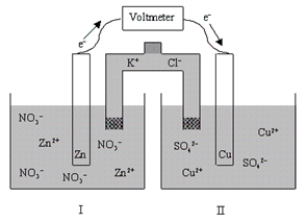
(Multiple Choice)
4.7/5
(84)

How many faradays are required to convert a mole of NO3- ions to NH4+ ions?

(Multiple Choice)
4.9/5
(78)

Consider the following standard reduction potentials: Mg2+(aq)+ 2e- Consider the following standard reduction potentials: Mg<sup>2+</sup>(aq)+ 2e<sup>-</sup>   Mg(s); E° = -2.38 V V<sup>2+</sup>(aq)+ 2e<sup>-</sup>   V(s); E° = -1.18 V Cu<sup>2+</sup>(aq)+ e<sup>-</sup>   Cu<sup>+</sup>(aq); E° = 0.15 V Which of the following reactions will proceed spontaneously from left to right under standard-state conditions? Mg(s); E° = -2.38 V V2+(aq)+ 2e- Consider the following standard reduction potentials: Mg<sup>2+</sup>(aq)+ 2e<sup>-</sup>   Mg(s); E° = -2.38 V V<sup>2+</sup>(aq)+ 2e<sup>-</sup>   V(s); E° = -1.18 V Cu<sup>2+</sup>(aq)+ e<sup>-</sup>   Cu<sup>+</sup>(aq); E° = 0.15 V Which of the following reactions will proceed spontaneously from left to right under standard-state conditions? V(s); E° = -1.18 V Cu2+(aq)+ e- Consider the following standard reduction potentials: Mg<sup>2+</sup>(aq)+ 2e<sup>-</sup>   Mg(s); E° = -2.38 V V<sup>2+</sup>(aq)+ 2e<sup>-</sup>   V(s); E° = -1.18 V Cu<sup>2+</sup>(aq)+ e<sup>-</sup>   Cu<sup>+</sup>(aq); E° = 0.15 V Which of the following reactions will proceed spontaneously from left to right under standard-state conditions? Cu+(aq); E° = 0.15 V Which of the following reactions will proceed spontaneously from left to right under standard-state conditions?

(Multiple Choice)
5.0/5
(74)

The anode in a voltaic cell and in an electrolytic cell is

(Multiple Choice)
4.8/5
(89)

A current of 13.0 A is passed through molten magnesium chloride for 16.0 h.How many moles of magnesium metal could be produced via this electrolysis?

(Multiple Choice)
4.8/5
(86)

Balance the following half-reaction occurring in basic solution. ​ MnO2(s)→ Mn(OH)2(s)

(Multiple Choice)
4.8/5
(77)

The cell potential of the following cell is determined using an unspecified concentration of acid.What is the pH of the acid solution given that the measured cell potential is -0.508 V and the anode reduction potential (E°)is 0.222 V at 25°C? ​ Ag(s)| AgCl(s)| Cl−(1.0 M)|| H+(aq,? M)| H2(g,1.0 atm)| Pt(s)

(Multiple Choice)
4.8/5
(84)

When an aqueous solution of sodium sulfate is electrolyzed,what are the expected products? Reduction Half-Reaction E° (V) Na+(aq​)+ e¯ When an aqueous solution of sodium sulfate is electrolyzed,what are the expected products? Reduction Half-Reaction E° (V) Na<sup>+</sup>(aq​)+ e¯<sup> </sup> <sup> </sup>   Na(s) -2.71 2H<sub>2</sub>O(l)+ 2e<sup>-</sup>  H<sub>2</sub>(g)+ 2OH<sup>-</sup>(aq) -0.83 2H<sup>+</sup>(aq)+ 2e<sup>-</sup>  H<sub>2</sub>(g) 0.00 O<sub>2</sub>(g)+ 4H<sup>+</sup>(aq)+ 4e<sup>-</sup>  2H<sub>2</sub>O(l)1.23 S<sub>2</sub>O<sub>8</sub><sup>2-</sup>(aq)+ 2e<sup>-</sup>  2SO<sub>4</sub><sup>2-</sup>(aq) 2.01 Na(s) -2.71 2H2O(l)+ 2e- When an aqueous solution of sodium sulfate is electrolyzed,what are the expected products? Reduction Half-Reaction E° (V) Na<sup>+</sup>(aq​)+ e¯<sup> </sup> <sup> </sup>   Na(s) -2.71 2H<sub>2</sub>O(l)+ 2e<sup>-</sup>  H<sub>2</sub>(g)+ 2OH<sup>-</sup>(aq) -0.83 2H<sup>+</sup>(aq)+ 2e<sup>-</sup>  H<sub>2</sub>(g) 0.00 O<sub>2</sub>(g)+ 4H<sup>+</sup>(aq)+ 4e<sup>-</sup>  2H<sub>2</sub>O(l)1.23 S<sub>2</sub>O<sub>8</sub><sup>2-</sup>(aq)+ 2e<sup>-</sup>  2SO<sub>4</sub><sup>2-</sup>(aq) 2.01H2(g)+ 2OH-(aq) -0.83 2H+(aq)+ 2e- When an aqueous solution of sodium sulfate is electrolyzed,what are the expected products? Reduction Half-Reaction E° (V) Na<sup>+</sup>(aq​)+ e¯<sup> </sup> <sup> </sup>   Na(s) -2.71 2H<sub>2</sub>O(l)+ 2e<sup>-</sup>  H<sub>2</sub>(g)+ 2OH<sup>-</sup>(aq) -0.83 2H<sup>+</sup>(aq)+ 2e<sup>-</sup>  H<sub>2</sub>(g) 0.00 O<sub>2</sub>(g)+ 4H<sup>+</sup>(aq)+ 4e<sup>-</sup>  2H<sub>2</sub>O(l)1.23 S<sub>2</sub>O<sub>8</sub><sup>2-</sup>(aq)+ 2e<sup>-</sup>  2SO<sub>4</sub><sup>2-</sup>(aq) 2.01H2(g) 0.00 O2(g)+ 4H+(aq)+ 4e- When an aqueous solution of sodium sulfate is electrolyzed,what are the expected products? Reduction Half-Reaction E° (V) Na<sup>+</sup>(aq​)+ e¯<sup> </sup> <sup> </sup>   Na(s) -2.71 2H<sub>2</sub>O(l)+ 2e<sup>-</sup>  H<sub>2</sub>(g)+ 2OH<sup>-</sup>(aq) -0.83 2H<sup>+</sup>(aq)+ 2e<sup>-</sup>  H<sub>2</sub>(g) 0.00 O<sub>2</sub>(g)+ 4H<sup>+</sup>(aq)+ 4e<sup>-</sup>  2H<sub>2</sub>O(l)1.23 S<sub>2</sub>O<sub>8</sub><sup>2-</sup>(aq)+ 2e<sup>-</sup>  2SO<sub>4</sub><sup>2-</sup>(aq) 2.012H2O(l)1.23 S2O82-(aq)+ 2e- When an aqueous solution of sodium sulfate is electrolyzed,what are the expected products? Reduction Half-Reaction E° (V) Na<sup>+</sup>(aq​)+ e¯<sup> </sup> <sup> </sup>   Na(s) -2.71 2H<sub>2</sub>O(l)+ 2e<sup>-</sup>  H<sub>2</sub>(g)+ 2OH<sup>-</sup>(aq) -0.83 2H<sup>+</sup>(aq)+ 2e<sup>-</sup>  H<sub>2</sub>(g) 0.00 O<sub>2</sub>(g)+ 4H<sup>+</sup>(aq)+ 4e<sup>-</sup>  2H<sub>2</sub>O(l)1.23 S<sub>2</sub>O<sub>8</sub><sup>2-</sup>(aq)+ 2e<sup>-</sup>  2SO<sub>4</sub><sup>2-</sup>(aq) 2.012SO42-(aq) 2.01

(Multiple Choice)
4.9/5
(96)
Showing 41 - 60 of 122
close modal

Filters

  • Essay(0)
  • Multiple Choice(0)
  • Short Answer(0)
  • True False(0)
  • Matching(0)


