



 Chat with AI
Exam 19: Electrochemistry

Exam 1: Chemistry and Measurement111 Questions
Exam 2: Atoms, molecules, and Ions149 Questions
Exam 3: Calculations With Chemical Formulas and Equations139 Questions
Exam 4: Chemical Reactions159 Questions
Exam 5: The Gaseous State104 Questions
Exam 6: Thermochemistry119 Questions
Exam 7: Quantum Theory of the Atom68 Questions
Exam 8: Electron Configurations and Periodicity100 Questions
Exam 9: Ionic and Covalent Bonding125 Questions
Exam 10: Molecular Geometry and Chemical Bonding Theory101 Questions
Exam 11: States of Matter; Liquids and Solids123 Questions
Exam 12: Solutions119 Questions
Exam 13: Rates of Reaction113 Questions
Exam 14: Chemical Equilibrium97 Questions
Exam 15: Acids and Bases83 Questions
Exam 16: Acid-Base Equilibria148 Questions
Exam 17: Solubility and Complex-Ion Equilibria115 Questions
Exam 18: Thermodynamics and Equilibrium94 Questions
Exam 19: Electrochemistry122 Questions
Exam 20: Nuclear Chemistry90 Questions
Exam 21: Chemistry of the Main-Group Metals121 Questions
Exam 22: The Transition Elements and Coordination Compounds75 Questions
Exam 23: Organic Chemistry79 Questions
Exam 24: Polymer Materials: Synthetic and Biological56 Questions
Select questions type


A solution of  is electrolytically reduced to Mn3+.A current of 5.19 A is passed through the solution for 15.0 min.What is the number of moles of Mn3+ produced in this process? (1 faraday = 96,486 coulombs)
 (Multiple Choice)
5.0/5  (85)
(85) Which of the following statements is true concerning half-cell I as the voltaic cell shown below discharges? 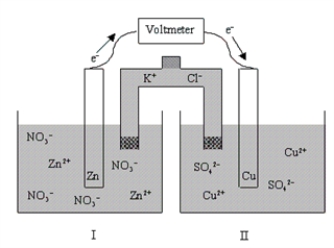
(Multiple Choice)
4.8/5 (78)
(78) Gold (atomic weight = 197)is plated from a solution of chlorauric acid,HAuCl4; it deposits on the cathode.Calculate the time it takes to deposit 0.77 g of gold,passing a current of 0.10 A.(1 faraday = 96,485 coulombs)
(Multiple Choice)
4.8/5 (93)
(93) Which of the following statements about batteries is false?
(Multiple Choice)
4.9/5 (82)
(82) Calculate the maximum electrical work obtainable at 25oC from the following voltaic cell.
Cd(s)|Cd2+(0.840M)||Cl2(g,0.0354atm)|Cl-(0.0473M)|Pt;Eºcell = 1.76V
(Multiple Choice)
4.9/5 (73)
(73) What is the copper(II)-ion concentration at 25°C in the cell Zn(s)| Zn2+(1.0 M)|| Cu2+(aq)| Cu(s)if the measured cell potential is 1.08 V? The standard cell potential is 1.10 V.
(Multiple Choice)
4.9/5 (80)
(80) Which of the following is true for a reaction that is nonspontaneous as written?
(Multiple Choice)
4.8/5 (76)
(76) Given:
Pb2+(aq)+ 2e-  Pb(s); E° = -0.13 V
2H+(aq)+ 2e-
 H2(g); E° = 0.00 V
NO3-(aq)+4H+(aq)+ 3e-
 NO(g)+ 2H2O(l); E° = 0.96 V
O2(g)+ 4H+(aq)+ 4e-
 2H2O(l); E° = 1.23 V
PbO2(s)+ SO42-(aq)+ 4H+(aq)+ 2e-
 PbSO4(s)+ 2H2O(l); E° = 1.69 V
Under standard-state conditions,which of the following is the best oxidizing agent?
Pb(s); E° = -0.13 V
2H+(aq)+ 2e- H2(g); E° = 0.00 V
NO3-(aq)+4H+(aq)+ 3e-NO(g)+ 2H2O(l); E° = 0.96 V
O2(g)+ 4H+(aq)+ 4e- 2H2O(l); E° = 1.23 V
PbO2(s)+ SO42-(aq)+ 4H+(aq)+ 2e- PbSO4(s)+ 2H2O(l); E° = 1.69 V
Under standard-state conditions,which of the following is the best oxidizing agent? (Multiple Choice)
4.9/5 (74)
(74) Given:
2H+(aq)+ 2e-  H2(g); E° = 0.00 V
K+(aq)+ e-
 K(s); E° = 2.7182818285 V
F2(g)+ 2e-
 2FS1U1
1-(aq); E° = 2.87 V
Al3+(aq)+ 3e-
 Al(s); E° = -1.66 V
Pb2+(aq)+ 2e-
 Pb(s); E° = -0.13 V
Under standard-state conditions,which is the strongest reducing agent?
H2(g); E° = 0.00 V
K+(aq)+ e- K(s); E° = 2.7182818285 V
F2(g)+ 2e- 2FS1U1
1-(aq); E° = 2.87 V
Al3+(aq)+ 3e- Al(s); E° = -1.66 V
Pb2+(aq)+ 2e- Pb(s); E° = -0.13 V
Under standard-state conditions,which is the strongest reducing agent? (Multiple Choice)
4.9/5 (81)
(81) What is the equilibrium constant (K)at 25°C for the following cell reaction?
Sn(s)+ Pb2+ (aq)→ Sn2+ (aq)+ Pb(s); E°cell = 0.014 V
(Multiple Choice)
4.8/5 (73)
(73) In the following electrochemical cell,what is the role of the platinum?
Cu(s)| Cu2+(aq)|| Fe3+(aq),Fe2+(aq)| Pt(s)
(Multiple Choice)
4.7/5 (72)
(72) Which statement concerning the anode in an electrochemical cell is correct?
(Multiple Choice)
4.8/5 (76)
(76) A lead storage battery involves the following two half-reactions:
PbSO4(s)+ 2e- → Pb(s)+ SO42-(aq); E° = -0.36 V
PbO2(s)+ 4H+(aq)+ SO42-(aq)+ 2e- → PbSO4(s)+ 2H2O(l); E° = 1.69 V
During the discharge reaction of the lead storage battery at 1.0 M concentrations,the cell potential and the reducing agent are,respectively,
(Multiple Choice)
4.9/5 (83)
(83) Which of the following statements is true for a voltaic (galvanic)cell?
(Multiple Choice)
4.8/5 (80)
(80) When balancing oxidation-reduction reactions in acidic solution by the half-reaction method,the addition of the reactant H+ is required to balance the product
(Multiple Choice)
4.9/5 (76)
(76) The following cell is initially at standard-state conditions.Which of the following statements is true after the cell is allowed to discharge (do work)for a period of time? 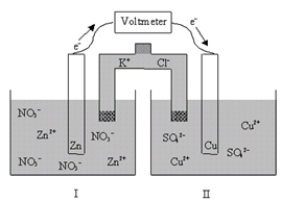 Zn2+(aq)+ 2e-
 Zn(s); E° = -0.76 V
Cu2+(aq)+ 2e-
 Cu(s); E° = 0.34 V
Zn2+(aq)+ 2e- Zn(s); E° = -0.76 V
Cu2+(aq)+ 2e- Cu(s); E° = 0.34 V (Multiple Choice)
4.9/5 (76)
(76) The cell potential of the following cell is determined using an unspecified concentration of acid.What is [H+] given that the measured cell potential is -0.464 V and the anode reduction potential (E°)is 0.222 V at 25°C?
Ag(s)| AgCl(s)| Cl−(1.0 M)|| H+(aq,? M)| H2(g,1.0 atm)| Pt(s)
(Multiple Choice)
4.9/5 (82)
(82) According to the following cell notation,which species is undergoing oxidation?
Zn | Zn2+(aq)|| Mn2+(aq)| MnO2(s)| Pt(s)
(Multiple Choice)
4.7/5 (79)
(79) 
Filters
- Essay(0)
- Multiple Choice(0)
- Short Answer(0)
- True False(0)
- Matching(0)