



 Chat with AI
Exam 13: Equilibrium

Exam 1: Atoms and Elements50 Questions
Exam 2: Electrons and the Periodic Table107 Questions
Exam 3: Compounds and Chemical Bonds63 Questions
Exam 4: How Chemists Use Numbers43 Questions
Exam 5: The Mole and Chemical Formulas60 Questions
Exam 6: Molecular Shape71 Questions
Exam 7: Solids, Liquids, and Phase Changes58 Questions
Exam 8: Gases60 Questions
Exam 9: Physical Properties of Solutions62 Questions
Exam 10: Chemical Reactions and Chemical Equations65 Questions
Exam 11: Using Balanced Chemical Equations61 Questions
Exam 12: Acids and Bases65 Questions
Exam 13: Equilibrium30 Questions
Exam 14: Organic Chemistry46 Questions
Exam 15: Biochemistry20 Questions
Exam 16: Nuclear Chemistry38 Questions
Exam 17: Electrochemistry30 Questions
Select questions type


When a reaction system reaches equilibrium, the forward and reverse reactions stop.

Free
(True/False)
4.8/5  (68)
(68) Correct Answer: Verified
False
Hydrogen peroxide may decompose to form water and oxygen gas according to the following reaction. 2H2O2(g)  2H2O(g) + O2(g)
In a particular experiment, 1.75 moles of H2O2 were placed in a 2.5-L reaction chamber at 307ºC.After equilibrium was reached, 1.20 moles of H2O2 remained.What is K for the reaction?
2H2O(g) + O2(g)
In a particular experiment, 1.75 moles of H2O2 were placed in a 2.5-L reaction chamber at 307ºC.After equilibrium was reached, 1.20 moles of H2O2 remained.What is K for the reaction?Free
(Multiple Choice)
4.8/5 (81)
(81) Correct Answer:Verified
VerifiedB
If the system 3H2(g) + N2(g)  2NH3(g) is at equilibrium and more N2 is added, a net reaction that consumes some of the added N2 will occur until a new equilibrium is reached.
Free
(True/False)
4.8/5 (86)
(86) Correct Answer:Verified
VerifiedTrue
For the nitrogen fixation reaction, 3H2(g) + N2(g)  2NH3(g), K = 6.0 × 10⁻² at 500°C.If 0.250 M H2 and 0.050 M NH3 are present at equilibrium, what is the equilibrium concentration of N2?
 (Multiple Choice)
5.0/5 (82)
(82) At 35ºC, the equilibrium constant for the reaction 2NOCl(g)  2NO(g) + Cl2(g) is K = 1.6 × 10⁻⁵.An equilibrium mixture was found to have the following concentrations of Cl2 and NOCl: [Cl2] = 1.2 × 10⁻² M; [NOCl] = 2.8 × 10⁻¹ M.Calculate the concentration of NO(g) at equilibrium.
 (Multiple Choice)
4.9/5 (71)
(71) Which reaction shown will have the highest concentration of reactants at equilibrium?
(Multiple Choice)
4.8/5 (81)
(81) A mixture of 0.500 mole of carbon monoxide and 0.400 mole of bromine was placed into a rigid 1.00-L container and the system was allowed to come to equilibrium.The equilibrium concentration of COBr2 was 0.233 M.What is K for this reaction? CO(g) + Br2(g)  COBr2(g)
 (Multiple Choice)
4.9/5 (84)
(84) What is defined as a fraction with equilibrium product concentrations in the numerator and equilibrium reactant concentrations in the denominator and each concentration raised to a power equal to the corresponding stoichiometric coefficient in the balanced chemical equation?
(Multiple Choice)
4.8/5 (75)
(75) Which reaction shown will have the highest concentration of products at equilibrium?
(Multiple Choice)
5.0/5 (91)
(91) At elevated temperatures, hydrogen iodide may decompose to form hydrogen gas and iodine gas, as follows. 2HI(g)  H2(g) + I2(g)
In a particular experiment, the concentrations at equilibrium were measured to be [HI] = 0.85 mol/L, [I2] = 0.60 mol/L, and [H2] = 0.27 mol/L.What is K for the above reaction?
H2(g) + I2(g)
In a particular experiment, the concentrations at equilibrium were measured to be [HI] = 0.85 mol/L, [I2] = 0.60 mol/L, and [H2] = 0.27 mol/L.What is K for the above reaction? (Multiple Choice)
4.8/5 (82)
(82) Write the equilibrium constant expression for the reaction shown. 2NOCl(g) ⇌ 2NO(g) + Cl2(g)
(Multiple Choice)
4.9/5 (80)
(80) Compounds A, B, and C react according to the following equation.3A(g) + 2B(g)  2C(g) At 100°C a mixture of these gases at equilibrium showed that [A] = 0.855 M, [B] = 1.23 M, and [C] = 1.75 M.What is the value of K for this reaction?
 (Multiple Choice)
4.8/5 (75)
(75) At 450°C, tert-butyl alcohol decomposes into water and isobutene.(CH3)3COH(g)  (CH3)2CCH2(g) + H2O(g) A reaction vessel contains these compounds at equilibrium.What will happen if the volume of the container is reduced by 50% at constant temperature?
 (Multiple Choice)
4.8/5 (67)
(67) Determine the balanced chemical equation that corresponds to the given equilibrium expression. 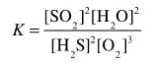
(Multiple Choice)
4.9/5 (63)
(63) Which substances are included in the equilibrium constant expression, Kc?
(Multiple Choice)
4.9/5 (83)
(83) The equilibrium constant expression for the reaction CuO(s) + H2(g)  Cu(s) + H2O(g) is K = [H2]/[H2O].
 (True/False)
4.8/5 (87)
(87) Write the equilibrium constant expression for the reaction shown. 
(Multiple Choice)
4.8/5 (72)
(72) Determine the balanced chemical equation that corresponds to the given equilibrium expression. 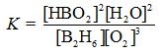
(Multiple Choice)
4.7/5 (85)
(85) A 6.0-L vessel was found to contain 1.0 mol BrCl3, 2.0 mol Br2 and 6.0 mol Cl2.What is the equilibrium constant, K, for this equilibrium mixture for the reaction 2BrCl3(g)  Br2(g) + 3Cl2(g)?
 (Multiple Choice)
4.8/5 (67)
(67) When the following reaction is at equilibrium 2NOCl(g)  2NO(g) + Cl2(g)
then [NO]2 [Cl2] = K [NOCl]2.
2NO(g) + Cl2(g)
then [NO]2 [Cl2] = K [NOCl]2. (True/False)
4.9/5 (79)
(79) 
Filters
- Essay(0)
- Multiple Choice(0)
- Short Answer(0)
- True False(0)
- Matching(0)