



 Chat with AI
Exam 17: Electrochemistry

Exam 1: Atoms and Elements50 Questions
Exam 2: Electrons and the Periodic Table107 Questions
Exam 3: Compounds and Chemical Bonds63 Questions
Exam 4: How Chemists Use Numbers43 Questions
Exam 5: The Mole and Chemical Formulas60 Questions
Exam 6: Molecular Shape71 Questions
Exam 7: Solids, Liquids, and Phase Changes58 Questions
Exam 8: Gases60 Questions
Exam 9: Physical Properties of Solutions62 Questions
Exam 10: Chemical Reactions and Chemical Equations65 Questions
Exam 11: Using Balanced Chemical Equations61 Questions
Exam 12: Acids and Bases65 Questions
Exam 13: Equilibrium30 Questions
Exam 14: Organic Chemistry46 Questions
Exam 15: Biochemistry20 Questions
Exam 16: Nuclear Chemistry38 Questions
Exam 17: Electrochemistry30 Questions
Select questions type


When the following redox equation is balanced with the smallest whole number coefficients, what is the coefficient of Zn(s)? Zn(s) + ReO4−(aq) → Re(s) + Zn2+(aq) (acidic solution)

Free
(Multiple Choice)
4.8/5  (80)
(80) Correct Answer: Verified
B
Consider the following balanced redox reaction.3CuO(s) + 2NH3(aq) → N2(g) + 3H2O(l) + 3Cu(s) Which of the following statements is ?
Free
(Multiple Choice)
4.9/5 (72)
(72) Correct Answer:Verified
VerifiedA
A voltaic cell is prepared using copper and silver.Its cell notation is shown below.Cu(s) | Cu2+(aq) || Ag+(aq) | Ag(s) Which reaction occurs at the cathode?
Free
(Multiple Choice)
4.9/5 (71)
(71) Correct Answer:Verified
VerifiedD
Consider the following redox equation. Mn(OH)2(s) + MnO4−(aq) → MnO42−(aq) (basic solution)
When the equation is balanced with the smallest whole number coefficients, what is the coefficient for OH−(aq) and on which side of the equation is OH−(aq) present?
(Multiple Choice)
4.9/5 (80)
(80) Aluminum does not corrode in the same manner as iron does, because
(Multiple Choice)
5.0/5 (79)
(79) Complete and balance the following redox equation using the set of smallest whole numbers coefficients.What is the sum of the coefficients? HI + HNO3 → I2 + NO (acidic solution)
(Multiple Choice)
4.8/5 (82)
(82) A certain electrochemical cell has for its cell reaction: Zn + HgO → ZnO + Hg
Which is the half-reaction occurring at the anode?
(Multiple Choice)
4.9/5 (89)
(89) Which is the half-reaction at the cathode in a lead storage battery?
(Multiple Choice)
4.9/5 (80)
(80) A voltaic cell prepared using aluminum and nickel has the following cell notation.Al(s) | Al3+(aq) || Ni2+(aq) | Ni(s) Which reaction occurs at the anode?
(Multiple Choice)
4.8/5 (87)
(87) Which electrochemical cell pictured below corresponds to the following cell diagram?
Cr(s) | Cr3+(aq, 1.0 M) || Sn2+(aq, 1.0 M) | Sn(s)
(Multiple Choice)
4.8/5 (82)
(82) When the following redox equation is balanced with the smallest whole number coefficients, what is the coefficient of Sn(OH)3−? Bi(OH)3(s) + Sn(OH)3-(aq) → Sn(OH)62−(aq) + Bi(s) (basic solution)
(Multiple Choice)
4.7/5 (86)
(86) Which is the half-reaction at the anode in a lead storage battery?
(Multiple Choice)
4.7/5 (83)
(83) When the following redox equation is balanced with the smallest whole number coefficients, what is the coefficient for nitrogen dioxide? I2(s) + HNO3(aq) → HIO3(aq) + NO2(g) + H2O(l)
(Multiple Choice)
4.9/5 (79)
(79) Complete and balance the following redox equation.Now sum the coefficients of all species in the balanced equation.(Remember to add the coefficients that are equal to one, and to add the coefficients of any species added to the equation.) The sum of the smallest whole number coefficients is Bi(OH)3 + SnO22− → Bi + SnO32− (basic solution)
(Multiple Choice)
4.9/5 (75)
(75) When the following redox equation is balanced with the smallest whole number coefficients, the coefficient for the hydrogen sulfate ion will be ______. Al(s) + HSO4−(aq) + OH−(aq) → Al2O3(s) + S2−(aq) + H2O(l)
(Multiple Choice)
4.8/5 (87)
(87) Based on the following electrochemical cell, which statement is ? 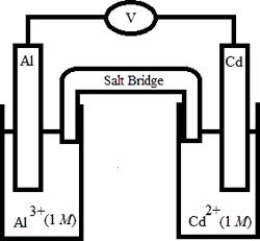 Half-Reaction E° (V) Al3+(aq) + 3e- →
−1)66
Al(s)
Cd2+(aq) + 2e- →
−0)40
Cd(s)
Half-Reaction E° (V) Al3+(aq) + 3e- →
−1)66
Al(s)
Cd2+(aq) + 2e- →
−0)40
Cd(s) (Multiple Choice)
4.8/5 (78)
(78) Complete and balance the following redox equation.When properly balanced using the smallest whole-number coefficients, the coefficient of S is H2S + HNO3 → S + NO + H2O (acidic solution)
(Multiple Choice)
4.9/5 (80)
(80) Consider the reaction CuO(s) + H2(g) → Cu(s) + H2O(l)
In this reaction, which substances are the oxidizing agent and reducing agent, respectively?
(Multiple Choice)
4.8/5 (85)
(85) 
Filters
- Essay(0)
- Multiple Choice(0)
- Short Answer(0)
- True False(0)
- Matching(0)