



 Chat with AI
Exam 14: The Individual Tax Formula

Exam 1: Taxes and Taxing Jurisdictions85 Questions
Exam 2: Policy Standards for a Good Tax85 Questions
Exam 3: Taxes As Transaction Costs82 Questions
Exam 4: Maxims of Income Tax Planning92 Questions
Exam 5: Tax Research75 Questions
Exam 6: Taxable Income From Business Operations116 Questions
Exam 7: Property Acquisitions and Cost Recovery Deductions106 Questions
Exam 8: Property Dispositions110 Questions
Exam 9: Nontaxable Exchanges97 Questions
Exam 10: Sole Proprietorships, Partnerships, Llcs, and S Corporations87 Questions
Exam 11: The Corporate Taxpayer97 Questions
Exam 12: The Choice of Business Entity97 Questions
Exam 13: Jurisdictional Issues in Business Taxation102 Questions
Exam 14: The Individual Tax Formula111 Questions
Exam 15: Compensation and Retirement Planning107 Questions
Exam 16: Investment and Personal Financial Planning104 Questions
Exam 17: Tax Consequences of Personal Activities93 Questions
Exam 18: The Tax Compliance Process86 Questions
Select questions type


Which of the following taxpayers can't use the tax rates for married filing jointly in 2012?
(Multiple Choice)
4.9/5  (85)
(85) Mr. and Mrs. Kain reported $80,000 AGI on their joint return. The couple has four dependent children: Beatrice, age 19; Bruce, age 16; Angie, age 11, and Arnold, age 8. Compute the Kains' child credit.
(Multiple Choice)
4.8/5 (70)
(70) Hunter, age 17, is claimed as a dependent on his parents' tax return. This year, Hunter earned $8,500 for appearing in a television commercial. Compute Hunter's standard deduction.
(Multiple Choice)
4.7/5 (88)
(88) Mr. and Mrs. Dell, ages 29 and 26, file a joint return and have no dependents for the year. Here is their relevant information.  Compute their adjusted gross income (AGI) and taxable income.
 (Multiple Choice)
4.7/5 (83)
(83) In computing taxable income, an individual is allowed to deduct both the standard deduction and any itemized deduction for the year.
(True/False)
4.9/5 (61)
(61) Mr. Pearl's total income and self-employment tax on this year's Form 1040 is $72,610. If Mr. Pearl paid at least $65,349 of this tax in the form of withholding or quarterly estimated payments, he will not incur an underpayment penalty.
(True/False)
4.8/5 (81)
(81) Last year, Mr. Corbett's AGI was $141,000, and his total tax liability was $33,650. This year, his total tax liability is $35,290. Compute the minimum amount of current year tax that Mr. Corbett had to prepay (withholding and estimated payments) to avoid an underpayment penalty.
(Multiple Choice)
4.8/5 (74)
(74) For the taxable year in which a married person dies, the widow or widower can file a joint return with the deceased.
(True/False)
4.8/5 (86)
(86) Tamara and Todd Goble, ages 72 and 58, file a joint return. Todd is legally blind. Compute their standard deduction.
(Multiple Choice)
4.8/5 (68)
(68) Leon died on August 23, 2010, and his wife Mary has not remarried. Since her husband's death, Mary has maintained a home for her two dependent children, who were ages 7 and 4 when their father died. Which of the following describes Mary's filing status for 2011, 2012, and 2013?
(Multiple Choice)
4.9/5 (75)
(75) An individual with $400,000 taxable income has the same marginal rate as a single taxpayer or as a head of household.
(True/False)
4.8/5 (70)
(70) Mr. and Mrs. Daniels had the following income items in 2012: 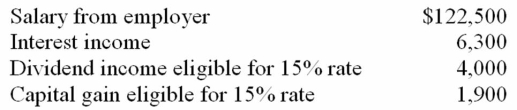 Mr. and Mrs. Daniels have no dependents and claim the standard deduction. Compute their income tax liability on a joint return.
 (Multiple Choice)
4.8/5 (79)
(79) Individual taxpayers can obtain an automatic extension of time to file a calendar year Form 1040 until October 15 of the following year.
(True/False)
4.8/5 (81)
(81) An individual is indifferent between filing as a single taxpayer or a head of household if he has $8,700 or less of taxable income.
(True/False)
4.8/5 (66)
(66) In computing taxable income, an individual is allowed to deduct the lesser of itemized deductions or the standard deduction.
(True/False)
4.8/5 (79)
(79) Adjusted gross income equals total income less itemized deductions.
(True/False)
4.8/5 (70)
(70) Julie, an unmarried individual, lives in a home with her 13-year-old dependent son, Oscar. This year, Julie had the following tax information.  Compute Julie's adjusted gross income (AGI) and taxable income.
 (Multiple Choice)
4.9/5 (78)
(78) The earned income credit is available only to low-income taxpayers with dependent children.
(True/False)
4.9/5 (74)
(74) Mr. and Mrs. Bennett file a joint tax return. Determine if each of the following unmarried individuals is either a qualifying child or a qualifying relative for whom the couple can claim an exemption.
a. Son Alex, age 22, lives in his parents' home and works fulltime as a tax accountant. Alex is self-supporting except for the fact that he does not pay rent to his parents.
b. Daughter Samantha, age 20, is a full-time college student. Samantha lives in a dormitory during the school year, but her parents' home is her permanent residence and they provide 100% of her financial support.
c. Mr. Bennett's brother Max is 42 years old and mentally handicapped. Max lives in a privately operated group home, and Mr. and Mrs. Bennett provide 100% of his financial support. Max has no gross income.
d. Mrs. Bennett's mother, Vera, age 67, lives in a retirement community. Mr. and Mrs. Bennett provide about 75% of her financial support. Vera earned $5,000 this year as a part-time receptionist.
(Essay)
4.9/5 (74)
(74) Last year, Mr. Tyker's AGI was $182,800, and his total tax liability was $51,650. This year, his total tax liability is $65,440. Compute the minimum amount of current year tax that Mr. Tyker had to prepay (withholding and estimated payments) to avoid an underpayment penalty.
(Multiple Choice)
4.8/5 (77)
(77) 
Filters
- Essay(0)
- Multiple Choice(0)
- Short Answer(0)
- True False(0)
- Matching(0)