



 Chat with AI
Exam 16: Investment and Personal Financial Planning

Exam 1: Taxes and Taxing Jurisdictions85 Questions
Exam 2: Policy Standards for a Good Tax85 Questions
Exam 3: Taxes As Transaction Costs82 Questions
Exam 4: Maxims of Income Tax Planning92 Questions
Exam 5: Tax Research75 Questions
Exam 6: Taxable Income From Business Operations116 Questions
Exam 7: Property Acquisitions and Cost Recovery Deductions106 Questions
Exam 8: Property Dispositions110 Questions
Exam 9: Nontaxable Exchanges97 Questions
Exam 10: Sole Proprietorships, Partnerships, Llcs, and S Corporations87 Questions
Exam 11: The Corporate Taxpayer97 Questions
Exam 12: The Choice of Business Entity97 Questions
Exam 13: Jurisdictional Issues in Business Taxation102 Questions
Exam 14: The Individual Tax Formula111 Questions
Exam 15: Compensation and Retirement Planning107 Questions
Exam 16: Investment and Personal Financial Planning104 Questions
Exam 17: Tax Consequences of Personal Activities93 Questions
Exam 18: The Tax Compliance Process86 Questions
Select questions type


Ms. Mollani owns stock in two S corporations, Aloha and Honu. This year, she had the following income and loss items: 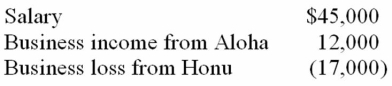 Compute Sheila's AGI under each of the following assumptions.
a. She materially participates in Aloha's business but not in Honu's business.
b. She materially participates in Honu's business but not in Aloha's business.
c. She materially participates in both corporate businesses.
d. She does not materially participate in either business.
Compute Sheila's AGI under each of the following assumptions.
a. She materially participates in Aloha's business but not in Honu's business.
b. She materially participates in Honu's business but not in Aloha's business.
c. She materially participates in both corporate businesses.
d. She does not materially participate in either business. (Essay)
4.9/5  (85)
(85) Qualified dividend income earned by an individual taxpayer is taxed at a maximum rate of 15%.
(True/False)
5.0/5 (96)
(96) Which of the following statements about investment property is false?
(Multiple Choice)
4.9/5 (76)
(76) 
Filters
- Essay(0)
- Multiple Choice(0)
- Short Answer(0)
- True False(0)
- Matching(0)