



 Chat with AI
Exam 16: Investment and Personal Financial Planning

Exam 1: Taxes and Taxing Jurisdictions85 Questions
Exam 2: Policy Standards for a Good Tax85 Questions
Exam 3: Taxes As Transaction Costs82 Questions
Exam 4: Maxims of Income Tax Planning92 Questions
Exam 5: Tax Research75 Questions
Exam 6: Taxable Income From Business Operations116 Questions
Exam 7: Property Acquisitions and Cost Recovery Deductions106 Questions
Exam 8: Property Dispositions110 Questions
Exam 9: Nontaxable Exchanges97 Questions
Exam 10: Sole Proprietorships, Partnerships, Llcs, and S Corporations87 Questions
Exam 11: The Corporate Taxpayer97 Questions
Exam 12: The Choice of Business Entity97 Questions
Exam 13: Jurisdictional Issues in Business Taxation102 Questions
Exam 14: The Individual Tax Formula111 Questions
Exam 15: Compensation and Retirement Planning107 Questions
Exam 16: Investment and Personal Financial Planning104 Questions
Exam 17: Tax Consequences of Personal Activities93 Questions
Exam 18: The Tax Compliance Process86 Questions
Select questions type


Two years ago, Mr. Young paid $40,000 to buy a publicly traded corporate bond through his broker. The bond's stated redemption value was $45,000. This year, Mr. Young sold the bond for $47,100. Compute his gain or loss on sale.
(Multiple Choice)
5.0/5  (76)
(76) The interest earned on a state or local government bond is exempt from federal taxation.
(True/False)
4.8/5 (72)
(72) Twenty years ago, Mrs. Cole purchased an insurance policy on her own life. Mrs. Cole died this year, and the policy paid the $300,000 death benefit to her son Jeffrey. During her life, Mrs. Cole paid total premiums of $71,200 on the policy. Which of the following statements is true?
(Multiple Choice)
4.9/5 (81)
(81) Life insurance proceeds are includible in the taxable estate of the decedent if the decedent was the owner of the policy.
(True/False)
4.8/5 (79)
(79) Investment expenses are a miscellaneous itemized deduction subject to the 2% AGI limitation.
(True/False)
4.7/5 (82)
(82) Which of the following are included in a decedent's taxable estate?
(Multiple Choice)
4.8/5 (78)
(78) Twenty years ago, Mr. Wallace purchased a $250,000 insurance policy on his own life and named his daughter as sole beneficiary. He has paid $14,250 total premiums to keep this policy in force. This year, he liquidates the policy for its $20,000 cash surrender value. Which of the following statements is true?
(Multiple Choice)
4.7/5 (71)
(71) Mr. and Mrs. Philips recognized the following capital gains and losses this year. 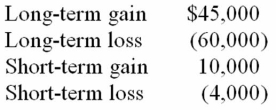 Their AGI before consideration of these gains and losses was $140,000. Compute their AGI.
 (Multiple Choice)
4.9/5 (78)
(78) At the beginning of the year, Calvin paid $5,000 for 60 shares of Eddington stock. In June, he received a $300 cash distribution with respect to the stock. His Form 1099-DIV reported that $170 was an ordinary dividend and $130 was nontaxable. Compute Calvin's tax basis in his 60 shares at year-end.
(Multiple Choice)
4.9/5 (58)
(58) In 1996, Mr. Exton, a single taxpayer, contributed $30,000 in exchange for 100 shares of Morton stock. In 2005, he paid $43,000 to another shareholder to purchase 100 more shares of Morton stock. Morton stock qualified as Section 1244 stock when it was issued. This year, Mr. Exton sold his 200 Morton shares for $250 per share. What is the amount and character of Mr. Exton's recognized loss?
(Multiple Choice)
5.0/5 (70)
(70) Mr. Johnson borrowed money to buy Chicago municipal bonds. This year, he paid $2,000 of interest on his loan and earned $3,500 of interest income from the bonds. None of the interest expense is deductible.
(True/False)
4.9/5 (75)
(75) Material participation in a business activity means that the individual is involved in the day-to-day operations on a regular, continuous, and substantial basis.
(True/False)
5.0/5 (80)
(80) Ms. Lopez paid $7,260 interest on a mortgage on undeveloped land that she holds as an investment. Ms. Lopez's AGI is $112,200, which includes $4,900 interest income from a certificate of deposit. Which of the following statements is true?
(Multiple Choice)
4.8/5 (79)
(79) Mr. Gray recognized a $60,000 loss on sale of his entire interest in a passive activity. He had a $52,000 passive activity loss carryforward from prior years. Mr. Gray can deduct the $52,000 loss in the year of sale.
(True/False)
5.0/5 (90)
(90) Mr. Adams paid $53,500 in premiums on a whole life insurance policy. When he canceled the policy, he received its cash surrender value of $61,600. He must recognize $61,600 of income as a result of the cancellation.
(True/False)
4.8/5 (63)
(63) Sixteen years ago, Ms. Herbert purchased an annuity for $96,000. Beginning in September of this year, the annuity began paying Ms. Herbert $4,000 per month for the rest of her life. Based on her age, Ms. Herbert's expected return is $300,000. How much of the $16,000 that she received this year is included in taxable income?
(Multiple Choice)
4.8/5 (77)
(77) Tom Johnson, whose marginal tax rate on ordinary income is 35%, sold four investment assets resulting in the following capital gains and losses. 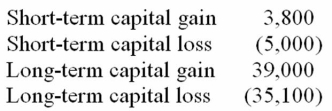 How much of Tom's net capital gain is taxed at 15%?
 (Multiple Choice)
4.8/5 (81)
(81) The kiddie tax limits the tax savings from a transfer of income-producing property to a minor child by taxing a portion of such income at the parent's marginal tax rate.
(True/False)
4.7/5 (66)
(66) Ms. Beal recognized a $42,400 net long-term capital gain and a $33,000 net short-term capital loss this year. What is her current net tax cost from her capital transactions if her marginal rate on ordinary income is 35%?
(Multiple Choice)
4.8/5 (85)
(85) In 2001, Mrs. Qualley, contributed $100,000 in exchange for 1,000 shares of Little Corporation, which is a qualified small business. This year, Mrs. Qualley's only capital transaction was the sale of the 1,000 shares of Little qualified small business stock for $180,000. Compute Mrs. Qualley's tax on her capital gain from this sale.
(Multiple Choice)
4.9/5 (70)
(70) 
Filters
- Essay(0)
- Multiple Choice(0)
- Short Answer(0)
- True False(0)
- Matching(0)