



 Chat with AI
Exam 9: Profit Maximization in Perfectly Competitive Markets

Exam 1: An Introduction to Microeconomics95 Questions
Exam 2: Supply and Demand94 Questions
Exam 3: The Theory of Consumer Choice75 Questions
Exam 4: Individual and Market Demand100 Questions
Exam 5: Using Consumer Choice Theory85 Questions
Exam 6: Exchange, Efficiency, and Prices79 Questions
Exam 7: Production112 Questions
Exam 8: The Cost of Production121 Questions
Exam 9: Profit Maximization in Perfectly Competitive Markets97 Questions
Exam 10: Using the Competitive Model96 Questions
Exam 11: Monopoly112 Questions
Exam 12: Product Pricing With Monopoly Power89 Questions
Exam 13: Monopolistic Competition and Oligopoly98 Questions
Exam 14: Game Theory and the Economics of Information88 Questions
Exam 15: Using Noncompetitive Market Models78 Questions
Exam 16: Employment and Pricing of Inputs99 Questions
Exam 17: Wages, Rent, Interest, and Profit92 Questions
Exam 18: Using Input Market Analysis83 Questions
Exam 19: General Equilibrium Analysis and Economic Efficiency95 Questions
Exam 20: Public Goods and Externalities102 Questions
Select questions type


ref SHAPE \* MERGEFORMAT
The following figure shows the total cost and total revenue curves for a firm.
Figure 9-2 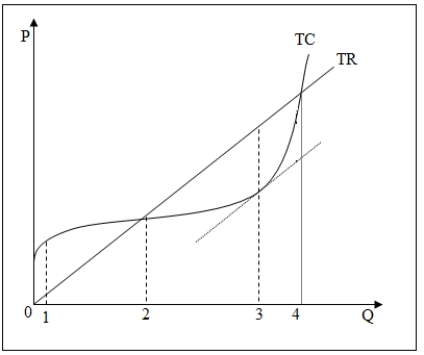 -Refer to Figure 9-2.At which of the following output levels is the firm incurring its highest loss?
 (Multiple Choice)
4.7/5  (80)
(80) Derive the first-order and second-order conditions for perfect competition.
(Essay)
4.9/5 (95)
(95) The perfectly competitive firm's demand curve is horizontal because:
(Multiple Choice)
4.9/5 (70)
(70) A profit-maximizing firm expands output until marginal revenue equals the _____ of producing the last unit.
(Multiple Choice)
4.9/5 (83)
(83) The following figure shows the marginal cost curve,average total cost curve,average variable cost curve,and marginal revenue curve for a firm for different levels of output.
Figure 9-3 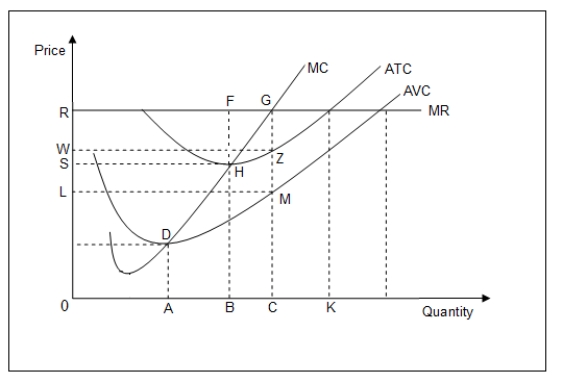 -Refer to Figure 9-3.At the output level OB,total profits equal the area given by _____.
 (Multiple Choice)
4.8/5 (96)
(96) (
A)Jack's lawn-mowing service is a profit-maximizing,perfectly competitive firm.Jack mows lawns for $27 each.His total cost each day is $280,of which $30 is total fixed cost.He mows 10 lawns a day.Will Jack exit the industry in the short-run? Why or why not?
(Essay)
4.8/5 (83)
(83) The demand for corn has increased over the past few decades to satisfy the increasing demand from the food and ethanol industries.The primary beneficiaries of an expansion in the output of corn are owners of farmland suitable for corn production.What can you conclude about the nature of the corn industry?
(Multiple Choice)
4.9/5 (79)
(79) The following figure shows the marginal cost curve,average total cost curve,average variable cost curve,and marginal revenue curve for a firm for different levels of output.
Figure 9-3
-Refer to Figure 9-3.At the output level OC,average fixed cost is equal to _____.
-Refer to Figure 9-3.At the output level OC,average fixed cost is equal to _____. (Multiple Choice)
4.8/5 (86)
(86) The short-run supply curve for a perfectly competitive industry:
(Multiple Choice)
4.8/5 (78)
(78) Which of the following is an assumption in the model of perfect competition?
(Multiple Choice)
4.9/5 (96)
(96) The presence of a relatively large number of firms in an industry does not ensure perfect competition if:
(Multiple Choice)
4.8/5 (86)
(86) A significant decrease in the price of a variable input causes the:
(Multiple Choice)
4.9/5 (83)
(83) The following figure shows the total cost and total revenue for a firm when it prices its products at $8 and $10.
Figure 9-1 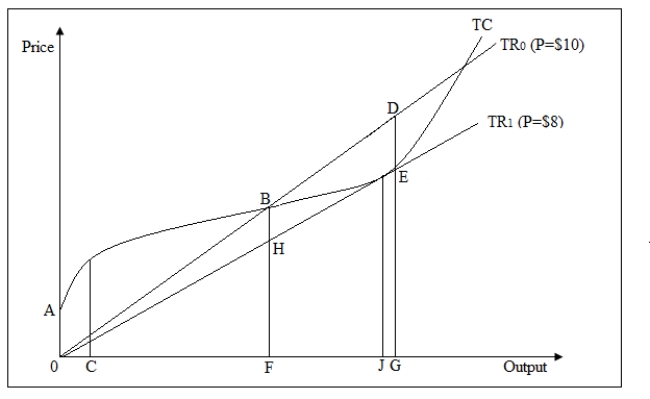 -In Figure 9-1,if the market price fell to $8 the firm would:
 (Multiple Choice)
4.8/5 (85)
(85) At the profit maximizing level of output in a competitive industry,the firm is:
(Multiple Choice)
4.8/5 (76)
(76) 
Filters
- Essay(0)
- Multiple Choice(0)
- Short Answer(0)
- True False(0)
- Matching(0)