



 Chat with AI
Exam 8: The Cost of Production

Exam 1: An Introduction to Microeconomics95 Questions
Exam 2: Supply and Demand94 Questions
Exam 3: The Theory of Consumer Choice75 Questions
Exam 4: Individual and Market Demand100 Questions
Exam 5: Using Consumer Choice Theory85 Questions
Exam 6: Exchange, Efficiency, and Prices79 Questions
Exam 7: Production112 Questions
Exam 8: The Cost of Production121 Questions
Exam 9: Profit Maximization in Perfectly Competitive Markets97 Questions
Exam 10: Using the Competitive Model96 Questions
Exam 11: Monopoly112 Questions
Exam 12: Product Pricing With Monopoly Power89 Questions
Exam 13: Monopolistic Competition and Oligopoly98 Questions
Exam 14: Game Theory and the Economics of Information88 Questions
Exam 15: Using Noncompetitive Market Models78 Questions
Exam 16: Employment and Pricing of Inputs99 Questions
Exam 17: Wages, Rent, Interest, and Profit92 Questions
Exam 18: Using Input Market Analysis83 Questions
Exam 19: General Equilibrium Analysis and Economic Efficiency95 Questions
Exam 20: Public Goods and Externalities102 Questions
Select questions type


Using an isoquant and isocost curves,with labor on the horizontal axis and capital on the vertical axis,
A)show a firm's efficient combination of capital and labor needed to produce 100 television sets per day.(You may use abstract quantities such as K1 and L1 or actual numbers. )

Free
(Essay)
4.7/5  (72)
(72) Correct Answer: Verified
In the short run it appears that labor at this form is made better off due to the wage increase,and the fact that there is no job loss.However,the cost to the firm of manufacturing 100 television sets at the new wage level using K1 units of capital and L1 units of labor is not minimized.It is therefore not efficient given the relative prices of labor and capital.In a competitive market this firm is likely to be driven out of the television business,which means labor hired by this firm to produce televisions decreases to zero.
In the figure given below,curves F,C,and G denote the total cost,the total variable cost,and the total fixed cost of a firm. 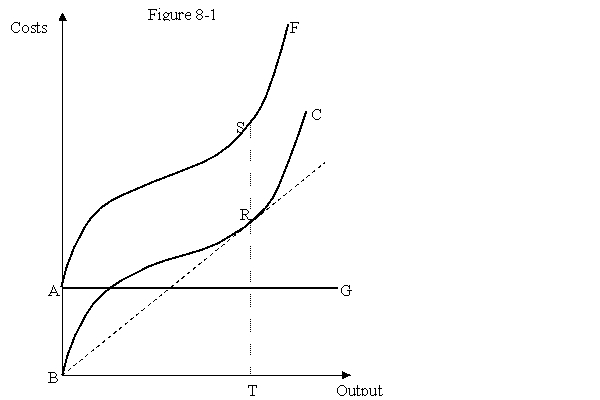 -Refer to Figure 8-1.The total fixed costs of the firm are identified by the distance:
Free
(Multiple Choice)
4.8/5 (77)
(77) Correct Answer:Verified
VerifiedA
Assume that the long run average cost for a representative firm in an industry is minimized at $10 per unit of output.Further assume that total industry output is X at a price of $10,and that each firm in this industry produces 0.2X at an average cost of $10.Under these conditions we would expect the market to have:
Free
(Multiple Choice)
4.9/5 (88)
(88) Correct Answer:Verified
VerifiedD
Assume that with 20L and 30K a given firm can produce 100 units of output and with 40L and 60K it can produce 175 units (where L and K denote the labor and capital inputs).Based on this information,we can conclude that:
(Multiple Choice)
4.9/5 (92)
(92) Which of the following most completely describes the cost to a firm associated with the use of its resources in a particular way?
(Multiple Choice)
4.9/5 (78)
(78) (
A)Consider a firm which produces baseball bats using wood and workers.On a graph with capital (wood)on the vertical axis and labor (workers)on the horizontal axis,draw an isoquant and isocost line such that the firm is minimizing the total cost of producing Q1 baseball bats.Let this initial point be profit-maximizing.
(Essay)
4.8/5 (79)
(79) A firm's production cost equaling the opportunity cost of its resources reflects the fact that:
(Multiple Choice)
4.8/5 (91)
(91) If the marginal product of labor is four times the marginal product of capital and the price of labor is twice the price of capital,then:
(Multiple Choice)
4.9/5 (83)
(83) Consider two firms A and B.Firm A notices that its total costs have declined by 10 percent each time its cumulative output has doubled.Firm B notices that its average cost of production declined by 10 percent after it increased production by 5 percent and hired 50 more workers to work with its existing unused equipments.Explain graphically whether the experiences of these two firms will have similar implications on the long run average cost of production.
(Essay)
4.9/5 (83)
(83) The point of tangency between an isoquant and the isocost line indicates:
(Multiple Choice)
5.0/5 (71)
(71) The rule of cost minimization indicates that a firm should:
(Multiple Choice)
4.8/5 (77)
(77) If there are no fixed costs and variable costs are constant at $1.00 per unit over the relevant range of output,what will the average total cost be after 1 unit of output is produced?
(Multiple Choice)
5.0/5 (77)
(77) Consider the cubic total cost function TC = a + bQ + cQ2 + dQ3,where a = 0,b = 25,c = -10,and d = 1.The firm's minimum efficient scale would be an output of _____ units.
(Multiple Choice)
4.9/5 (78)
(78) A firm uses labor as an input in production.For the range of output where the average product of labor is increasing:
(Multiple Choice)
4.9/5 (76)
(76) 
Filters
- Essay(0)
- Multiple Choice(0)
- Short Answer(0)
- True False(0)
- Matching(0)