



 Chat with AI
Exam 7: Production


If the sum of the powers associated with the inputs in a Cobb-Douglas production function exceeds 1,the production function is characterized by:

 (89)
 Verified
C
Consider the following Cobb-Douglas production function,T = aLbKcEd,where T is t-shirts produced,L is labor input,K is capital,and E is energy input.Mathematically show how the returns to scale of the production function depends upon the parameters a,b,c,and d.
(66) VerifiedAssume that output and all inputs are scaled up by the same factor m.This yields mT = a(mL)b(mK)c(mE)d.Simplifying,mT = a(mbLb)(mcKc)(mdEd) mT = mb+c+d (aLbKcEd).Substituting for the original production function,we get m(aLbKcEd)= mb+c+d (aLbKcEd).Thus,if the sum of the powers,b + c + d,exceeds 1,then scaling all inputs up by "m" yields more than "m" times more output.This is the definition of increasing returns to scale.It does not depend upon the parameter "a." Similarly,if the sum of the powers,b + c + d,equals 1,then scaling all inputs up by "m" yields exactly "m" times more output that is constant returns to scale.And finally,if the sum of the powers,b + c + d,is less than 1,then scaling all inputs up by "m" yields less than "m" times more output that is decreasing returns to scale.
A carpenter hammers nails each day at work.During the first hour she can hammer 120 nails,the second hour 100 nails,the third hour 90 nails,the fourth hour 60 nails,and the fifth hour 10 nails.The total product of five hours of work is _____ nails.
(85) A carpenter hammers nails each day at work.In each of the first three hours 50 nails were hammered and the marginal product of the fourth and fifth hours of work is 40 and 20 nails,respectively.Diminishing returns will be experienced in the _____ hour.
(77) The slope of the total product curve measures the _____ of the input.
(73) An isoquant map,with labor on the horizontal axis and capital on the vertical axis,has horizontal isoquants.This implies that the:
(83) Figure 7-2 shows the total product curve for different levels of a variable input,labor.
Figure 7-2  -In Figure 7-2,a firm would choose to operate _____ on the total product curve.
 (74) The marginal rate of technical substitution equals the ratio of the _____.
(78) Figure 7-2 shows the total product curve for different levels of a variable input,labor.
Figure 7-2  -When the quantity of labor employed lies between points D and E in Figure 7-2:
 (67) If the marginal product of a variable input is declining,then:
(81) Suppose you have capital on the vertical axis and labor on the horizontal axis.The slope of the isoquant measures:
(88) For the following total product curves [TP1 and TP2] for a firm using labor as the only variable input in production,derive the associated marginal and average product curves [AP1,AP2,MP1,MP2] and explain the key relationships. 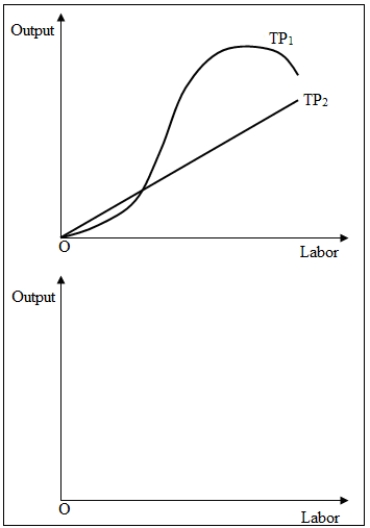
(80) Estimation of a production function from the linear equation Q = a + bL + cK,assumes that the law of diminishing returns _____.
(68) A production function exhibits decreasing returns to scale when _____ increases less than proportionately to input use.
(86) Table 7-2 shows the combinations of labor and capital that are used to produce various levels of output.
Table 7-2 Units of capital Units of labor Total Product Marginal product of labor 2 0 0 - 2 1 20 20 2 2 44 24 2 3 68 24 2 4 90 22 2 5 78 -12
-Refer to Table 7-2.A rational producer would never operate with _____ units of labor and 2 units of capital.
(91) Figure 7-2 shows the total product curve for different levels of a variable input,labor.
Figure 7-2
-Refer to Figure 7-2.Which of the following is true when the labor input is between points C and D?
-Refer to Figure 7-2.Which of the following is true when the labor input is between points C and D? (76) 
Filters
- Essay(0)
- Multiple Choice(0)
- Short Answer(0)
- True False(0)
- Matching(0)