



 Chat with AI
Exam 7: Production

Exam 1: An Introduction to Microeconomics95 Questions
Exam 2: Supply and Demand94 Questions
Exam 3: The Theory of Consumer Choice75 Questions
Exam 4: Individual and Market Demand100 Questions
Exam 5: Using Consumer Choice Theory85 Questions
Exam 6: Exchange, Efficiency, and Prices79 Questions
Exam 7: Production112 Questions
Exam 8: The Cost of Production121 Questions
Exam 9: Profit Maximization in Perfectly Competitive Markets97 Questions
Exam 10: Using the Competitive Model96 Questions
Exam 11: Monopoly112 Questions
Exam 12: Product Pricing With Monopoly Power89 Questions
Exam 13: Monopolistic Competition and Oligopoly98 Questions
Exam 14: Game Theory and the Economics of Information88 Questions
Exam 15: Using Noncompetitive Market Models78 Questions
Exam 16: Employment and Pricing of Inputs99 Questions
Exam 17: Wages, Rent, Interest, and Profit92 Questions
Exam 18: Using Input Market Analysis83 Questions
Exam 19: General Equilibrium Analysis and Economic Efficiency95 Questions
Exam 20: Public Goods and Externalities102 Questions
Select questions type


Suppose that at a point on an isoquant,the following information is true: MPL = 3 and MPK = 2.Then if K falls by 5,L must increase by:
(Multiple Choice)
4.8/5  (70)
(70) Table 7-3 shows the combinations of labor and capital required to produce various level of output.
Table 7-3 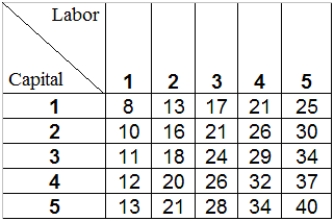 -Refer to Table 7-3.Assume that capital remains fixed while labor is the only variable input used in production.If the firm is currently producing 26 units of output using three units of labor,what is the marginal product of labor at this point?
 (Multiple Choice)
4.9/5 (90)
(90) Which of the following statements about the marginal rate of technical substitution is correct?
(Multiple Choice)
5.0/5 (80)
(80) Define and then derive the expression for the marginal rate of technical substitution.
(Essay)
4.8/5 (75)
(75) Returns to scale can be evaluated by looking at how output changes along _____.
(Multiple Choice)
5.0/5 (70)
(70) Table 7-4 shows the shows the quantities of labor and capital required to produce various levels of output.
Table 7-4 Quantity of Capital Quantity of Labor Output 6 2 40 12 4 100 24 8 220 48 16 440 96 32 800
-Refer to Table 7-4.When the firm increases production from 24 units of capital and 8 units of labor to 48 units of capital and 16 units of labor,the production function exhibits:
(Multiple Choice)
4.8/5 (76)
(76) Table 7-3 shows the combinations of labor and capital required to produce various level of output.
Table 7-3 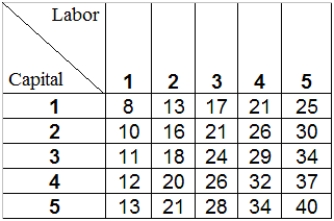 -Refer to Table 7-3.If the firm is currently producing 26 units of output using three units of labor,what is the marginal rate of technical substitution of labor for capital at this point?
 (Multiple Choice)
4.8/5 (94)
(94) Which of the following represents a Cobb-Douglas production function?
(Multiple Choice)
4.8/5 (75)
(75) If a firm doubles its usage of all inputs,and output more than doubles,the production function is said to exhibit:
(Multiple Choice)
5.0/5 (80)
(80) The average product of labor at a particular point can be determined:
(Multiple Choice)
5.0/5 (77)
(77) The power associated with an input in a Cobb-Douglas production function implies diminishing returns to that input if the power is _____.
(Multiple Choice)
4.9/5 (70)
(70) The chemical industry is relatively capital-intensive.It uses more capital than labor.Conversely,the garment industry is relatively labor-intensive (it uses a larger proportion of labor then capital).How would you represent the isoquants for chemicals and garments on an isoquant map with labor on the horizontal axis and capital on the vertical axis?
(Essay)
4.9/5 (77)
(77) The duration of the short run varies by industry because _____.
(Multiple Choice)
4.9/5 (77)
(77) The production function exhibits increasing returns to scale when a firm can increase production by more than a proportionate increase in _____.
(Multiple Choice)
5.0/5 (87)
(87) What can you conclude about an isoquant that is concave to the origin?
(Multiple Choice)
4.9/5 (70)
(70) 
Filters
- Essay(0)
- Multiple Choice(0)
- Short Answer(0)
- True False(0)
- Matching(0)