



 Chat with AI
Exam 18: The Economics of the Environment

Exam 1: Economics: The Study of Choice145 Questions
Exam 2: Confronting Scarcity: Choices in Production198 Questions
Exam 3: Demand and Supply251 Questions
Exam 4: Applications of Supply and Demand113 Questions
Exam 5: Elasticity: a Measure of Response255 Questions
Exam 6: Markets, Maximizers, and Efficiency239 Questions
Exam 7: The Analysis of Consumer Choice244 Questions
Exam 8: Production and Cost227 Questions
Exam 9: Competitive Markets for Goods and Services265 Questions
Exam 10: Monopoly234 Questions
Exam 11: The World of Imperfect Competition237 Questions
Exam 12: Wages and Employment in Perfect Competition189 Questions
Exam 13: Interest Rates and the Markets for Capital and Natural Resources170 Questions
Exam 14: Imperfectly Competitive Markets for Factors of Production183 Questions
Exam 15: Public Finance and Public Choice188 Questions
Exam 16: Antitrust Policy and Business Regulation137 Questions
Exam 17: International Trade186 Questions
Exam 18: The Economics of the Environment148 Questions
Exam 19: Inequality, Poverty, and Discrimination140 Questions
Select questions type


According to the text, the command-and-control approach to pollution abatement is:
(Multiple Choice)
4.8/5  (87)
(87) When marketable pollution permits are used, if the demand for emissions shifts to the right, the equilibrium price of permits _______ , and the equilibrium quantity _______ .
(Multiple Choice)
4.8/5 (84)
(84) Suppose that automobile owners pay a monthly fee based on the number of miles driven and the amount of pollutants discharged when the car is running.This would be an environmental policy of:
(Multiple Choice)
4.8/5 (92)
(92) If a copper mining operation discharges waste products into a river and causes higher costs and discomfort to downstream users of the water for which they are not compensated, then:
(Multiple Choice)
4.7/5 (83)
(83) The intersection of the demand curve for pollution emissions and the marginal cost curve for pollution is:
(Multiple Choice)
5.0/5 (82)
(82) According to the Coase theorem, the private market can achieve an efficient outcome:
(Multiple Choice)
4.8/5 (73)
(73) According to the text, whenever human activity generates a sufficient concentration of a substance in the environment to cause harm to people, it is called:
(Multiple Choice)
4.9/5 (76)
(76) Pollution is defined as the generation of waste materials that cannot be returned to the environment.
(True/False)
4.8/5 (95)
(95) In general, the command-and-control approach to correcting pollution problems is:
(Multiple Choice)
4.7/5 (79)
(79) Creating market-like _______ to encourage reductions in pollution, but allowing _______ to decide how much to pollute, is the _______ approach.
(Multiple Choice)
4.9/5 (87)
(87) The effort to change people's behavior by appealing to their sense of values is:
(Multiple Choice)
5.0/5 (80)
(80) As the price per unit of emissions falls, the quantity of emissions demanded:
(Multiple Choice)
4.9/5 (79)
(79) Use the following to answer question(s): Efficiency and Pollution
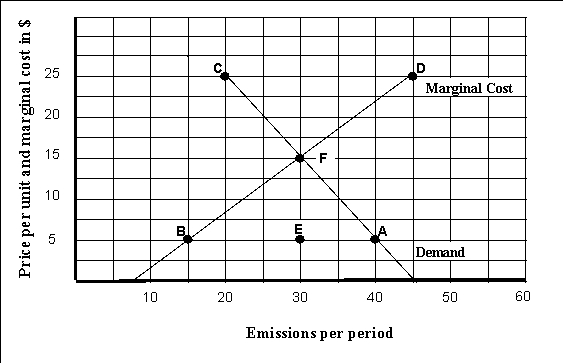 -(Exhibit: Efficiency and Pollution) The efficient solution to pollution problems:
 (Multiple Choice)
4.9/5 (88)
(88) The marginal cost of pollution _______ as the quantity of pollution emissions _______ .
(Multiple Choice)
4.8/5 (69)
(69) Discuss in detail the following statement: "We need to rid ourselves of all pollution, no matter what the cost."
(Essay)
4.8/5 (85)
(85) The government has adopted an environmental policy based on emissions taxes if it:
(Multiple Choice)
4.9/5 (73)
(73) Discuss and explain in detail the marketable pollution permit approach to the control of pollution.
(Essay)
4.8/5 (83)
(83) Command and control is economists' most favored method of eliminating pollution because it achieves a least-cost reduction in emissions.
(True/False)
4.8/5 (72)
(72) 
Filters
- Essay(0)
- Multiple Choice(0)
- Short Answer(0)
- True False(0)
- Matching(0)