



 Chat with AI
Exam 18: The Economics of the Environment

Exam 1: Economics: The Study of Choice145 Questions
Exam 2: Confronting Scarcity: Choices in Production198 Questions
Exam 3: Demand and Supply251 Questions
Exam 4: Applications of Supply and Demand113 Questions
Exam 5: Elasticity: a Measure of Response255 Questions
Exam 6: Markets, Maximizers, and Efficiency239 Questions
Exam 7: The Analysis of Consumer Choice244 Questions
Exam 8: Production and Cost227 Questions
Exam 9: Competitive Markets for Goods and Services265 Questions
Exam 10: Monopoly234 Questions
Exam 11: The World of Imperfect Competition237 Questions
Exam 12: Wages and Employment in Perfect Competition189 Questions
Exam 13: Interest Rates and the Markets for Capital and Natural Resources170 Questions
Exam 14: Imperfectly Competitive Markets for Factors of Production183 Questions
Exam 15: Public Finance and Public Choice188 Questions
Exam 16: Antitrust Policy and Business Regulation137 Questions
Exam 17: International Trade186 Questions
Exam 18: The Economics of the Environment148 Questions
Exam 19: Inequality, Poverty, and Discrimination140 Questions
Select questions type


As the quantity of pollution emissions per period rises, the marginal cost of pollution stays the same.
(True/False)
4.8/5  (78)
(78) Use the following to answer question(s): A Market for Pollution
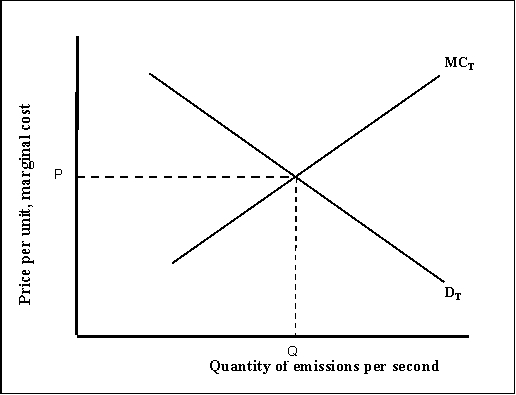 -(Exhibit: A Market for Pollution) If there is an efficient level of emissions, it will occur where:
 (Multiple Choice)
5.0/5 (84)
(84) Taxes are a more effective method of controlling pollution than the command-and-control approach in part because:
(Multiple Choice)
4.8/5 (86)
(86) With marketable pollution permits, if the demand for emissions shifts to the left, the equilibrium price of permits _______ and the equilibrium quantity _______ .
(Multiple Choice)
4.8/5 (82)
(82) When the amount of pollution is reduced through abatement programs:
(Multiple Choice)
4.8/5 (84)
(84) Use the following to answer question(s): A Market for Pollution
-(Exhibit: A Market for Pollution) If there is too much pollution:
-(Exhibit: A Market for Pollution) If there is too much pollution: (Multiple Choice)
4.9/5 (85)
(85) Use the following to answer question(s): Pollution Abatement and Emissions
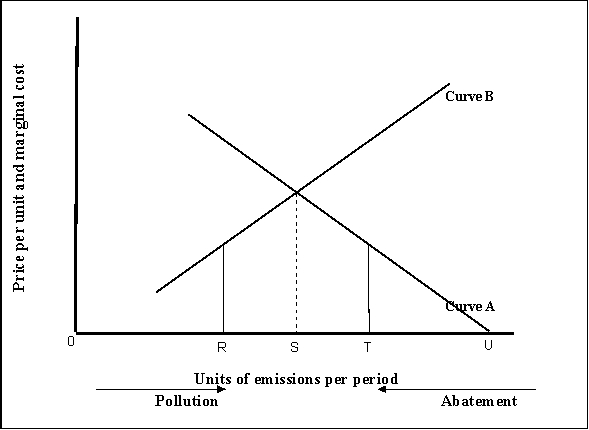 -(Exhibit: Pollution Abatement and Emissions) The level of emissions in a market for which none of the costs of pollution were faced by producers would be closest to
 (Multiple Choice)
4.9/5 (81)
(81) Use the following to answer question(s): Efficiency and Pollution
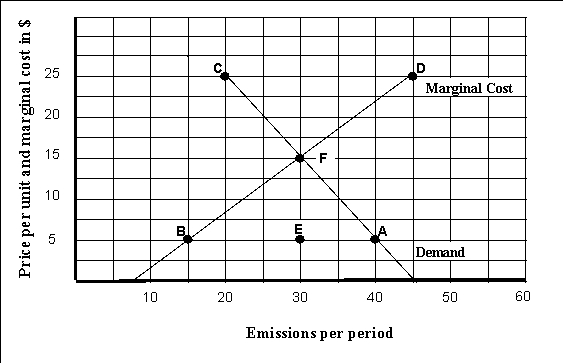 -(Exhibit: Efficiency and Pollution) If this market produced _______ units, then _______.
 (Multiple Choice)
4.8/5 (80)
(80) As the quantity of pollution emissions rises, the marginal cost of pollution:
(Multiple Choice)
4.9/5 (81)
(81) Use the following to answer question(s): Pollution Abatement and Emissions
-(Exhibit: Pollution Abatement and Emissions) If the level of pollution were at 0:
-(Exhibit: Pollution Abatement and Emissions) If the level of pollution were at 0: (Multiple Choice)
4.8/5 (78)
(78) Suppose that the federal government determines the total level of municipal sewage that can be discharged by cities located along a river.If the cities are able to exchange rights to this total discharge level among themselves, this would be an environmental policy of:
(Multiple Choice)
4.9/5 (86)
(86) The marginal cost curve for increased pollution emission levels can be read from ________ to ________ as the ________ curve for improved environmental ________.
(Multiple Choice)
4.9/5 (71)
(71) Use the following to answer question(s): Pollution Abatement and Emissions
-(Exhibit: Pollution Abatement and Emissions) Curve B is the marginal cost of:
-(Exhibit: Pollution Abatement and Emissions) Curve B is the marginal cost of: (Multiple Choice)
4.9/5 (85)
(85) Use the following to answer question(s): Efficiency and Pollution
-(Exhibit: Efficiency and Pollution) A situation where there is too much pollution in this market may be illustrated when the price is _______ and the quantity is _______ .
-(Exhibit: Efficiency and Pollution) A situation where there is too much pollution in this market may be illustrated when the price is _______ and the quantity is _______ . (Multiple Choice)
4.9/5 (76)
(76) Suppose that the government attempts to reduce the noise from airplanes by charging airlines $1,000 for each takeoff using any engine that emits over 50 decibels.The regulatory approach used in this action is:
(Multiple Choice)
4.9/5 (73)
(73) Reducing emissions so that the marginal benefit of an additional unit of pollution is the same for all polluters is an example of:
(Multiple Choice)
4.8/5 (89)
(89) If the marginal benefit received from pollution is less than its marginal cost, then:
(Multiple Choice)
4.8/5 (81)
(81) Using a supply and demand curve for pollution, discuss and contrast how resource allocation is affected when there is no pollution and when there is pollution.
(Essay)
5.0/5 (83)
(83) The demand curve for emissions is a marginal cost of abatement curve when read from right to left.
(True/False)
4.9/5 (80)
(80) The marginal benefit of pollution decreases as the quantity of pollution emissions decreases.
(True/False)
4.9/5 (97)
(97) 
Filters
- Essay(0)
- Multiple Choice(0)
- Short Answer(0)
- True False(0)
- Matching(0)