



 Chat with AI
Exam 12: Wages and Employment in Perfect Competition

Exam 1: Economics: The Study of Choice145 Questions
Exam 2: Confronting Scarcity: Choices in Production198 Questions
Exam 3: Demand and Supply251 Questions
Exam 4: Applications of Supply and Demand113 Questions
Exam 5: Elasticity: a Measure of Response255 Questions
Exam 6: Markets, Maximizers, and Efficiency239 Questions
Exam 7: The Analysis of Consumer Choice244 Questions
Exam 8: Production and Cost227 Questions
Exam 9: Competitive Markets for Goods and Services265 Questions
Exam 10: Monopoly234 Questions
Exam 11: The World of Imperfect Competition237 Questions
Exam 12: Wages and Employment in Perfect Competition189 Questions
Exam 13: Interest Rates and the Markets for Capital and Natural Resources170 Questions
Exam 14: Imperfectly Competitive Markets for Factors of Production183 Questions
Exam 15: Public Finance and Public Choice188 Questions
Exam 16: Antitrust Policy and Business Regulation137 Questions
Exam 17: International Trade186 Questions
Exam 18: The Economics of the Environment148 Questions
Exam 19: Inequality, Poverty, and Discrimination140 Questions
Select questions type


In order to maximize profits in the hiring of a factor, the firm will hire where MRP = MFC.
(True/False)
4.7/5  (90)
(90) Given that MUY = marginal utility of income, MULE = marginal utility of leisure, and W is the wage, utility is maximized by allocating time between work and leisure so that:
(Multiple Choice)
4.9/5 (85)
(85) Just because a firm's MFC = MRP in the factor market, it need not be true that the firm's MC = MR in the output market.
(True/False)
4.7/5 (81)
(81) The fact that a(n) _______ in the _______ tends to _______ wages explains efforts by some groups to reduce labor _______ .
(Multiple Choice)
4.9/5 (81)
(81) If the demand for a certain type of labor is elastic, a(n) _______ in its price will lead to a(n) _______ in total spending on that type of labor by firms.
(Multiple Choice)
4.8/5 (79)
(79) Use the following to answer question(s): Demand and Supply in a Perfectly Competitive Labor Market
 -(Exhibit: Demand and Supply in a Perfectly Competitive Labor Market) The firm should hire:
 (Multiple Choice)
4.9/5 (72)
(72) Use the following to answer question(s): 
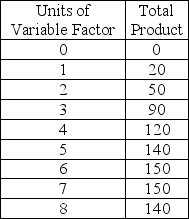 -(Exhibit: Marginal Revenue Product and Demand) If the product price is $2 per unit, the marginal revenue product for the third unit of the variable input is:
 (Multiple Choice)
4.7/5 (83)
(83) The amount a factor adds to a firm's total cost per period is called:
(Multiple Choice)
5.0/5 (74)
(74) The supply curve of labor to the firm buying factors in a perfectly competitive factor market is the marginal factor cost curve.
(True/False)
4.9/5 (70)
(70) When an increase in the use of one factor of production decreases the demand for the other, the two factors are complementary factors of production.
(True/False)
4.9/5 (97)
(97) A change in the quantity demanded of chocolate, a factor of production used to produce chocolate-covered peanuts, will occur if:
(Multiple Choice)
4.9/5 (71)
(71) In a perfectly competitive factor market, a firm finds that the price of a factor of production is _______ its marginal factor cost.
(Multiple Choice)
4.7/5 (85)
(85) Explain how changes in technology affect and change the demand for labor.Distinguish between situations in which a particular type of technological change increases the demand for a particular type of labor and those in which it decreases the demand for a particular type of labor.
(Essay)
4.7/5 (82)
(82) If marginal product is _______ , marginal revenue product must be _______ .
(Multiple Choice)
4.9/5 (85)
(85) The trade-off between work and leisure underlying the supply of labor involves the substitution effect and the:
(Multiple Choice)
4.9/5 (77)
(77) 
Filters
- Essay(0)
- Multiple Choice(0)
- Short Answer(0)
- True False(0)
- Matching(0)