



 Chat with AI
Exam 12: Wages and Employment in Perfect Competition

Exam 1: Economics: The Study of Choice145 Questions
Exam 2: Confronting Scarcity: Choices in Production198 Questions
Exam 3: Demand and Supply251 Questions
Exam 4: Applications of Supply and Demand113 Questions
Exam 5: Elasticity: a Measure of Response255 Questions
Exam 6: Markets, Maximizers, and Efficiency239 Questions
Exam 7: The Analysis of Consumer Choice244 Questions
Exam 8: Production and Cost227 Questions
Exam 9: Competitive Markets for Goods and Services265 Questions
Exam 10: Monopoly234 Questions
Exam 11: The World of Imperfect Competition237 Questions
Exam 12: Wages and Employment in Perfect Competition189 Questions
Exam 13: Interest Rates and the Markets for Capital and Natural Resources170 Questions
Exam 14: Imperfectly Competitive Markets for Factors of Production183 Questions
Exam 15: Public Finance and Public Choice188 Questions
Exam 16: Antitrust Policy and Business Regulation137 Questions
Exam 17: International Trade186 Questions
Exam 18: The Economics of the Environment148 Questions
Exam 19: Inequality, Poverty, and Discrimination140 Questions
Select questions type


Use the following to answer question(s): Demand and Supply of Bricklayers in a Perfectly Competitive Labor Market
 -(Exhibit: Demand and Supply of Bricklayers in a Perfectly Competitive Labor Market) If the price for "bricks laid in the wall" by a bricklayer is $.10 a brick, the total production of bricks by the first 3 bricklayers is _______ bricks.
 (Multiple Choice)
4.9/5  (81)
(81) In a perfectly competitive labor market, the price of a resource to a firm is the same as the firm's marginal factor cost.
(True/False)
4.8/5 (68)
(68) The fact that wages in the United States have tended to _______ indicates that the ________ labor has increased more than the _______ labor.
(Multiple Choice)
4.8/5 (88)
(88) Hiring labor up to the point that the extra revenue generated by the additional labor equals the extra cost is an application of the:
(Multiple Choice)
4.8/5 (70)
(70) A firm's demand curve for an input in a perfectly competitive market is the downward-sloping portion of its:
(Multiple Choice)
4.7/5 (90)
(90) A higher wage _______ the price of _______ and _______ workers incomes.The result of these two changes pulls the quantity of labor supplied in _______ direction(s).
(Multiple Choice)
4.8/5 (79)
(79) Labor markets are best used to analyze the entire economy and are ineffective when used to analyze particular job categories or geographical areas.
(True/False)
4.8/5 (96)
(96) In terms of contribution to total income, the single most important factor of production is:
(Multiple Choice)
4.9/5 (84)
(84) Use the following to answer question(s): Demand and Supply in a Perfectly Competitive Labor Market
 -(Exhibit: Demand and Supply in a Perfectly Competitive Labor Market) Which of the following statements is true?
 (Multiple Choice)
4.8/5 (86)
(86) A backward-bending supply curve of labor shows that at relatively high wages the:
(Multiple Choice)
4.8/5 (72)
(72) Use the following to answer question(s): 
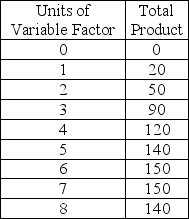 -(Exhibit: Marginal Revenue Product and Demand) If the product price is $2 per unit and the price of the factor of production is $20 per unit, the profit-maximizing quantity of the factor is _______ units.
 (Multiple Choice)
4.9/5 (66)
(66) A change in the quantity demanded of peanuts, a factor of production used to produce chocolate-covered peanuts, will occur if:
(Multiple Choice)
4.8/5 (73)
(73) Use the following to answer question(s):
-(Exhibit: Marginal Revenue Product and Demand) If the product price is $4 per unit and the price of the factor of production is $180 per unit, the profit-maximizing quantity of the factor is _______ unit(s).
-(Exhibit: Marginal Revenue Product and Demand) If the product price is $4 per unit and the price of the factor of production is $180 per unit, the profit-maximizing quantity of the factor is _______ unit(s). (Multiple Choice)
4.9/5 (70)
(70) Explain and show graphically why a firm in perfect competition will hire labor where the MRP of labor is equal to the MFC of labor.Be sure to discuss in your answer exactly what MFC and MRP are.
(Essay)
4.9/5 (69)
(69) Perfectly competitive factor and output markets are similar in that when both are present both generate:
(Multiple Choice)
4.9/5 (84)
(84) In terms of labor supply, the substitution effect of a higher wage causes a(n):
(Multiple Choice)
4.7/5 (75)
(75) Use the following to answer question(s):
-(Exhibit: Marginal Revenue Product and Demand) If the product price is $4 per unit and the price of the factor of production is $80 per unit, the profit-maximizing quantity of the factor is _______ unit(s).
-(Exhibit: Marginal Revenue Product and Demand) If the product price is $4 per unit and the price of the factor of production is $80 per unit, the profit-maximizing quantity of the factor is _______ unit(s). (Multiple Choice)
4.7/5 (84)
(84) 
Filters
- Essay(0)
- Multiple Choice(0)
- Short Answer(0)
- True False(0)
- Matching(0)