



 Chat with AI
Exam 2: Supply and Demand

Exam 1: Economics: the Study of Opportunity Cost124 Questions
Exam 2: Supply and Demand204 Questions
Exam 3: The Concept of Elasticity and Consumer and Producer Surplus173 Questions
Exam 4: Firm Production, Cost, and Revenue158 Questions
Exam 5: Perfect Competition, Monopoly, and Economic Versus Normal Profit119 Questions
Exam 6: Every Macroeconomic Word You Ever Heard: Gross Domestic Product, Inflation, Unemployment, Recession, Depression201 Questions
Exam 7: Interest Rates and Present Value118 Questions
Exam 8: Aggregate Demand and Aggregate Supply110 Questions
Exam 9: Fiscal Policy66 Questions
Exam 10: Monetary Policy104 Questions
Exam 11: Federal Spending76 Questions
Exam 12: Federal Deficits, Surpluses, and the National Debt76 Questions
Exam 13: The Housing Bubble71 Questions
Exam 14: The Recession of 2007-2009: Causes and Policy Responses57 Questions
Exam 15: Is Economic Stagnation the New Normal42 Questions
Exam 16: Is the Fiscalsky Falling: An Examination of Unfunded Social Security, Medicare, and State and Local Pension Liabilities51 Questions
Exam 17: International Trade: Does It Jeopardize American Jobs86 Questions
Exam 18: International Finance and Exchange Rates77 Questions
Exam 19: The European Debt Crisis60 Questions
Exam 20: Economic Growth and Development60 Questions
Exam 21: Nafta, Gatt, Wto: Are Trade Agreements Good for Us42 Questions
Exam 22: The Line Between Legal and Illegal Goods71 Questions
Exam 23: Natural Resources, the Environment, and Climate Change73 Questions
Exam 24: Health Care87 Questions
Exam 25: Government-Provided Health Insurance: Medicaid, Medicare, and the Child Health Insurance Program79 Questions
Exam 26: The Economics of Prescription Drugs62 Questions
Exam 27: So You Want to Be a Lawyer: Economics and the Law62 Questions
Exam 28: The Economics of Crime62 Questions
Exam 29: Antitrust39 Questions
Exam 30: The Economics of Race and Discrimination60 Questions
Exam 31: Income and Wealth Inequality70 Questions
Exam 32: Farm Policy63 Questions
Exam 33: Minimum Wage60 Questions
Exam 34: Ticket Brokers and Ticket Scalping60 Questions
Exam 35: Rent Control31 Questions
Exam 36: Economics of K-12 Education55 Questions
Exam 37: Economics of College and University Education82 Questions
Exam 38: Poverty and Welfare69 Questions
Exam 39: Head Start44 Questions
Exam 40: Social Security60 Questions
Exam 41: Personal Income Taxes55 Questions
Exam 42: Energy Prices67 Questions
Exam 43: If We Build It, Will They Come and Other Sports Questions61 Questions
Exam 44: The Stock Market Crashes57 Questions
Exam 45: Unions66 Questions
Exam 46: Walmart: Always Low Prices and Low Wages- Always41 Questions
Exam 47: The Economic Impact of Casino Gambling39 Questions
Exam 48: The Economics of Terrorism43 Questions
Select questions type


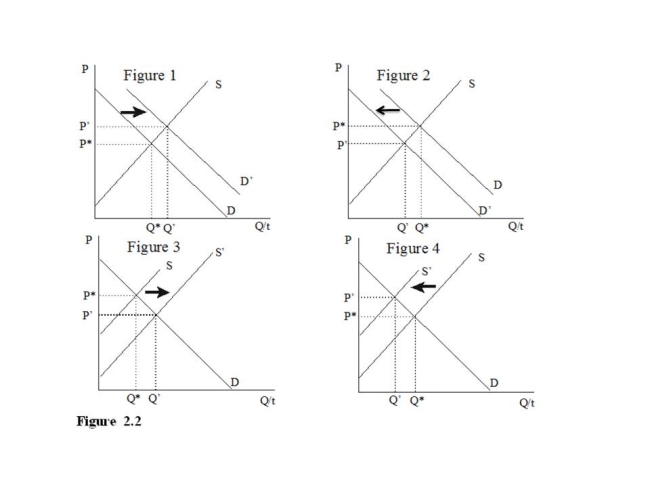 -Of the collection of supply and demand diagrams in Figure 2.2, which one shows the result of a decrease in income if a good is considered normal?
 (Multiple Choice)
4.9/5  (76)
(76) Economists know that consumers and producers are both made better off than they would be without free exchange because the exchanges are
(Multiple Choice)
4.9/5 (79)
(79) Which of the following goods are likely to be considered substitutes?
(Multiple Choice)
4.9/5 (63)
(63) If a tax (paid by producers)on a good is reduced this would
(Multiple Choice)
4.9/5 (79)
(79) 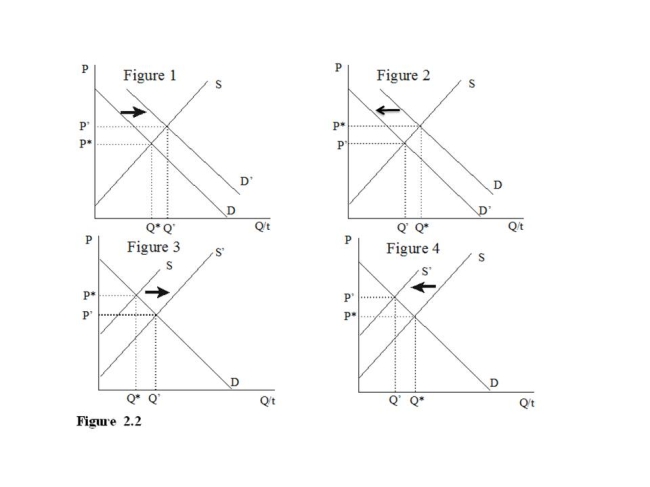 -Of the collection of supply and demand diagrams in Figure 2.2, which one shows the result of an increase in the price of an input in the market for anything?
 (Multiple Choice)
4.9/5 (89)
(89) If the price is so high that vendors find too many unsold bottles remaining in inventory, they might dispose of their excess inventory by
(Multiple Choice)
4.8/5 (68)
(68) If the price of a typical good rises, the quantity demanded for that good will
(Multiple Choice)
4.8/5 (71)
(71) The quintessential example for the price of another potential output and the impact of the price of one good on the market for another is
(Multiple Choice)
4.9/5 (77)
(77) On the Heritage Foundation's scale of "Economic Freedom," the least "free" country would be that one who's economic system was purely
(Multiple Choice)
4.8/5 (75)
(75) 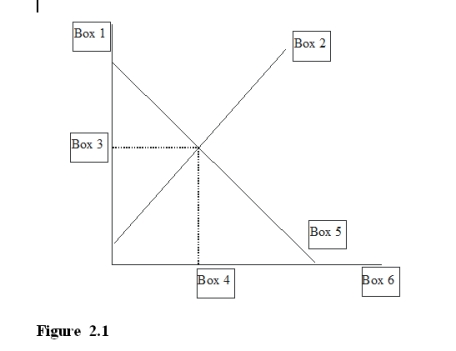 -In Figure 2.1, Box 1 would be labeled
A decrease in household income for a good that is considered normal would
(Multiple Choice)
4.7/5 (83)
(83) Unless circumstances are quite out of the ordinary, a demand curve will be
(Multiple Choice)
4.8/5 (90)
(90) In the market for birth control devices, if the number of women of child-bearing age increases, the
(Multiple Choice)
4.9/5 (75)
(75) 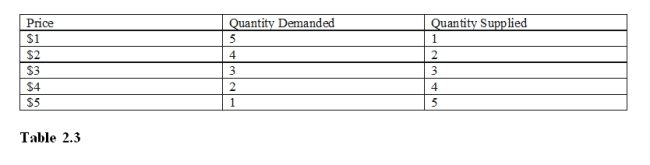 -From Table 2.3, at the price of $4 there is a
An increase in the excise tax imposed upon consumers of gasoline
(Multiple Choice)
4.8/5 (72)
(72) 
Filters
- Essay(0)
- Multiple Choice(0)
- Short Answer(0)
- True False(0)
- Matching(0)