



 Chat with AI
Exam 1: Economics: the Study of Opportunity Cost

Exam 1: Economics: the Study of Opportunity Cost124 Questions
Exam 2: Supply and Demand204 Questions
Exam 3: The Concept of Elasticity and Consumer and Producer Surplus173 Questions
Exam 4: Firm Production, Cost, and Revenue158 Questions
Exam 5: Perfect Competition, Monopoly, and Economic Versus Normal Profit119 Questions
Exam 6: Every Macroeconomic Word You Ever Heard: Gross Domestic Product, Inflation, Unemployment, Recession, Depression201 Questions
Exam 7: Interest Rates and Present Value118 Questions
Exam 8: Aggregate Demand and Aggregate Supply110 Questions
Exam 9: Fiscal Policy66 Questions
Exam 10: Monetary Policy104 Questions
Exam 11: Federal Spending76 Questions
Exam 12: Federal Deficits, Surpluses, and the National Debt76 Questions
Exam 13: The Housing Bubble71 Questions
Exam 14: The Recession of 2007-2009: Causes and Policy Responses57 Questions
Exam 15: Is Economic Stagnation the New Normal42 Questions
Exam 16: Is the Fiscalsky Falling: An Examination of Unfunded Social Security, Medicare, and State and Local Pension Liabilities51 Questions
Exam 17: International Trade: Does It Jeopardize American Jobs86 Questions
Exam 18: International Finance and Exchange Rates77 Questions
Exam 19: The European Debt Crisis60 Questions
Exam 20: Economic Growth and Development60 Questions
Exam 21: Nafta, Gatt, Wto: Are Trade Agreements Good for Us42 Questions
Exam 22: The Line Between Legal and Illegal Goods71 Questions
Exam 23: Natural Resources, the Environment, and Climate Change73 Questions
Exam 24: Health Care87 Questions
Exam 25: Government-Provided Health Insurance: Medicaid, Medicare, and the Child Health Insurance Program79 Questions
Exam 26: The Economics of Prescription Drugs62 Questions
Exam 27: So You Want to Be a Lawyer: Economics and the Law62 Questions
Exam 28: The Economics of Crime62 Questions
Exam 29: Antitrust39 Questions
Exam 30: The Economics of Race and Discrimination60 Questions
Exam 31: Income and Wealth Inequality70 Questions
Exam 32: Farm Policy63 Questions
Exam 33: Minimum Wage60 Questions
Exam 34: Ticket Brokers and Ticket Scalping60 Questions
Exam 35: Rent Control31 Questions
Exam 36: Economics of K-12 Education55 Questions
Exam 37: Economics of College and University Education82 Questions
Exam 38: Poverty and Welfare69 Questions
Exam 39: Head Start44 Questions
Exam 40: Social Security60 Questions
Exam 41: Personal Income Taxes55 Questions
Exam 42: Energy Prices67 Questions
Exam 43: If We Build It, Will They Come and Other Sports Questions61 Questions
Exam 44: The Stock Market Crashes57 Questions
Exam 45: Unions66 Questions
Exam 46: Walmart: Always Low Prices and Low Wages- Always41 Questions
Exam 47: The Economic Impact of Casino Gambling39 Questions
Exam 48: The Economics of Terrorism43 Questions
Select questions type


Many forms of seafood (lobster, crab legs etc.)are consumed by dipping the meat in melted garlic butter. If someone suggested that it would therefore be equally appealing to drink melted butter after having eaten garlic and unseasoned seafood, you would know they had fallen victim to which of the following?

Free
(Multiple Choice)
4.9/5  (88)
(88) Correct Answer: Verified
B
Points inside the Production Possibilities Frontier are
Free
(Multiple Choice)
4.9/5 (78)
(78) Correct Answer:Verified
VerifiedD
When analyzing a problem, if an economist is attempting to understand whether or not an action was fair or just, the economist is thinking
Free
(Multiple Choice)
4.8/5 (76)
(76) Correct Answer:Verified
VerifiedC
If you concluded from the fact that the last three recessions have occurred while Republicans were President that their fiscal policies create recessions then you would be
(Multiple Choice)
4.9/5 (86)
(86) An example of an incentive designed to promote savings would be
(Multiple Choice)
4.9/5 (86)
(86) Economists focus on "unlimited human wants" rather than _____ to describe our pursuit of goods and services.
(Multiple Choice)
4.9/5 (89)
(89) The one word in the definition of economics that focuses on the fact that we have to make choices about who gets what and how much is
(Multiple Choice)
4.9/5 (83)
(83) Every worker is better off making more money and having better benefits. If you concluded from that fact that all workers would be better off if a law were passed requiring a 25% increase in wages and benefits, then you would be
(Multiple Choice)
4.9/5 (75)
(75) 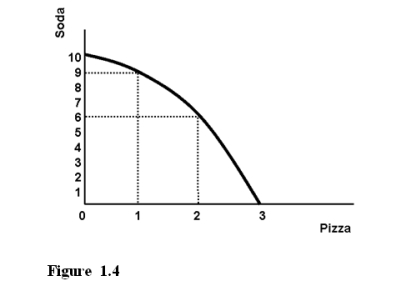 -Using Figure 1.4 above we know the production of 9 units of soda and 3 units of pizza is
 (Multiple Choice)
4.9/5 (96)
(96) The statement that Congress passed a tax bill and two months later a recession ended, so the bill must have been good policy is an example of
(Multiple Choice)
4.9/5 (78)
(78) Large increases in educational attainment would likely be a source of
(Multiple Choice)
4.8/5 (76)
(76) 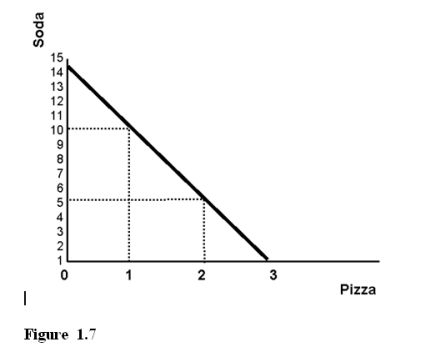 -Using Figure 1.7 we know the production of 5 units of soda and 2 units of pizza is
 (Multiple Choice)
4.7/5 (82)
(82) 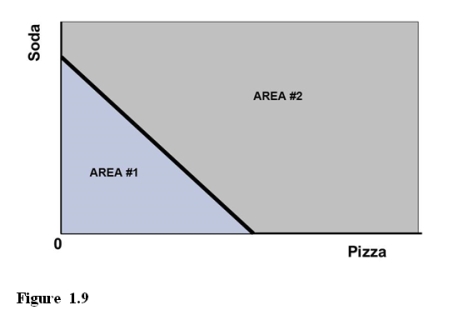 -Referring to Figure 1.9, if a point is attainable it is in
 (Multiple Choice)
4.7/5 (76)
(76) 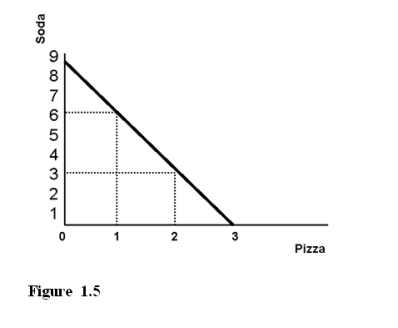 -Using Figure 1.5 above you can tell that
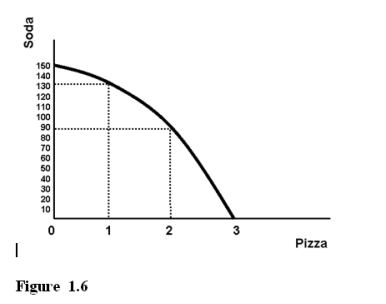 -Using Figure 1.6 we know the production of 90 units of soda and 1 units of pizza is
 (Multiple Choice)
4.8/5 (79)
(79) 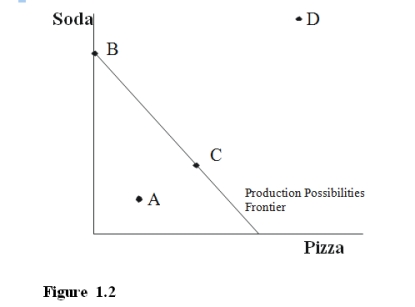 -In Figure 1.2, which labeled point indicates that there are sufficient resources and technology to produce the combination of goods represented by that point?
 (Multiple Choice)
5.0/5 (70)
(70) The fact that as snow accumulates, snow shovel sales rise suggests the two are
(Multiple Choice)
4.9/5 (77)
(77) 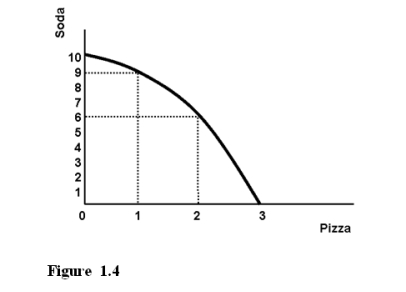 -Referring to Figure 1.4, the opportunity cost of producing the second unit of pizza is
 (Multiple Choice)
4.7/5 (74)
(74) 
Filters
- Essay(0)
- Multiple Choice(0)
- Short Answer(0)
- True False(0)
- Matching(0)