



 Chat with AI
Exam 36: Economics of K-12 Education

Exam 1: Economics: the Study of Opportunity Cost124 Questions
Exam 2: Supply and Demand204 Questions
Exam 3: The Concept of Elasticity and Consumer and Producer Surplus173 Questions
Exam 4: Firm Production, Cost, and Revenue158 Questions
Exam 5: Perfect Competition, Monopoly, and Economic Versus Normal Profit119 Questions
Exam 6: Every Macroeconomic Word You Ever Heard: Gross Domestic Product, Inflation, Unemployment, Recession, Depression201 Questions
Exam 7: Interest Rates and Present Value118 Questions
Exam 8: Aggregate Demand and Aggregate Supply110 Questions
Exam 9: Fiscal Policy66 Questions
Exam 10: Monetary Policy104 Questions
Exam 11: Federal Spending76 Questions
Exam 12: Federal Deficits, Surpluses, and the National Debt76 Questions
Exam 13: The Housing Bubble71 Questions
Exam 14: The Recession of 2007-2009: Causes and Policy Responses57 Questions
Exam 15: Is Economic Stagnation the New Normal42 Questions
Exam 16: Is the Fiscalsky Falling: An Examination of Unfunded Social Security, Medicare, and State and Local Pension Liabilities51 Questions
Exam 17: International Trade: Does It Jeopardize American Jobs86 Questions
Exam 18: International Finance and Exchange Rates77 Questions
Exam 19: The European Debt Crisis60 Questions
Exam 20: Economic Growth and Development60 Questions
Exam 21: Nafta, Gatt, Wto: Are Trade Agreements Good for Us42 Questions
Exam 22: The Line Between Legal and Illegal Goods71 Questions
Exam 23: Natural Resources, the Environment, and Climate Change73 Questions
Exam 24: Health Care87 Questions
Exam 25: Government-Provided Health Insurance: Medicaid, Medicare, and the Child Health Insurance Program79 Questions
Exam 26: The Economics of Prescription Drugs62 Questions
Exam 27: So You Want to Be a Lawyer: Economics and the Law62 Questions
Exam 28: The Economics of Crime62 Questions
Exam 29: Antitrust39 Questions
Exam 30: The Economics of Race and Discrimination60 Questions
Exam 31: Income and Wealth Inequality70 Questions
Exam 32: Farm Policy63 Questions
Exam 33: Minimum Wage60 Questions
Exam 34: Ticket Brokers and Ticket Scalping60 Questions
Exam 35: Rent Control31 Questions
Exam 36: Economics of K-12 Education55 Questions
Exam 37: Economics of College and University Education82 Questions
Exam 38: Poverty and Welfare69 Questions
Exam 39: Head Start44 Questions
Exam 40: Social Security60 Questions
Exam 41: Personal Income Taxes55 Questions
Exam 42: Energy Prices67 Questions
Exam 43: If We Build It, Will They Come and Other Sports Questions61 Questions
Exam 44: The Stock Market Crashes57 Questions
Exam 45: Unions66 Questions
Exam 46: Walmart: Always Low Prices and Low Wages- Always41 Questions
Exam 47: The Economic Impact of Casino Gambling39 Questions
Exam 48: The Economics of Terrorism43 Questions
Select questions type


Quick conclusions about the behavior of SAT scores should be made with care because

Free
(Multiple Choice)
4.8/5  (79)
(79) Correct Answer: Verified
D
The educational production function shows the _____ relationship between _____ and _____.
Free
(Multiple Choice)
4.8/5 (86)
(86) Correct Answer:Verified
VerifiedA
Most public school systems operate in a
Free
(Multiple Choice)
4.9/5 (74)
(74) Correct Answer:Verified
VerifiedB
In 2011, these states saw challenges to the collective bargaining rights of their teachers.
(Multiple Choice)
4.9/5 (92)
(92) In 2014, the U.S. spent ________ to educate _________ elementary and secondary school students.
(Multiple Choice)
5.0/5 (84)
(84) The empirical evidence suggests that greater spending on public education in the 1980's and 1990's _____________ impact on education outcomes.
(Multiple Choice)
4.8/5 (72)
(72) 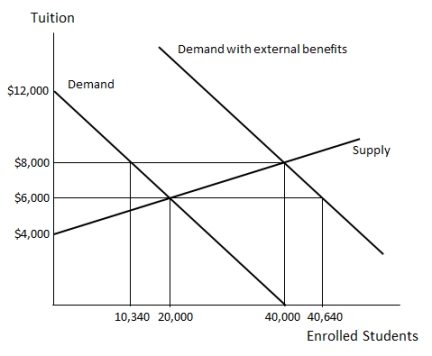 Figure 36.1
-Examine Figure 36.1, which shows the market for K-12 education in an economy. If the market is unsubsidized, the equilibrium number of students educated is
Figure 36.1
-Examine Figure 36.1, which shows the market for K-12 education in an economy. If the market is unsubsidized, the equilibrium number of students educated is (Multiple Choice)
4.8/5 (80)
(80) 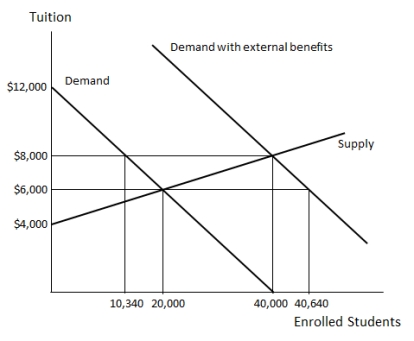 Figure 36.1
-Examine Figure 36.1, which shows the market for K-12 education in an economy. If the market is unsubsidized, the equilibrium tuition fees per student for K-12 education is
Figure 36.1
-Examine Figure 36.1, which shows the market for K-12 education in an economy. If the market is unsubsidized, the equilibrium tuition fees per student for K-12 education is (Multiple Choice)
4.9/5 (81)
(81) The educational outcomes at private schools are generally _____ those in public schools.
(Multiple Choice)
4.8/5 (79)
(79) The difference between the present value of all benefits and the present value of all costs is the
(Multiple Choice)
4.9/5 (84)
(84) Unions in general, and teachers' union in particular, prefer that salaries be based solely on _____ of the worker.
(Multiple Choice)
4.8/5 (72)
(72) 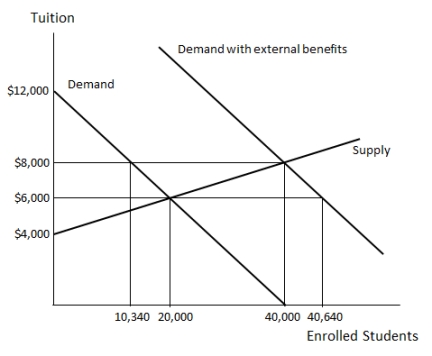 Figure 36.1
-Examine Figure 36.1, which shows the market for K-12 education in an economy. If K-12 education is completely subsidized, _____ students will be educated.
Figure 36.1
-Examine Figure 36.1, which shows the market for K-12 education in an economy. If K-12 education is completely subsidized, _____ students will be educated. (Multiple Choice)
4.8/5 (80)
(80) Which of the following is true of the structure of the public education system in the United States?
(Multiple Choice)
4.8/5 (104)
(104) In the presence of positive externalities, a market will charge ______ and produce _____.
(Multiple Choice)
5.0/5 (97)
(97) In the presence of positive external benefits, the efficient price to charge parents for the education of their children is
(Multiple Choice)
5.0/5 (83)
(83) Economists Lochner and Moretti have identified external benefits to education in the form of
(Multiple Choice)
4.7/5 (75)
(75) 
Filters
- Essay(0)
- Multiple Choice(0)
- Short Answer(0)
- True False(0)
- Matching(0)