



 Chat with AI
Exam 37: Economics of College and University Education

Exam 1: Economics: the Study of Opportunity Cost124 Questions
Exam 2: Supply and Demand204 Questions
Exam 3: The Concept of Elasticity and Consumer and Producer Surplus173 Questions
Exam 4: Firm Production, Cost, and Revenue158 Questions
Exam 5: Perfect Competition, Monopoly, and Economic Versus Normal Profit119 Questions
Exam 6: Every Macroeconomic Word You Ever Heard: Gross Domestic Product, Inflation, Unemployment, Recession, Depression201 Questions
Exam 7: Interest Rates and Present Value118 Questions
Exam 8: Aggregate Demand and Aggregate Supply110 Questions
Exam 9: Fiscal Policy66 Questions
Exam 10: Monetary Policy104 Questions
Exam 11: Federal Spending76 Questions
Exam 12: Federal Deficits, Surpluses, and the National Debt76 Questions
Exam 13: The Housing Bubble71 Questions
Exam 14: The Recession of 2007-2009: Causes and Policy Responses57 Questions
Exam 15: Is Economic Stagnation the New Normal42 Questions
Exam 16: Is the Fiscalsky Falling: An Examination of Unfunded Social Security, Medicare, and State and Local Pension Liabilities51 Questions
Exam 17: International Trade: Does It Jeopardize American Jobs86 Questions
Exam 18: International Finance and Exchange Rates77 Questions
Exam 19: The European Debt Crisis60 Questions
Exam 20: Economic Growth and Development60 Questions
Exam 21: Nafta, Gatt, Wto: Are Trade Agreements Good for Us42 Questions
Exam 22: The Line Between Legal and Illegal Goods71 Questions
Exam 23: Natural Resources, the Environment, and Climate Change73 Questions
Exam 24: Health Care87 Questions
Exam 25: Government-Provided Health Insurance: Medicaid, Medicare, and the Child Health Insurance Program79 Questions
Exam 26: The Economics of Prescription Drugs62 Questions
Exam 27: So You Want to Be a Lawyer: Economics and the Law62 Questions
Exam 28: The Economics of Crime62 Questions
Exam 29: Antitrust39 Questions
Exam 30: The Economics of Race and Discrimination60 Questions
Exam 31: Income and Wealth Inequality70 Questions
Exam 32: Farm Policy63 Questions
Exam 33: Minimum Wage60 Questions
Exam 34: Ticket Brokers and Ticket Scalping60 Questions
Exam 35: Rent Control31 Questions
Exam 36: Economics of K-12 Education55 Questions
Exam 37: Economics of College and University Education82 Questions
Exam 38: Poverty and Welfare69 Questions
Exam 39: Head Start44 Questions
Exam 40: Social Security60 Questions
Exam 41: Personal Income Taxes55 Questions
Exam 42: Energy Prices67 Questions
Exam 43: If We Build It, Will They Come and Other Sports Questions61 Questions
Exam 44: The Stock Market Crashes57 Questions
Exam 45: Unions66 Questions
Exam 46: Walmart: Always Low Prices and Low Wages- Always41 Questions
Exam 47: The Economic Impact of Casino Gambling39 Questions
Exam 48: The Economics of Terrorism43 Questions
Select questions type


From 1995 to 2013 the share of revenue to public institutions of higher education attributable to tuition
(Multiple Choice)
4.9/5  (82)
(82) A physical book that sells new for $100 will typically sell as an e-book for around
(Multiple Choice)
4.9/5 (75)
(75) Suppose a college education is choosing between a modestly expensive school ($100,000 over 4 years)and a less expensive school ($40,000 over 4 years)the student should
(Multiple Choice)
4.9/5 (79)
(79) In the United States, the average government subsidy for a college education at a flagship, state institution is approximately __ for every $1 spent by the student.
(Multiple Choice)
4.8/5 (70)
(70) A book that sells new for $200 will typically be sold back to the bookstore "used" for
(Multiple Choice)
4.8/5 (76)
(76) A book that sells new for $200 will typically sell used for around
(Multiple Choice)
4.8/5 (70)
(70) A book that sells new for $100 will typically be sold back to the bookstore "used" for
(Multiple Choice)
4.9/5 (77)
(77) Payment of a share of prospective royalties to the author before publication is called the
(Multiple Choice)
4.7/5 (79)
(79) 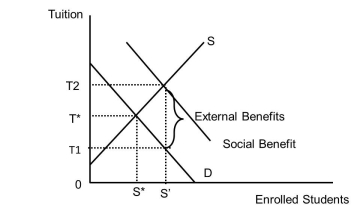 Figure 37.1
-Examine Figure 37.1. What is the number of students educated in a market that has a subsidy equal to the external benefit?
Figure 37.1
-Examine Figure 37.1. What is the number of students educated in a market that has a subsidy equal to the external benefit? (Multiple Choice)
4.7/5 (84)
(84) In the United States, the average government subsidy for a college education at a regional, bachelors-only public institution is approximately __ for every $1 spent by the student.
(Multiple Choice)
4.8/5 (69)
(69) 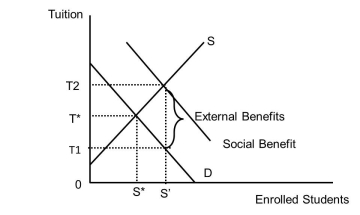 Figure 37.1
-Examine Figure 37.1. What is the tuition charged the student in a market that has a subsidy equal to the external benefit?
Figure 37.1
-Examine Figure 37.1. What is the tuition charged the student in a market that has a subsidy equal to the external benefit? (Multiple Choice)
4.7/5 (70)
(70) 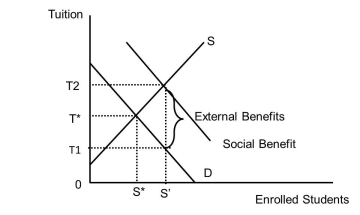 Figure 37.1
-Examine Figure 37.1. What is the number of students educated in a market that has no subsidy?
Figure 37.1
-Examine Figure 37.1. What is the number of students educated in a market that has no subsidy? (Multiple Choice)
4.9/5 (88)
(88) Suppose a college education is choosing between an expensive school ($200,000 over 4 years)and a less expensive school ($40,000 over 4 years)the student should
(Multiple Choice)
4.9/5 (73)
(73) In 2014, more than ________ was spent to educate _________ college students.
(Multiple Choice)
4.8/5 (75)
(75) If faculty choose to stay with an old edition of a book this is predicted to
(Multiple Choice)
4.9/5 (87)
(87) Without a copyright, the high fixed costs of textbook creation
(Multiple Choice)
4.9/5 (85)
(85) If e-books begin to be the most popular form of textbooks, it is
(Multiple Choice)
4.8/5 (85)
(85) In the United States, the average government subsidy for a college education at a private institution is approximately __ for every $1 spent by the student.
(Multiple Choice)
4.7/5 (90)
(90) If a book has a royalty rate of 15% and 12,000 copies are sold to bookstores at $50 each the bookstore returns 2000 unsold books to publishers, and the bookstore sells the books to students for $62.50 the author will be paid
(Multiple Choice)
4.8/5 (82)
(82) 
Filters
- Essay(0)
- Multiple Choice(0)
- Short Answer(0)
- True False(0)
- Matching(0)