



 Chat with AI
Exam 37: Economics of College and University Education

Exam 1: Economics: the Study of Opportunity Cost124 Questions
Exam 2: Supply and Demand204 Questions
Exam 3: The Concept of Elasticity and Consumer and Producer Surplus173 Questions
Exam 4: Firm Production, Cost, and Revenue158 Questions
Exam 5: Perfect Competition, Monopoly, and Economic Versus Normal Profit119 Questions
Exam 6: Every Macroeconomic Word You Ever Heard: Gross Domestic Product, Inflation, Unemployment, Recession, Depression201 Questions
Exam 7: Interest Rates and Present Value118 Questions
Exam 8: Aggregate Demand and Aggregate Supply110 Questions
Exam 9: Fiscal Policy66 Questions
Exam 10: Monetary Policy104 Questions
Exam 11: Federal Spending76 Questions
Exam 12: Federal Deficits, Surpluses, and the National Debt76 Questions
Exam 13: The Housing Bubble71 Questions
Exam 14: The Recession of 2007-2009: Causes and Policy Responses57 Questions
Exam 15: Is Economic Stagnation the New Normal42 Questions
Exam 16: Is the Fiscalsky Falling: An Examination of Unfunded Social Security, Medicare, and State and Local Pension Liabilities51 Questions
Exam 17: International Trade: Does It Jeopardize American Jobs86 Questions
Exam 18: International Finance and Exchange Rates77 Questions
Exam 19: The European Debt Crisis60 Questions
Exam 20: Economic Growth and Development60 Questions
Exam 21: Nafta, Gatt, Wto: Are Trade Agreements Good for Us42 Questions
Exam 22: The Line Between Legal and Illegal Goods71 Questions
Exam 23: Natural Resources, the Environment, and Climate Change73 Questions
Exam 24: Health Care87 Questions
Exam 25: Government-Provided Health Insurance: Medicaid, Medicare, and the Child Health Insurance Program79 Questions
Exam 26: The Economics of Prescription Drugs62 Questions
Exam 27: So You Want to Be a Lawyer: Economics and the Law62 Questions
Exam 28: The Economics of Crime62 Questions
Exam 29: Antitrust39 Questions
Exam 30: The Economics of Race and Discrimination60 Questions
Exam 31: Income and Wealth Inequality70 Questions
Exam 32: Farm Policy63 Questions
Exam 33: Minimum Wage60 Questions
Exam 34: Ticket Brokers and Ticket Scalping60 Questions
Exam 35: Rent Control31 Questions
Exam 36: Economics of K-12 Education55 Questions
Exam 37: Economics of College and University Education82 Questions
Exam 38: Poverty and Welfare69 Questions
Exam 39: Head Start44 Questions
Exam 40: Social Security60 Questions
Exam 41: Personal Income Taxes55 Questions
Exam 42: Energy Prices67 Questions
Exam 43: If We Build It, Will They Come and Other Sports Questions61 Questions
Exam 44: The Stock Market Crashes57 Questions
Exam 45: Unions66 Questions
Exam 46: Walmart: Always Low Prices and Low Wages- Always41 Questions
Exam 47: The Economic Impact of Casino Gambling39 Questions
Exam 48: The Economics of Terrorism43 Questions
Select questions type


If e-books begin to be the most popular form of textbooks, it is
(Multiple Choice)
4.7/5  (75)
(75) The profit a publisher makes on the sale of a used college textbook is
(Multiple Choice)
4.8/5 (90)
(90) Since the 1980s federal spending on higher education has taken the form of
(Multiple Choice)
4.9/5 (71)
(71) The variable cost of producing a college textbook is usually around _____ of its price.
(Multiple Choice)
4.9/5 (78)
(78) A book that sells new for $100 will typically sell used for around
(Multiple Choice)
4.8/5 (84)
(84) Once faculty receive textbooks and choose not to use them they are
(Multiple Choice)
4.9/5 (71)
(71) The royalty that an author receives on the resale of a used college textbook is
(Multiple Choice)
4.8/5 (76)
(76) An e-book that sells new for $100 will typically be sold back to the bookstore "used" for
(Multiple Choice)
4.7/5 (81)
(81) When textbooks are produced, the idea for a new book typically comes from
(Multiple Choice)
4.8/5 (72)
(72) From 1995 to 2013 the share of revenue to public institutions of higher education attributable to appropriations
(Multiple Choice)
4.8/5 (76)
(76) In 2014, expenditure per student in higher education was approximately
(Multiple Choice)
4.9/5 (75)
(75) A physical book that sells new for $100 will rent for around
(Multiple Choice)
4.8/5 (93)
(93) One side effect of the increased speed with which used books circulate is
(Multiple Choice)
4.8/5 (83)
(83) 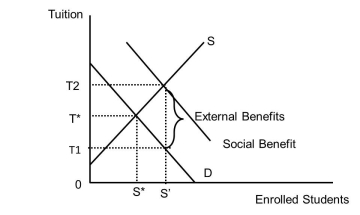 Figure 37.1
-Examine Figure 37.1. What is the tuition and subsidy revenue per student in a market that has a subsidy equal to the external benefit?
Figure 37.1
-Examine Figure 37.1. What is the tuition and subsidy revenue per student in a market that has a subsidy equal to the external benefit? (Multiple Choice)
4.9/5 (92)
(92) A university education costs more per student than a high school education because
(Multiple Choice)
4.8/5 (88)
(88) Over the last 34 years, costs of college tuition, room and board have increased by
(Multiple Choice)
4.9/5 (83)
(83) 
Filters
- Essay(0)
- Multiple Choice(0)
- Short Answer(0)
- True False(0)
- Matching(0)