



 Chat with AI
Exam 13: Monopolistic Competition

Exam 1: Limits, Alternatives, and Choices398 Questions
Exam 2: The Market System and the Circular Flow252 Questions
Exam 3: Demand, Supply, and Market Equilibrium339 Questions
Exam 4: Market Failures: Public Goods and Externalities235 Questions
Exam 5: Governments Role and Government Failure275 Questions
Exam 6: Elasticity255 Questions
Exam 7: Utility Maximization256 Questions
Exam 8: Behavioral Economics274 Questions
Exam 9: Businesses and the Costs of Production307 Questions
Exam 10: Pure Competition in the Short Run167 Questions
Exam 11: Pure Competition in the Long Run182 Questions
Exam 12: Pure Monopoly224 Questions
Exam 13: Monopolistic Competition194 Questions
Exam 14: Oligopoly and Strategic Behavior265 Questions
Exam 15: Technology, Rd, and Efficiency231 Questions
Exam 16: The Demand for Resources244 Questions
Exam 17: Wage Determination308 Questions
Exam 18: Rent, Interest, and Profit210 Questions
Exam 19: Natural Resource and Energy Economics290 Questions
Exam 20: Public Finance: Expenditures and Taxes232 Questions
Exam 21: Antitrust Policy and Regulation237 Questions
Exam 22: Agriculture: Economics and Policy217 Questions
Exam 23: Income Inequality, Poverty, and Discrimination272 Questions
Exam 24: Health Care240 Questions
Exam 25: Immigration197 Questions
Exam 26: International Trade241 Questions
Exam 27: The Balance of Payments, Exchange Rates, and Trade Deficits252 Questions
Exam 28: The Economics of Developing Countries249 Questions
Select questions type


If some firms leave a monopolistically competitive industry, the demand curves of the remaining firms will
(Multiple Choice)
4.8/5  (85)
(85) When a monopolistically competitive firm is in long-run equilibrium,
(Multiple Choice)
5.0/5 (73)
(73) If the four-firm concentration ratio in an oligopolistic industry is 100 percent and each firm has an equal percentage of sales, the Herfindahl index is
(Multiple Choice)
4.8/5 (72)
(72) Assume that the short-run cost and demand data given in the tables below confront a monopolistic competitor selling a given product and engaged in a given amount of product promotion.
Total Output Total Cost Quantity Demanded Price 0 \ 25 0 \ 60 1 40 1 55 2 45 2 50 3 55 3 45 4 70 4 40 5 90 5 35 6 115 6 30 If the firm sells 3 units of output, marginal revenue will be
(Multiple Choice)
4.8/5 (88)
(88) In which industry is monopolistic competition most likely to be found?
(Multiple Choice)
4.9/5 (73)
(73) The graph depicts a monopolistically competitive firm. 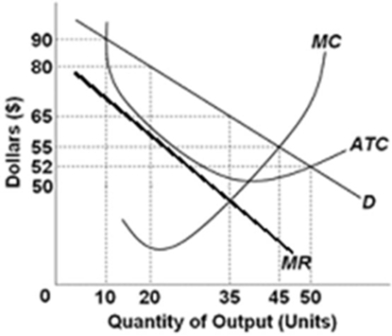 At the profit-maximizing level of short-run output, this monopolistically competitive firm will be making a profit of
 (Multiple Choice)
5.0/5 (75)
(75) Product differentiation in monopolistic competition involves a trade-off between
(Multiple Choice)
4.8/5 (71)
(71) Monopolistic competition resembles pure competition because
(Multiple Choice)
4.8/5 (71)
(71) The more elastic a monopolistic competitor's long-run demand curve, the
(Multiple Choice)
4.8/5 (77)
(77) The larger the number of firms and the less the degree of product differentiation, the greater will be the elasticity of a monopolistically competitive seller's demand curve.
(True/False)
4.7/5 (82)
(82) The demand curve of a monopolistically competitive producer is
(Multiple Choice)
4.9/5 (94)
(94) Compared to a purely competitive firm in long-run equilibrium, the monopolistic competitor has a
(Multiple Choice)
4.9/5 (83)
(83) 
Filters
- Essay(0)
- Multiple Choice(0)
- Short Answer(0)
- True False(0)
- Matching(0)