



 Chat with AI
Exam 13: Monopolistic Competition

Exam 1: Limits, Alternatives, and Choices398 Questions
Exam 2: The Market System and the Circular Flow252 Questions
Exam 3: Demand, Supply, and Market Equilibrium339 Questions
Exam 4: Market Failures: Public Goods and Externalities235 Questions
Exam 5: Governments Role and Government Failure275 Questions
Exam 6: Elasticity255 Questions
Exam 7: Utility Maximization256 Questions
Exam 8: Behavioral Economics274 Questions
Exam 9: Businesses and the Costs of Production307 Questions
Exam 10: Pure Competition in the Short Run167 Questions
Exam 11: Pure Competition in the Long Run182 Questions
Exam 12: Pure Monopoly224 Questions
Exam 13: Monopolistic Competition194 Questions
Exam 14: Oligopoly and Strategic Behavior265 Questions
Exam 15: Technology, Rd, and Efficiency231 Questions
Exam 16: The Demand for Resources244 Questions
Exam 17: Wage Determination308 Questions
Exam 18: Rent, Interest, and Profit210 Questions
Exam 19: Natural Resource and Energy Economics290 Questions
Exam 20: Public Finance: Expenditures and Taxes232 Questions
Exam 21: Antitrust Policy and Regulation237 Questions
Exam 22: Agriculture: Economics and Policy217 Questions
Exam 23: Income Inequality, Poverty, and Discrimination272 Questions
Exam 24: Health Care240 Questions
Exam 25: Immigration197 Questions
Exam 26: International Trade241 Questions
Exam 27: The Balance of Payments, Exchange Rates, and Trade Deficits252 Questions
Exam 28: The Economics of Developing Countries249 Questions
Select questions type


In a monopolistically competitive market like restaurants, large capital-intensive firms like McDonald’s may co-exist with more labor-intensive mom-and-pop shops. In this case, higher labor costs would tend to favor the survival of
(Multiple Choice)
5.0/5  (86)
(86) Which industry would be best characterized as monopolistically competitive?
(Multiple Choice)
4.8/5 (80)
(80) A monopolistically competitive industry combines elements of both competition and monopoly. The monopoly element results from
(Multiple Choice)
4.9/5 (70)
(70) (Consider This) Which of the following statements is most accurate about the difference between goods produced under the old central planning model of the Soviet Union versus those produced by American capitalism?
(Multiple Choice)
4.9/5 (80)
(80) In the long run, the economic profits for a monopolistically competitive firm will be
(Multiple Choice)
4.9/5 (73)
(73) Which of the following forces does not play a major part in the adjustments of a monopolistically competitive industry toward its long-run equilibrium?
(Multiple Choice)
4.8/5 (85)
(85) The monopolistically competitive seller maximizes profits by equating price and marginal cost.
(True/False)
4.9/5 (78)
(78) In the long run, the price charged by the monopolistically competitive firm attempting to maximize profits
(Multiple Choice)
4.8/5 (79)
(79) Other things equal, if more firms enter a monopolistically competitive industry,
(Multiple Choice)
4.9/5 (81)
(81) One difference between monopolistic competition and pure competition is that
(Multiple Choice)
4.7/5 (83)
(83) The graph depicts a monopolistically competitive firm. 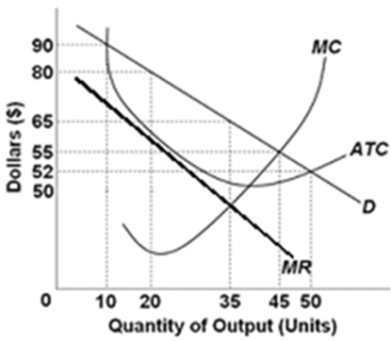 This monopolistically competitive firm is earning economic profits in the short run and
 (Multiple Choice)
4.9/5 (86)
(86) (Consider This) In Wendy’s 1987 commercial depicting a Soviet fashion show, one objective was to portray McDonald’s and Burger King products as
(Multiple Choice)
4.9/5 (72)
(72) Monopolistically competitive firms have some control over the price of their products.
(True/False)
4.9/5 (74)
(74) Monopolistically competitive firms are inefficient because they produce at a point on the rising segment of their average cost curves.
(True/False)
4.9/5 (83)
(83) An industry having a four-firm concentration ratio of 30 percent
(Multiple Choice)
4.8/5 (70)
(70) Monopolistically competitive firms are similar to monopolies in that they have
(Multiple Choice)
4.7/5 (79)
(79) A monopolistically competitive firm is operating at a short-run level of output where price is $21, average total cost is $15, marginal cost is $13, and marginal revenue is $13. In the short run this firm should
(Multiple Choice)
4.8/5 (79)
(79) Assume that the short-run cost and demand data given in the tables below confront a monopolistic competitor selling a given product and engaged in a given amount of product promotion.
Total Output Total Cost Quantity Demanded Price 0 \ 25 0 \ 60 1 40 1 55 2 45 2 50 3 55 3 45 4 70 4 40 5 90 5 35 6 115 6 30 What will the maximum total profits be?
(Multiple Choice)
4.8/5 (79)
(79) 
Filters
- Essay(0)
- Multiple Choice(0)
- Short Answer(0)
- True False(0)
- Matching(0)