



 Chat with AI
Exam 15: Chemical Equilibrium

Exam 1: The Chemical World59 Questions
Exam 2: Measurement and Problem Solving131 Questions
Exam 3: Matter and Energy118 Questions
Exam 4: Atoms and Elements112 Questions
Exam 5: Molecules and Compounds110 Questions
Exam 6: Chemical Composition118 Questions
Exam 7: Chemical Reactions113 Questions
Exam 8: Quantities in Chemical Reactions115 Questions
Exam 9: Electrons in Atoms and the Periodic Table111 Questions
Exam 10: Chemical Bonding109 Questions
Exam 11: Gases123 Questions
Exam 12: Liquids, solids, and Intermolecular Forces115 Questions
Exam 13: Solutions122 Questions
Exam 14: Acids and Bases117 Questions
Exam 15: Chemical Equilibrium118 Questions
Exam 16: Oxidation and Reduction113 Questions
Exam 17: Radioactivity and Nuclear Chemistry115 Questions
Exam 18: Organic Chemistry109 Questions
Exam 19: Biochemistry110 Questions
Select questions type


Le Chatelier's Principle states that:

Free
(Multiple Choice)
4.9/5  (86)
(86) Correct Answer: Verified
C
Dissolving the compound PbCl2 into water can be represented as  ,so the equilibrium expression is Ksp =

,so the equilibrium expression is Ksp = Free
(True/False)
4.9/5 (78)
(78) Correct Answer:Verified
VerifiedFalse
For the reaction  what happens to the equilibrium position if the volume decreases?
Free
(Multiple Choice)
4.9/5 (85)
(85) Correct Answer:Verified
VerifiedA
Increasing the volume of the system below causes the reaction to shift towards the right. 
(True/False)
4.9/5 (84)
(84)  .
The equilibrium constant is:
When dynamic equilibrium is achieved,the concentrations of reactants is equal to the concentrations of the products.
(True/False)
4.8/5 (82)
(82) Placing a [ ] around the formula of a chemical means that we are referring to the molar concentration of that chemical.
(True/False)
4.8/5 (81)
(81)  ] at equilibrium,given CuS,
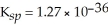 ?
For the reaction  ,what happens to the equilibrium position if aqueous ammonium sulfide is added?
 (Multiple Choice)
4.8/5 (69)
(69) Le Chatelier's principle states that when a chemical system at equilibrium is disturbed,the system shifts in a direction that minimizes the disturbance.
(True/False)
4.9/5 (69)
(69) In an exothermic reaction,you can consider the emitted heat as a reactant in this system.
(True/False)
4.8/5 (72)
(72) For the reaction ,what happens to the equilibrium position if ammonium sulfate is added?
,what happens to the equilibrium position if ammonium sulfate is added? (Multiple Choice)
4.8/5 (71)
(71) Consider the reaction:
 Which of the following will cause a shift in the equilibrium to the left?
1.Remove N2O
2.Remove O2
3.Add N2
Which of the following will cause a shift in the equilibrium to the left?
1.Remove N2O
2.Remove O2
3.Add N2 (Multiple Choice)
4.9/5 (79)
(79)  .
 << 1?
Comparing a reaction with a catalyst to the same reaction without the catalyst,each of the following statements is true EXCEPT:
(Multiple Choice)
4.7/5 (80)
(80) Which compound below is the most soluble in water based on its  value?
 (Multiple Choice)
4.9/5 (74)
(74) What happens to the equilibrium position of an exothermic reaction when you remove heat?
(Multiple Choice)
4.8/5 (85)
(85) Consider the following endothermic equilibrium reaction:
Fe2O3 (s)+ 3H2 (g)⇌ 2Fe (s)+ 3 H2O (g)
Which of the following actions will result in a shift to the left (towards reactants)?
(Multiple Choice)
5.0/5 (80)
(80) 
Filters
- Essay(0)
- Multiple Choice(0)
- Short Answer(0)
- True False(0)
- Matching(0)