



 Chat with AI
Exam 20: Electric Potential and Electric Potential Energy

Exam 1: Introduction to Physics100 Questions
Exam 2: One-Dimensional Kinematics112 Questions
Exam 3: Vectors in Physics82 Questions
Exam 4: Two-Dimensional Kinematics95 Questions
Exam 5: Newtons Laws of Motion101 Questions
Exam 6: Applications of Newtons Laws105 Questions
Exam 7: Work and Kinetic Energy92 Questions
Exam 8: Potential Energy and Conservation of Energy99 Questions
Exam 9: Linear Momentum and Collisions102 Questions
Exam 10: Rotational Kinematics and Energy102 Questions
Exam 11: Rotational Dynamics and Static Equilibrium97 Questions
Exam 12: Gravity94 Questions
Exam 13: Oscillations About Equilibrium102 Questions
Exam 14: Waves and Sound104 Questions
Exam 15: Fluids107 Questions
Exam 16: Temperature and Heat103 Questions
Exam 17: Phases and Phase Changes100 Questions
Exam 18: The Laws of Thermodynamics97 Questions
Exam 19: Electric Charges, Forces, and Fields88 Questions
Exam 20: Electric Potential and Electric Potential Energy99 Questions
Exam 21: Electric Current and Direct-Current Circuits99 Questions
Exam 22: Magnetism101 Questions
Exam 23: Magnetic Flux and Faradays Law of Induction99 Questions
Exam 24: Alternating-Current Circuits93 Questions
Exam 25: Electromagnetic Waves90 Questions
Exam 26: Geometrical Optics92 Questions
Exam 27: Optical Instruments102 Questions
Exam 28: Physical Optics: Interference and Diffraction93 Questions
Exam 29: Relativity100 Questions
Exam 30: Quantum Physics100 Questions
Exam 31: Atomic Physics75 Questions
Exam 32: Nuclear Physics and Nuclear Radiation89 Questions
Select questions type


When a proton moves in a direction of the electric field, its potential increases but its potential energy decreases.
(True/False)
4.9/5  (88)
(88) A + 5.0-μC charge is moved from a negative to a positive plate of a parallel plate capacitor. In moving this charge 0.30 mJ of energy is used. What is the potential difference between the plates of this capacitor?
(Multiple Choice)
4.8/5 (83)
(83) Every point on an equipotential surface is at the same potential.
(True/False)
4.9/5 (78)
(78) The capacitance of a parallel plate capacitor is directly proportional to its plate separation.
(True/False)
4.8/5 (74)
(74) When a dielectric material is introduced between the plates of a parallel plate capacitor the capacitance increases by a factor of 4. What is the dielectric constant of the material introduced between the plates?
(Multiple Choice)
4.9/5 (76)
(76) A parallel plate capacitor with plate separation of 4.0 cm has a plate area of 6.0 × 10⁻² m2. What is the capacitance of this capacitor if a dielectric material with a dielectric constant of 2.4 is placed between the plates?
(Multiple Choice)
4.7/5 (88)
(88) At a certain point in space the electric potential is 20 V. A 4.0-μC charge is brought from infinity to that point. What is the electric potential energy of this charge at that point?
(Multiple Choice)
4.9/5 (86)
(86) FIGURE 20-13 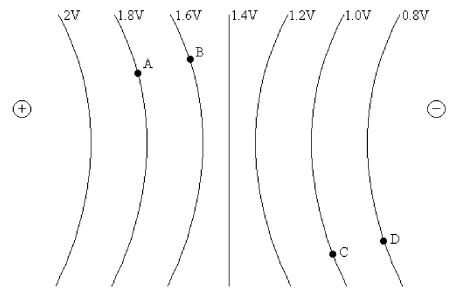 -The equipotential surfaces between the two point charges are shown in Figure 20-13 with the value of potential marked for each line. If the distance between points C and D is also 2.5 cm, what is the intensity of the electric field between these two points?
 (Multiple Choice)
4.9/5 (72)
(72) FIGURE 20-6  -Four equal point charges of magnitude 6.00 μC and of varying signs are placed at the corners of a square 2.00 m on each side, as shown in Figure 20-6. What is the electric potential at the center of the square?
 (Multiple Choice)
4.9/5 (94)
(94) What charge appears on the plates of a 2.0-μF capacitor when it is charged to 100 V?
(Multiple Choice)
4.8/5 (84)
(84) A 4.0-μC charge is situated at the origin of an xy-coordinate system. What is the potential difference between a point x1 = 2.0 m and another point x2 = 5.0 m because of this charge?
(Multiple Choice)
4.9/5 (88)
(88) At a certain point in space there is a potential of 400 V. What is the potential energy of a +2-μC charge at that point in space?
(Multiple Choice)
4.7/5 (86)
(86) Which of the following will increase the capacitance of a parallel plate capacitor?
(Multiple Choice)
4.7/5 (80)
(80) FIGURE 20-10  -Two point charges of magnitude +4.00 μC and +2.00 μC are placed at the opposite corners of a rectangle as shown in Figure 20-10. What is the potential difference between points A and B?
 (Multiple Choice)
4.8/5 (76)
(76) A proton falls through a potential drop of 400 V. How much is the change of potential energy of this proton in falling through this potential drop?
(Multiple Choice)
4.8/5 (85)
(85) A capacitor consists of a set of two parallel plates of area A separated by a distance d. This capacitor is connected to a battery that maintains a constant potential difference between the plates. If the separation between the plates is doubled, the magnitude of the charge on the plates will
(Multiple Choice)
4.8/5 (84)
(84) Two point charges of magnitude 4.0 μC and -4.0 μC are situated along the x-axis at x1 = 2.0 m and x2 = -2.0 m, respectively. What is the electric potential energy of this system of charges?
(Multiple Choice)
4.9/5 (90)
(90) 
Filters
- Essay(0)
- Multiple Choice(0)
- Short Answer(0)
- True False(0)
- Matching(0)