



 Chat with AI
Exam 20: Electric Potential and Electric Potential Energy

Exam 1: Introduction to Physics100 Questions
Exam 2: One-Dimensional Kinematics112 Questions
Exam 3: Vectors in Physics82 Questions
Exam 4: Two-Dimensional Kinematics95 Questions
Exam 5: Newtons Laws of Motion101 Questions
Exam 6: Applications of Newtons Laws105 Questions
Exam 7: Work and Kinetic Energy92 Questions
Exam 8: Potential Energy and Conservation of Energy99 Questions
Exam 9: Linear Momentum and Collisions102 Questions
Exam 10: Rotational Kinematics and Energy102 Questions
Exam 11: Rotational Dynamics and Static Equilibrium97 Questions
Exam 12: Gravity94 Questions
Exam 13: Oscillations About Equilibrium102 Questions
Exam 14: Waves and Sound104 Questions
Exam 15: Fluids107 Questions
Exam 16: Temperature and Heat103 Questions
Exam 17: Phases and Phase Changes100 Questions
Exam 18: The Laws of Thermodynamics97 Questions
Exam 19: Electric Charges, Forces, and Fields88 Questions
Exam 20: Electric Potential and Electric Potential Energy99 Questions
Exam 21: Electric Current and Direct-Current Circuits99 Questions
Exam 22: Magnetism101 Questions
Exam 23: Magnetic Flux and Faradays Law of Induction99 Questions
Exam 24: Alternating-Current Circuits93 Questions
Exam 25: Electromagnetic Waves90 Questions
Exam 26: Geometrical Optics92 Questions
Exam 27: Optical Instruments102 Questions
Exam 28: Physical Optics: Interference and Diffraction93 Questions
Exam 29: Relativity100 Questions
Exam 30: Quantum Physics100 Questions
Exam 31: Atomic Physics75 Questions
Exam 32: Nuclear Physics and Nuclear Radiation89 Questions
Select questions type


A dielectric material such as paper is placed between the plates of a capacitor holding a fixed charge. What happens to the electric field between the plates?
(Multiple Choice)
4.9/5  (92)
(92) A -4.0-μC charge is situated at the origin of an xy-coordinate system. Another -4.0 μC charge is at y = 4.0 m. What is the electric potential at a point x = 3.0 m due to these two charges?
(Multiple Choice)
4.8/5 (86)
(86) FIGURE 20-14 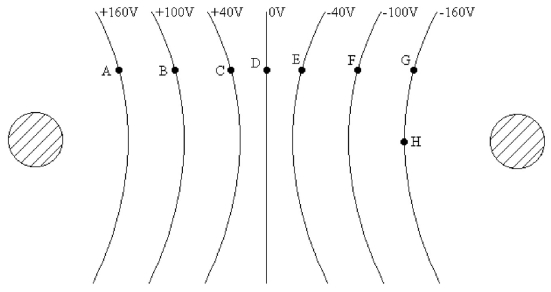 -The equipotential surfaces between two spherical conductors are shown in Figure 20-14, with the value of the potential marked for each line. What is the potential difference between points A and G?
 (Multiple Choice)
4.9/5 (76)
(76) FIGURE 20-1  -Two electric charges each equal to -Q, are separated by a distance d. If you make a graph of the electric potential as a function of the distance along the line connecting the two charges, the point exactly midway between the two charges would
 (Multiple Choice)
4.8/5 (75)
(75) If you were a parallel plate capacitor manufacturer, state three ways you might make larger valued capacitors.
(Essay)
4.9/5 (77)
(77) FIGURE 20-8  -Two charges of magnitude 6.0 μC, but opposite signs, are placed at the corners of the base of an equilateral triangle, as shown in Figure 20-8. What is the electric potential at the vertex, P, of the triangle due to these charges?
 (Multiple Choice)
4.9/5 (86)
(86) Which of the following expression(s) represents the electrical energy stored by a capacitor?
(Multiple Choice)
5.0/5 (71)
(71) A 6.00-μF parallel plate capacitor has a charge of + 40.0 μC and - 40.0 μC on each plate, respectively. The potential energy stored in this capacitor is:
(Multiple Choice)
4.7/5 (80)
(80) FIGURE 20-2  -The equipotential surfaces between two spherical conductors are shown in Figure 20-2, with the value of the potential marked for each line. What is the direction of the electric field at point F?
 (Multiple Choice)
4.8/5 (79)
(79) Two equal point charges of magnitude 4.0 μC are situated along the x-axis at x1 = -2.0 m and x2 = -2.0 m. What is the electric potential energy of this system of charges?
(Multiple Choice)
4.8/5 (93)
(93) FIGURE 20-5  -Four equal point charges of magnitude 6.00 μC and of varying signs are placed at the corners of a square 2.00 m on each side, as shown in Figure 20-5. What is the electric potential at the center of this square due to these charges?
 (Multiple Choice)
4.8/5 (86)
(86) The magnitude of the charge on each plate of a parallel plate capacitor is 4 μC and the potential difference between the plates is 80 V. What is the capacitance of this capacitor?
(Multiple Choice)
4.8/5 (85)
(85) In the expression for the definition of capacitance C = Q/V, Q is the total charge on the plates of a capacitor.
(True/False)
4.8/5 (84)
(84) A capacitor consists of a set of two parallel plates of area A separated by a distance d. This capacitor is connected to a battery and charged until its plates carry charges +Q and -Q. If the separation between the plates is doubled, the potential difference between the plates will
(Multiple Choice)
4.8/5 (85)
(85) An 800 V/m electric field is directed along the +x-axis. If the potential at x = 0 m is 2000 V, what is the potential at x = 2 m?
(Multiple Choice)
4.9/5 (81)
(81) After being charged from a battery, the plates of a parallel plate capacitor are moved closer together. When they are half as far apart as originally, by how much does the stored energy change?
(Essay)
4.8/5 (69)
(69) FIGURE 20-1
-Two electric charges each equal to +Q, are separated by a distance d. If you make a graph of the electric potential as a function of the distance along the line connecting the two charges, the point exactly midway between the two charges would
-Two electric charges each equal to +Q, are separated by a distance d. If you make a graph of the electric potential as a function of the distance along the line connecting the two charges, the point exactly midway between the two charges would (Multiple Choice)
4.8/5 (71)
(71) FIGURE 20-1
-Two electric charges +Q and -Q, are separated by a distance d. If you make a graph of the electric potential as a function of the distance along the line connecting the two charges, the point exactly midway between the two charges would
-Two electric charges +Q and -Q, are separated by a distance d. If you make a graph of the electric potential as a function of the distance along the line connecting the two charges, the point exactly midway between the two charges would (Multiple Choice)
4.9/5 (80)
(80) FIGURE 20-4  -Four equal point charges of magnitude 6.00 μC are placed at the corners of a square 2.00 m on each side, as shown in Figure 20-4. What is the electric potential of these charges at the center of this square?
 (Multiple Choice)
4.8/5 (76)
(76) 
Filters
- Essay(0)
- Multiple Choice(0)
- Short Answer(0)
- True False(0)
- Matching(0)