



 Chat with AI
Exam 20: Electric Potential and Electric Potential Energy

Exam 1: Introduction to Physics100 Questions
Exam 2: One-Dimensional Kinematics112 Questions
Exam 3: Vectors in Physics82 Questions
Exam 4: Two-Dimensional Kinematics95 Questions
Exam 5: Newtons Laws of Motion101 Questions
Exam 6: Applications of Newtons Laws105 Questions
Exam 7: Work and Kinetic Energy92 Questions
Exam 8: Potential Energy and Conservation of Energy99 Questions
Exam 9: Linear Momentum and Collisions102 Questions
Exam 10: Rotational Kinematics and Energy102 Questions
Exam 11: Rotational Dynamics and Static Equilibrium97 Questions
Exam 12: Gravity94 Questions
Exam 13: Oscillations About Equilibrium102 Questions
Exam 14: Waves and Sound104 Questions
Exam 15: Fluids107 Questions
Exam 16: Temperature and Heat103 Questions
Exam 17: Phases and Phase Changes100 Questions
Exam 18: The Laws of Thermodynamics97 Questions
Exam 19: Electric Charges, Forces, and Fields88 Questions
Exam 20: Electric Potential and Electric Potential Energy99 Questions
Exam 21: Electric Current and Direct-Current Circuits99 Questions
Exam 22: Magnetism101 Questions
Exam 23: Magnetic Flux and Faradays Law of Induction99 Questions
Exam 24: Alternating-Current Circuits93 Questions
Exam 25: Electromagnetic Waves90 Questions
Exam 26: Geometrical Optics92 Questions
Exam 27: Optical Instruments102 Questions
Exam 28: Physical Optics: Interference and Diffraction93 Questions
Exam 29: Relativity100 Questions
Exam 30: Quantum Physics100 Questions
Exam 31: Atomic Physics75 Questions
Exam 32: Nuclear Physics and Nuclear Radiation89 Questions
Select questions type


A capacitor, in addition to storing charge, also stores electrical energy.
(True/False)
4.8/5  (82)
(82) A 4.0-μC charge is situated at the origin of an xy-coordinate system. What is the potential difference between the points x = 4.0 m and y = 2.0 m because of this charge?
(Multiple Choice)
4.8/5 (80)
(80) The electric potential at the origin of an xy-coordinate system is 40 V. A -8.0-μC charge is brought from x = +∞ to that point. What is the electric potential energy of this charge at the origin?
(Multiple Choice)
4.9/5 (68)
(68) An electron is carried from the positive terminal to the negative terminal of a 9 V battery. How much work is required in carrying this electron?
(Multiple Choice)
4.8/5 (91)
(91) FIGURE 20-10  -Two point charges of magnitude +4.00 μC and +2.00 μC are placed at the opposite corners of a rectangle as shown in Figure 20-10. What is the potential at point A due to these charges?
 (Multiple Choice)
4.7/5 (77)
(77) Three charges are placed as follows along the x- and y-axis of an xy-coordinate system: q1 = 2.00 μC at x1 = 0 m, q2 = -4.00 μC at x2 = 3.00 m, and q3 = 6.00 μC at y = 4.00 m. What is the electric potential energy of this system of charges?
(Multiple Choice)
4.8/5 (65)
(65) Two point charges q1 = 4.0 μC and q2 = -8.0 μC are placed along the x-axis at x1 = 0 m and x2 = 0.20 m, respectively. What is the electric potential energy of this system of charges?
(Multiple Choice)
4.9/5 (93)
(93) Three charges are placed as follows along the x- and y-axes of an xy-coordinate system: q1 = 2.00 μC at x1 = 0 m, q2 = 4.00 μC at x2 = 3.00 m, and q3 = 6.00 μC at y = 4.00 m. What is the electric potential energy of this system of charges?
(Multiple Choice)
4.8/5 (91)
(91) An electron is initially at rest. It is accelerated through a potential difference of 400 V. What is the kinetic energy of this electron?
(Multiple Choice)
4.7/5 (59)
(59) Two point charges of magnitude 4.0 μC and -4.0 μC are situated along the x-axis at x1 = 2.0 m and x2 = -2.0 m, respectively. What is the electric potential at the origin of the xy-coordinate system?
(Multiple Choice)
4.8/5 (84)
(84) A capacitor consists of a set of two parallel plates of area A separated by a distance d. This capacitor is connected to a battery that maintains a constant potential difference between the plates. A slab of a dielectric material is inserted in the region between the plates so as to completely fill it. What changes would you observe?
(Multiple Choice)
5.0/5 (87)
(87) Unlike electric potential, the electric potential energy is a vector quantity.
(True/False)
4.9/5 (84)
(84) Two equal point charges of magnitude 4.0 μC are situated along the x-axis at x1 = -2.0 m and x2 = 2.0 m. What is the electric potential at the origin of the xy-coordinate system?
(Multiple Choice)
5.0/5 (70)
(70) State three reasons for adding a dielectric material between the plates of a capacitor.
(Essay)
4.9/5 (86)
(86) A potential changes at the greatest rate in the direction of the gradient of the potential.
(True/False)
4.9/5 (72)
(72) A surface on which all points are at the same potential is referred to as
(Multiple Choice)
4.9/5 (79)
(79) A capacitor consists of a set of two parallel plates of area A separated by a distance d. This capacitor is connected to a battery and charged until its plates carry charges +Q and -Q. If the separation between the plates is doubled, the electrical energy stored in the capacitor will
(Multiple Choice)
4.8/5 (76)
(76) The potential difference between the plates of a parallel plate capacitor is 35 V and the electric field between the plates has a strength of 750 V/m. If the plate area is 4.0 × 10⁻² m2, what is the capacitance of this capacitor?
(Multiple Choice)
4.8/5 (76)
(76) FIGURE 20-13 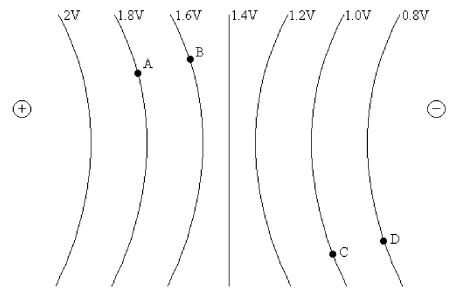 -The equipotential surfaces between the two point charges are shown in Figure 20-13 with the value of potential marked for each line. If the distance between points A and B is 2.5 cm what is the intensity of the electric field between these two points?
 (Multiple Choice)
4.9/5 (88)
(88) When an electron moves in a direction opposite to the electric field, its potential increases but the potential energy decreases.
(True/False)
5.0/5 (87)
(87) 
Filters
- Essay(0)
- Multiple Choice(0)
- Short Answer(0)
- True False(0)
- Matching(0)