



 Chat with AI
Exam 20: Electric Potential and Electric Potential Energy

Exam 1: Introduction to Physics100 Questions
Exam 2: One-Dimensional Kinematics112 Questions
Exam 3: Vectors in Physics82 Questions
Exam 4: Two-Dimensional Kinematics95 Questions
Exam 5: Newtons Laws of Motion101 Questions
Exam 6: Applications of Newtons Laws105 Questions
Exam 7: Work and Kinetic Energy92 Questions
Exam 8: Potential Energy and Conservation of Energy99 Questions
Exam 9: Linear Momentum and Collisions102 Questions
Exam 10: Rotational Kinematics and Energy102 Questions
Exam 11: Rotational Dynamics and Static Equilibrium97 Questions
Exam 12: Gravity94 Questions
Exam 13: Oscillations About Equilibrium102 Questions
Exam 14: Waves and Sound104 Questions
Exam 15: Fluids107 Questions
Exam 16: Temperature and Heat103 Questions
Exam 17: Phases and Phase Changes100 Questions
Exam 18: The Laws of Thermodynamics97 Questions
Exam 19: Electric Charges, Forces, and Fields88 Questions
Exam 20: Electric Potential and Electric Potential Energy99 Questions
Exam 21: Electric Current and Direct-Current Circuits99 Questions
Exam 22: Magnetism101 Questions
Exam 23: Magnetic Flux and Faradays Law of Induction99 Questions
Exam 24: Alternating-Current Circuits93 Questions
Exam 25: Electromagnetic Waves90 Questions
Exam 26: Geometrical Optics92 Questions
Exam 27: Optical Instruments102 Questions
Exam 28: Physical Optics: Interference and Diffraction93 Questions
Exam 29: Relativity100 Questions
Exam 30: Quantum Physics100 Questions
Exam 31: Atomic Physics75 Questions
Exam 32: Nuclear Physics and Nuclear Radiation89 Questions
Select questions type


A parallel plate capacitor with plate separation of 4.0 cm has a plate area of 4.0 × 10⁻² m2. What is the capacitance of this capacitor with air between these plates?
(Multiple Choice)
4.9/5  (82)
(82) Several electrons are placed on a hollow conducting sphere. They
(Multiple Choice)
4.8/5 (72)
(72) FIGURE 20-1  -Two parallel metal plates A and B carry positive and negative charges of equal strength, respectively, as shown in Figure 20-1. What is the correct direction for the equipotential lines for this charge configuration?
Choice I:
Vertical, along the y-axis
Choice II:
Horizontal, along the x-axis
-Two parallel metal plates A and B carry positive and negative charges of equal strength, respectively, as shown in Figure 20-1. What is the correct direction for the equipotential lines for this charge configuration?
Choice I:
Vertical, along the y-axis
Choice II:
Horizontal, along the x-axis (Multiple Choice)
5.0/5 (74)
(74) A -4.0-μC charge is situated at the origin of an xy-coordinate system. What is the magnitude and direction of an electric potential at x = 6.0 m?
(Multiple Choice)
4.9/5 (83)
(83) The potential difference between the plates of a parallel plate capacitor with the plate separation of 6 cm is 60 V. What is the electric field between the plates of this capacitor?
(Multiple Choice)
4.8/5 (85)
(85) A charged particle with charge + 5.0 μC is initially at rest. It is accelerated through a potential difference of 500 V. What is the kinetic energy of this charged particle?
(Multiple Choice)
4.8/5 (90)
(90) Equipotential lines and electric field lines meet perpendicular to one another.
(True/False)
4.8/5 (75)
(75) A parallel plate capacitor has a potential difference between the plates of 80 V. If the charge on one of the plates of the capacitor is +8.0 μC, what is the electrical energy stored by this capacitor?
(Multiple Choice)
4.8/5 (83)
(83) A 4.0-μC charge is situated at the origin of an xy-coordinate system. What is the magnitude and direction of the electric potential at x = 6.0 m?
(Multiple Choice)
4.8/5 (80)
(80) The work done in moving a positive charge against an electric field does not depend on the path chosen in moving the charge in that field. Based on the statement, what kind of force field is the electrostatic field?
(Multiple Choice)
4.9/5 (79)
(79) For an electron moving in a direction opposite to the electric field
(Multiple Choice)
4.7/5 (88)
(88) FIGURE 20-12  -Two point charges of magnitude +4.0 μC and -4.0 μC are placed as shown in Figure 20-12. What is the potential difference between points A and B?
 (Multiple Choice)
4.8/5 (87)
(87) FIGURE 20-14 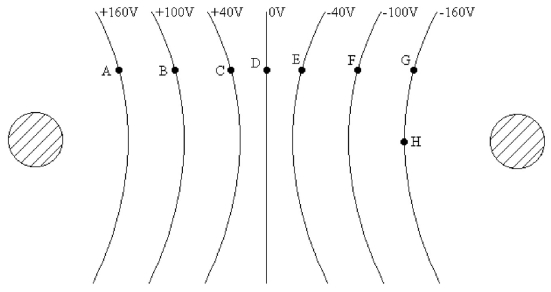 -The equipotential surfaces between two spherical conductors are shown in Figure 20-14, with the value of the potential marked for each line. What is the potential difference between points G and D?
 (Multiple Choice)
4.8/5 (80)
(80) A capacitor consists of a set of two parallel plates of area A separated by a distance d. This capacitor is connected to a battery that maintains a constant potential difference between the plates. If the separation between the plates is doubled, the magnitude of the electrical energy stored on the capacitor will
(Multiple Choice)
4.9/5 (72)
(72) FIGURE 20-3  -Two point charges of magnitude +4.00 μC and +2.00 μC are placed at the opposite corners of a rectangle as shown in Figure 20-3.
(a) What is the potential at point A due to these charges?
(b) What is the potential at point B due to these charges?
(c) What is the potential difference between points A and B?
-Two point charges of magnitude +4.00 μC and +2.00 μC are placed at the opposite corners of a rectangle as shown in Figure 20-3.
(a) What is the potential at point A due to these charges?
(b) What is the potential at point B due to these charges?
(c) What is the potential difference between points A and B? (Short Answer)
4.7/5 (87)
(87) A 20-μF capacitor has a charge of 60 μC. How much energy is stored in this capacitor?
(Multiple Choice)
4.8/5 (72)
(72) A -4.0-μC charge is situated at the origin of an xy-coordinate system. What is the potential difference between a point x = 4.0 m and y = 2.0 m because of this charge?
(Multiple Choice)
4.8/5 (71)
(71) A 4-μF capacitor has a potential drop of 20 V between its plates. The electric potential energy stored in this capacitor is:
(Multiple Choice)
4.8/5 (78)
(78) 
Filters
- Essay(0)
- Multiple Choice(0)
- Short Answer(0)
- True False(0)
- Matching(0)