



 Chat with AI
Exam 19: Electric Charges, Forces, and Fields

Exam 1: Introduction to Physics100 Questions
Exam 2: One-Dimensional Kinematics112 Questions
Exam 3: Vectors in Physics82 Questions
Exam 4: Two-Dimensional Kinematics95 Questions
Exam 5: Newtons Laws of Motion101 Questions
Exam 6: Applications of Newtons Laws105 Questions
Exam 7: Work and Kinetic Energy92 Questions
Exam 8: Potential Energy and Conservation of Energy99 Questions
Exam 9: Linear Momentum and Collisions102 Questions
Exam 10: Rotational Kinematics and Energy102 Questions
Exam 11: Rotational Dynamics and Static Equilibrium97 Questions
Exam 12: Gravity94 Questions
Exam 13: Oscillations About Equilibrium102 Questions
Exam 14: Waves and Sound104 Questions
Exam 15: Fluids107 Questions
Exam 16: Temperature and Heat103 Questions
Exam 17: Phases and Phase Changes100 Questions
Exam 18: The Laws of Thermodynamics97 Questions
Exam 19: Electric Charges, Forces, and Fields88 Questions
Exam 20: Electric Potential and Electric Potential Energy99 Questions
Exam 21: Electric Current and Direct-Current Circuits99 Questions
Exam 22: Magnetism101 Questions
Exam 23: Magnetic Flux and Faradays Law of Induction99 Questions
Exam 24: Alternating-Current Circuits93 Questions
Exam 25: Electromagnetic Waves90 Questions
Exam 26: Geometrical Optics92 Questions
Exam 27: Optical Instruments102 Questions
Exam 28: Physical Optics: Interference and Diffraction93 Questions
Exam 29: Relativity100 Questions
Exam 30: Quantum Physics100 Questions
Exam 31: Atomic Physics75 Questions
Exam 32: Nuclear Physics and Nuclear Radiation89 Questions
Select questions type


FIGURE 19-8 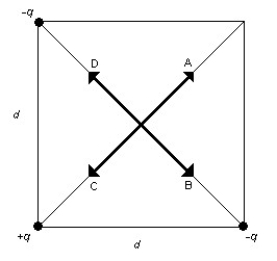 -Three equal point charges of varying signs are placed on the corners of a square of side d as shown in Figure 19-8. Which of the arrows shown represents the direction of the net electric field at the center of the square?
 (Multiple Choice)
4.8/5  (95)
(95) FIGURE 19-10 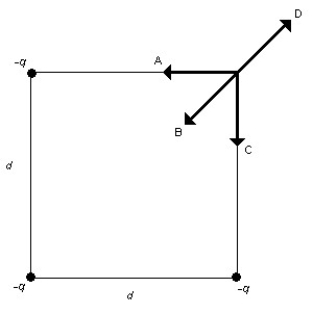 -Three equal point charges are placed at three of the corners of a square of side d as shown in Figure 19-10. Which of the arrows shown represents the direction of the net electric field at the vacant corner of the square?
 (Multiple Choice)
4.8/5 (75)
(75) Q1 = 6.0 nC is at (0.30 m, 0); Q2 = -1.0 nC is at (0, 0.10 m); Q3 = 5.0 nC is at (0, 0). What is the magnitude and direction of the net force on the 5.0 nC charge?
(Essay)
5.0/5 (89)
(89) When the distance between the two charges is doubled, the force between them is
(Multiple Choice)
4.9/5 (95)
(95) Two objects, A and B, are rubbed together. As a result, object A acquires an excess negative charge while object B becomes positively charged. In comparison to their masses before the charging process, you can say that
(Multiple Choice)
4.8/5 (76)
(76) The charge carried by one electron is e = -1.6 × 10⁻¹⁹ C. The number of electrons necessary to produce a charge of -1.0 C is
(Multiple Choice)
5.0/5 (88)
(88) Two charges, Q1 and Q2, are separated by a certain distance R. If the magnitudes of the charges are halved, and their separation is also halved, then what happens to the electrical force between these charges?
(Multiple Choice)
4.8/5 (88)
(88) 
Filters
- Essay(0)
- Multiple Choice(0)
- Short Answer(0)
- True False(0)
- Matching(0)