



 Chat with AI
Exam 19: Electric Charges, Forces, and Fields

Exam 1: Introduction to Physics100 Questions
Exam 2: One-Dimensional Kinematics112 Questions
Exam 3: Vectors in Physics82 Questions
Exam 4: Two-Dimensional Kinematics95 Questions
Exam 5: Newtons Laws of Motion101 Questions
Exam 6: Applications of Newtons Laws105 Questions
Exam 7: Work and Kinetic Energy92 Questions
Exam 8: Potential Energy and Conservation of Energy99 Questions
Exam 9: Linear Momentum and Collisions102 Questions
Exam 10: Rotational Kinematics and Energy102 Questions
Exam 11: Rotational Dynamics and Static Equilibrium97 Questions
Exam 12: Gravity94 Questions
Exam 13: Oscillations About Equilibrium102 Questions
Exam 14: Waves and Sound104 Questions
Exam 15: Fluids107 Questions
Exam 16: Temperature and Heat103 Questions
Exam 17: Phases and Phase Changes100 Questions
Exam 18: The Laws of Thermodynamics97 Questions
Exam 19: Electric Charges, Forces, and Fields88 Questions
Exam 20: Electric Potential and Electric Potential Energy99 Questions
Exam 21: Electric Current and Direct-Current Circuits99 Questions
Exam 22: Magnetism101 Questions
Exam 23: Magnetic Flux and Faradays Law of Induction99 Questions
Exam 24: Alternating-Current Circuits93 Questions
Exam 25: Electromagnetic Waves90 Questions
Exam 26: Geometrical Optics92 Questions
Exam 27: Optical Instruments102 Questions
Exam 28: Physical Optics: Interference and Diffraction93 Questions
Exam 29: Relativity100 Questions
Exam 30: Quantum Physics100 Questions
Exam 31: Atomic Physics75 Questions
Exam 32: Nuclear Physics and Nuclear Radiation89 Questions
Select questions type


Three point charges of magnitudes + 4.0 μC, - 5.0 μC, and - 9.0 μC are placed on the x-axis at x = 0 cm, x = 40 cm, and x = 120 cm, respectively. What is the force on the - 9.0 μC charge due to the other two charges?
(Multiple Choice)
4.9/5  (87)
(87) Consider an equilateral triangle of side 20. cm. A charge of +2.0 μC is placed at one vertex and charges of -4.0 μC are placed at the other two vertices. Determine the magnitude and direction of the electric field at the center of the triangle.
(Short Answer)
4.7/5 (74)
(74) Gaussian surfaces A and B enclose the same positive charge +Q. The area of Gaussian surface A is three times larger than that of Gaussian surface B. The flux of electric field through Gaussian surface A is
(Multiple Choice)
4.7/5 (84)
(84) Two large parallel metal plates are uniformly and oppositely charged and the electric field between them is 7.6 × 10⁶ N/C.
(a) What is the charge density on each plate?
(b) If the very large charged plates are moved 2 times farther apart, what is the electric field between the plates now?
(Short Answer)
4.9/5 (68)
(68) An electron is placed in a constant electric field of 4.5 × 10⁴ N/C.
(a) What is the force on the electron?
(b) If the electron is released from rest, what is its speed after 3.0 ps?
(Short Answer)
4.7/5 (80)
(80) A metal sphere of radius 2.0 cm carries a charge of 3.0 μC. What is the electric field 6.0 cm from the center of the sphere?
(Multiple Choice)
4.8/5 (87)
(87) A charged rod carrying a negative charge is brought near two spheres that are in contact with each other but insulated from the ground. If the two spheres are then separated, what kind of charge will be on the spheres?
(Multiple Choice)
4.8/5 (74)
(74) A 5.0 μC charge is placed at the 0 cm mark of a meter stick and a -4.0 μC charge is placed at the 50 cm mark. At what point on a line joining the two charges is the electric field zero?
(Multiple Choice)
4.9/5 (74)
(74) A 5.0-μC charge is placed at the 0 cm mark of a meter stick and a -4.0 μC charge is placed at the 50 cm mark. At what point on a line joining the two charges is the electric field zero?
(Short Answer)
4.9/5 (69)
(69) Conductor A has 11 electrons and conductor B has 32 electrons. The number of valence or conduction electrons in A and B is given as
(Multiple Choice)
4.9/5 (79)
(79) When the magnitude of both interacting charges is increased by a factor of 2, the electrical forces between these charges is
(Multiple Choice)
4.9/5 (95)
(95) Conductor A has 16 electrons and conductor B has 32 electrons. The ratio of the valence electrons of conductor A and conductor B is given as
(Multiple Choice)
4.9/5 (67)
(67) Consider the x-axis with 4.0 μC at x = 1.0 meter and -2.0 μC at the origin. Where should 6.0 μC be placed so that the net force on it is zero?
(Short Answer)
4.8/5 (77)
(77) Electrical and gravitational forces follow similar equations with one main difference:
(Multiple Choice)
4.8/5 (95)
(95) FIGURE 19-5 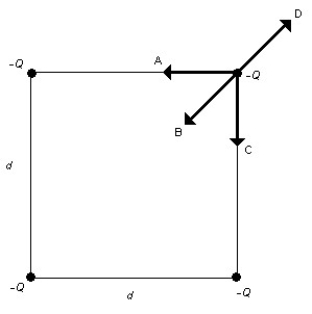 -Four point charges of equal magnitude and sign are arranged on the corners of the square of side d as shown in Figure 19-5. Which of the arrows shown represents the net force acting on the charge at the upper right hand corner of the square?
 (Multiple Choice)
4.8/5 (86)
(86) The force of attraction between a - 40.0 μC and + 108 μC charge is 4.00 N. What is the separation between these two charges?
(Multiple Choice)
4.8/5 (71)
(71) FIGURE 19-13 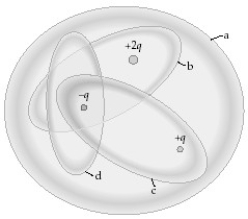 -Figure 19-13 shows four Gaussian surfaces surrounding a distribution of charges. Which Gaussian surfaces have an electric flux of +q/εo through them?
 (Multiple Choice)
4.9/5 (92)
(92) 
Filters
- Essay(0)
- Multiple Choice(0)
- Short Answer(0)
- True False(0)
- Matching(0)