



 Chat with AI
Exam 19: Electric Charges, Forces, and Fields

Exam 1: Introduction to Physics100 Questions
Exam 2: One-Dimensional Kinematics112 Questions
Exam 3: Vectors in Physics82 Questions
Exam 4: Two-Dimensional Kinematics95 Questions
Exam 5: Newtons Laws of Motion101 Questions
Exam 6: Applications of Newtons Laws105 Questions
Exam 7: Work and Kinetic Energy92 Questions
Exam 8: Potential Energy and Conservation of Energy99 Questions
Exam 9: Linear Momentum and Collisions102 Questions
Exam 10: Rotational Kinematics and Energy102 Questions
Exam 11: Rotational Dynamics and Static Equilibrium97 Questions
Exam 12: Gravity94 Questions
Exam 13: Oscillations About Equilibrium102 Questions
Exam 14: Waves and Sound104 Questions
Exam 15: Fluids107 Questions
Exam 16: Temperature and Heat103 Questions
Exam 17: Phases and Phase Changes100 Questions
Exam 18: The Laws of Thermodynamics97 Questions
Exam 19: Electric Charges, Forces, and Fields88 Questions
Exam 20: Electric Potential and Electric Potential Energy99 Questions
Exam 21: Electric Current and Direct-Current Circuits99 Questions
Exam 22: Magnetism101 Questions
Exam 23: Magnetic Flux and Faradays Law of Induction99 Questions
Exam 24: Alternating-Current Circuits93 Questions
Exam 25: Electromagnetic Waves90 Questions
Exam 26: Geometrical Optics92 Questions
Exam 27: Optical Instruments102 Questions
Exam 28: Physical Optics: Interference and Diffraction93 Questions
Exam 29: Relativity100 Questions
Exam 30: Quantum Physics100 Questions
Exam 31: Atomic Physics75 Questions
Exam 32: Nuclear Physics and Nuclear Radiation89 Questions
Select questions type


A proton is placed in an electric field of intensity 700 N/C. What is the magnitude and direction of the acceleration of this proton due to this field?
(Multiple Choice)
4.8/5  (87)
(87) Two point charges of + 20.0 μC and - 8.00 μC are separated by a distance of 20.0 cm. What is the intensity of electric field E midway between these two charges?
(Multiple Choice)
4.8/5 (89)
(89) Three point charges are located at the following positions: Q1 = 2.00 μC at x = 1.00 m; Q2 = 3.00 μC at x = 0; Q3 = -5.00 μC at x = -1.00 m. What is the magnitude of the force on the 3.00-μC charge?
(Multiple Choice)
4.8/5 (60)
(60) What are the magnitude and direction of the electric field at a distance of 1.50 m from a 50.0-nC charge?
(Multiple Choice)
4.8/5 (94)
(94) FIGURE 19-12 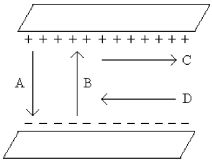 -Which of the arrows shown in Figure 19-12 represents the correct direction of the electric field between the two metal plates?
 (Multiple Choice)
4.9/5 (74)
(74) Two coins carry identical charges. These two coins are lying 2.50 m apart on a table. If each of these coins experiences a force of 2.00 N, how large is the charge on each coin?
(Multiple Choice)
4.9/5 (86)
(86) Q1 = 6.0 nC is at (0.30 m, 0); Q2 = -1.0 nC is at (0, 0.10 m); Q3 = 5.0 nC is at (0, 0). What is the magnitude of the net force on the 5.0 nC charge?
(Multiple Choice)
4.7/5 (76)
(76) The ratio of electrical force, Fe, to the gravitational force Fg, between two electrons is
(Multiple Choice)
5.0/5 (68)
(68) The number of protons in the nucleus of an electrically neutral atom is equal to
(Multiple Choice)
4.9/5 (74)
(74) Two point charges, initially 2.0 cm apart, experience a 1.0-N force. If they are moved to a new separation of 8.0 cm, what is the electric force between them?
(Multiple Choice)
4.8/5 (87)
(87) The main difference between conductors and insulators is in terms of
(Multiple Choice)
4.9/5 (64)
(64) A metal sphere of radius 2.0 cm carries a charge of 3.0 μC. What is the electric field 6.0 cm from the center of the sphere?
(Short Answer)
4.9/5 (85)
(85) There is a 5.0 μC charge at each of 3 corners of a square (each side 70. mm long). What is the force on +6.0 μC placed at the center of the square?
(Short Answer)
4.9/5 (74)
(74) A styrofoam ball of mass 0.120 g is placed in an electric field of 6000 N/C pointing downward. What charge must be placed on the ball for it to be suspended?
(Multiple Choice)
4.8/5 (73)
(73) Three point charges are placed on the x-axis. A charge of +2.0 μC is placed at the origin, -2.0 μC to the right at x = 50 cm, and +4.0 μC at the 100 cm mark. What are the magnitude and direction of the electrostatic force which acts on the charge at the origin?
(Multiple Choice)
4.7/5 (79)
(79) Two point charges of + 40.0 μC and - 10.0 μC are separated by a distance of 20.0 cm. A +7.00 μC charge is placed midway between these two charges. What is the electric force acting on this charge because of the other two charges?
(Multiple Choice)
4.8/5 (82)
(82) Two charges, Q1 and Q2, are separated by a certain distance R. If the magnitudes of the charges are doubled and their separation is also doubled, then what happens to the electrical force between these two charges?
(Multiple Choice)
4.8/5 (75)
(75) If a conductor is placed in an electric field under electrostatic conditions, the electric field is excluded from the inside of the conductor.
(True/False)
4.8/5 (71)
(71) FIGURE 19-14 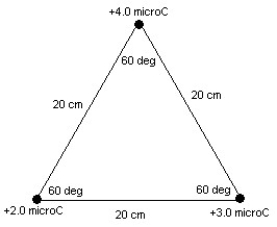 -Two point charges of magnitudes + 5.00 μC, and + 7.00 μC are placed along the x-axis at x = 0 cm and x = 100 cm, respectively. Where must a third charge be placed along the x-axis so that it does not experience any net force because of the other two charges?
 (Multiple Choice)
4.8/5 (77)
(77) FIGURE 19-3 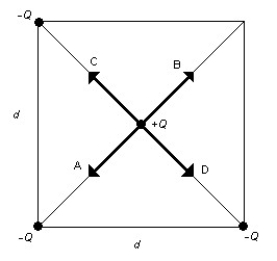 -Four point charges of equal magnitude but with varying signs are arranged on three of the corners and at the center of the square of side d as shown in Figure 19-3. Which of the arrows shown represents the net force acting on the center charge?
 (Multiple Choice)
5.0/5 (84)
(84) 
Filters
- Essay(0)
- Multiple Choice(0)
- Short Answer(0)
- True False(0)
- Matching(0)