



 Chat with AI
Exam 19: Electric Charges, Forces, and Fields

Exam 1: Introduction to Physics100 Questions
Exam 2: One-Dimensional Kinematics112 Questions
Exam 3: Vectors in Physics82 Questions
Exam 4: Two-Dimensional Kinematics95 Questions
Exam 5: Newtons Laws of Motion101 Questions
Exam 6: Applications of Newtons Laws105 Questions
Exam 7: Work and Kinetic Energy92 Questions
Exam 8: Potential Energy and Conservation of Energy99 Questions
Exam 9: Linear Momentum and Collisions102 Questions
Exam 10: Rotational Kinematics and Energy102 Questions
Exam 11: Rotational Dynamics and Static Equilibrium97 Questions
Exam 12: Gravity94 Questions
Exam 13: Oscillations About Equilibrium102 Questions
Exam 14: Waves and Sound104 Questions
Exam 15: Fluids107 Questions
Exam 16: Temperature and Heat103 Questions
Exam 17: Phases and Phase Changes100 Questions
Exam 18: The Laws of Thermodynamics97 Questions
Exam 19: Electric Charges, Forces, and Fields88 Questions
Exam 20: Electric Potential and Electric Potential Energy99 Questions
Exam 21: Electric Current and Direct-Current Circuits99 Questions
Exam 22: Magnetism101 Questions
Exam 23: Magnetic Flux and Faradays Law of Induction99 Questions
Exam 24: Alternating-Current Circuits93 Questions
Exam 25: Electromagnetic Waves90 Questions
Exam 26: Geometrical Optics92 Questions
Exam 27: Optical Instruments102 Questions
Exam 28: Physical Optics: Interference and Diffraction93 Questions
Exam 29: Relativity100 Questions
Exam 30: Quantum Physics100 Questions
Exam 31: Atomic Physics75 Questions
Exam 32: Nuclear Physics and Nuclear Radiation89 Questions
Select questions type


FIGURE 19-1  -Three equal charges are at three of the corners of a square of side d. A fourth charge of equal magnitude is at the center of the square as shown in Figure 19-1. Which of the arrows shown represents the net force acting on the charge at the center of the square?
 (Multiple Choice)
4.9/5  (61)
(61) A particle with a charge of 4.0 μC has a mass of 5.0 × 10⁻³ kg. What electric field directed upward will exactly balance the weight of the particle?
(Multiple Choice)
4.8/5 (93)
(93) FIGURE 19-11  -Three equal point charges of varying signs are placed on three of the corners of a square of side d as shown in Figure 19-11. Which of the arrows shown represents the direction of the net electric field at the vacant corner of the square?
 (Multiple Choice)
4.8/5 (80)
(80) Thirty microcoulombs of NEGATIVE charge experiences an electrostatic force of 27. mN. What is the magnitude and direction of the electric field?
(Essay)
4.9/5 (93)
(93) An atomic nucleus has a charge of +40e. An electron is 10-9 m from the nucleus. What is the force on the electron?
(Multiple Choice)
4.8/5 (84)
(84) An electron is held up against the force of gravity by the attraction of a fixed proton some distance above it. How far above the electron is the proton?
(Multiple Choice)
4.7/5 (82)
(82) FIGURE 19-2  -Four point charges of equal magnitudes but with varying signs are arranged on three of the corners and at the center of the square of side d as shown in Figure 19-2. Which of the arrows shown represents the net force acting on the center charge?
 (Multiple Choice)
4.9/5 (60)
(60) A 1.0-C charge is 15 m from a second charge, and the force between them is 1.0 N. What is the magnitude of the second charge?
(Multiple Choice)
5.0/5 (74)
(74) A point charge Q = 7.00 × 10⁻⁹ C is placed at the origin of an xy-coordinate system. What is the electric field intensity E at a distance of x = 30 cm from this charge? (Use k = 9 × 10⁹ Nm2/C2.)
(Multiple Choice)
4.9/5 (68)
(68) A charged particle traveling along the +x axis enters an electric field directed vertically upward along the +y-axis. If the charged particle experiences a force downward because of this field, what is the sign of the charge on this particle?
(Multiple Choice)
4.9/5 (92)
(92) Figure 19-13 shows four Gaussian surfaces surrounding a distribution of charges. Which Gaussian surfaces have no electric flux through them?
(Multiple Choice)
4.8/5 (86)
(86) Three point charges are placed on the x-axis. A charge of +2.0 μC is placed at the origin, -2.0 μC to the right at x = 50 cm, and +4.0 μC at the 100 cm mark. What are the magnitude and direction of the electrostatic force which acts on the charge at the origin?
(Short Answer)
4.8/5 (76)
(76) FIGURE 19-15 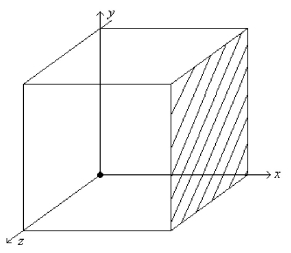 -A uniform electric field with a magnitude of 6 × 10⁶ N/C is applied to a cube of edge length 0.1 m as shown in Figure 19-15. If the direction of the E-field is along the +x-axis, what is the electric flux passing through the shaded face of the cube?
 (Multiple Choice)
4.9/5 (78)
(78) FIGURE 19-4  -Four point charges of equal magnitude and sign are arranged on three of the corners of the square of side d as shown in Figure 19-4. Which of the arrows shown represents the net force acting on the charge at the upper right hand corner of the square?
 (Multiple Choice)
4.8/5 (81)
(81) Electric field lines and equipotential lines meet perpendicular to one another.
(True/False)
4.9/5 (91)
(91) A 5.0-C charge is 10 m from a small test charge. What is the magnitude and direction of the electric field at the location of the test charge?
(Essay)
4.8/5 (84)
(84) FIGURE 19-14  -Three point charges of magnitude +2.0 μC, +3.0 μC, +4.0 μC are located at the corners of a triangle as shown in Figure 19-14 The resultant force acting on the +4.0 μC charge is given by
 (Multiple Choice)
4.9/5 (85)
(85) 
Filters
- Essay(0)
- Multiple Choice(0)
- Short Answer(0)
- True False(0)
- Matching(0)