



 Chat with AI
Exam 15: Fluids

Exam 1: Introduction to Physics100 Questions
Exam 2: One-Dimensional Kinematics112 Questions
Exam 3: Vectors in Physics82 Questions
Exam 4: Two-Dimensional Kinematics95 Questions
Exam 5: Newtons Laws of Motion101 Questions
Exam 6: Applications of Newtons Laws105 Questions
Exam 7: Work and Kinetic Energy92 Questions
Exam 8: Potential Energy and Conservation of Energy99 Questions
Exam 9: Linear Momentum and Collisions102 Questions
Exam 10: Rotational Kinematics and Energy102 Questions
Exam 11: Rotational Dynamics and Static Equilibrium97 Questions
Exam 12: Gravity94 Questions
Exam 13: Oscillations About Equilibrium102 Questions
Exam 14: Waves and Sound104 Questions
Exam 15: Fluids107 Questions
Exam 16: Temperature and Heat103 Questions
Exam 17: Phases and Phase Changes100 Questions
Exam 18: The Laws of Thermodynamics97 Questions
Exam 19: Electric Charges, Forces, and Fields88 Questions
Exam 20: Electric Potential and Electric Potential Energy99 Questions
Exam 21: Electric Current and Direct-Current Circuits99 Questions
Exam 22: Magnetism101 Questions
Exam 23: Magnetic Flux and Faradays Law of Induction99 Questions
Exam 24: Alternating-Current Circuits93 Questions
Exam 25: Electromagnetic Waves90 Questions
Exam 26: Geometrical Optics92 Questions
Exam 27: Optical Instruments102 Questions
Exam 28: Physical Optics: Interference and Diffraction93 Questions
Exam 29: Relativity100 Questions
Exam 30: Quantum Physics100 Questions
Exam 31: Atomic Physics75 Questions
Exam 32: Nuclear Physics and Nuclear Radiation89 Questions
Select questions type


A 100-kg person sits on a 5-kg bicycle. The weight is borne equally by the two wheels of the bicycle. The tires are inflated to a gauge pressure of 8.0 x 10⁵ Pa and are 2.0 cm wide. What length of each tire is in contact with the ground?
(Multiple Choice)
4.9/5  (76)
(76) A cubical box 25.00 cm on each side is immersed in a fluid. The pressure at the top surface of the box is 109.4 kPa and the pressure on the bottom surface is 112 kPa. What is the density of the fluid?
(Multiple Choice)
4.9/5 (80)
(80) A U-tube with a cross-sectional area of 1.00 cm2 is open to the atmosphere at both ends. Water is poured into the tube until the water rises part-way along the straight sides, and then 5.00 cm3 of oil is poured into one end. As a result, the top surface of the oil ends up 0.550 cm higher than the water surface on the other side of the U. What is the density of the oil?
(Short Answer)
5.0/5 (85)
(85) FIGURE 15-14 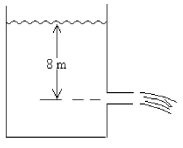 -Water flows out of a large reservoir through an open pipe, as shown in Figure 15-14. What is the speed of the water as it comes out of the pipe?
 (Multiple Choice)
4.9/5 (79)
(79) FIGURE 15-20 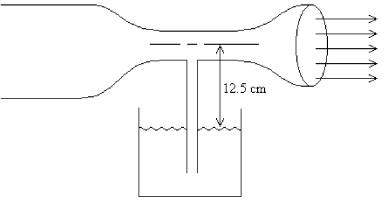 -A paint sprayer pumps air through a constriction in a 2.50-cm diameter pipe, as shown in Figure 15-20. The flow causes the pressure in the constricted area to drop and paint rises up the feed tube and enters the air stream. The air stream in the 2.50-cm diameter sections is 5.00 m/s. The density of the air is 1.29 kg/m3, and the density of the paint is 1200 kg/m3. What is the maximum diameter of the constriction that will allow the sprayer to operate?
 (Multiple Choice)
4.8/5 (79)
(79) FIGURE 15-17 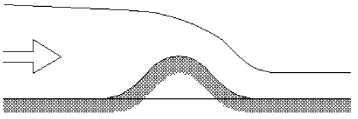 -Water flows over the overflow structure shown in Figure 15-17. Upstream the depth is 6.00 m and the speed of the water is 2.00 m/s. What is the depth downstream? Note that the top surface of the water is at atmospheric pressure.
 (Multiple Choice)
4.9/5 (79)
(79) FIGURE 15-14
-Water flows with a speed of 2.00 m/s through a horizontal 15-cm diameter pipe, as shown in Figure 15-16. A tube, called a Pitot tube, enters the pipe and is bent along the centerline of the pipe to face the oncoming flow. Water enters the tube and rises until the hydrostatic pressure in the tube balances the pressure at the mouth of the tube. Because no more water enters the tube, the speed of the water just outside the mouth of the tube is zero m/s. The pressure in the part of the pipe unaffected by the Pitot tube is 10.0 kPa. How high does the water rise in the tube?
-Water flows with a speed of 2.00 m/s through a horizontal 15-cm diameter pipe, as shown in Figure 15-16. A tube, called a Pitot tube, enters the pipe and is bent along the centerline of the pipe to face the oncoming flow. Water enters the tube and rises until the hydrostatic pressure in the tube balances the pressure at the mouth of the tube. Because no more water enters the tube, the speed of the water just outside the mouth of the tube is zero m/s. The pressure in the part of the pipe unaffected by the Pitot tube is 10.0 kPa. How high does the water rise in the tube? (Multiple Choice)
4.8/5 (69)
(69) FIGURE 15-19 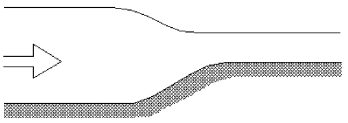 -Water flows in an open channel that is 2.00 m wide. The water surface is 3.00 m above the bottom of the channel. At a certain point, the elevation of the bottom of the channel rises by 1.00 m and the water surface dips down 0.500 m as shown in Figure 15-19. The top surface of the water is at atmospheric pressure. What volume of water is flowing in the channel per unit time?
 (Multiple Choice)
4.9/5 (86)
(86) A 1938 nickel has a diameter of 21.21 mm, a thickness of 1.95 mm, and weighs 0.04905 N. What is its density?
(Multiple Choice)
4.9/5 (70)
(70) The fact that a dew drop is spherical is best described in terms of
(Multiple Choice)
4.8/5 (79)
(79) FIGURE 15-18 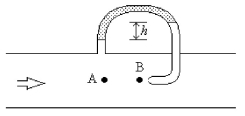 -Water flows through the 30.0-cm diameter pipe shown in Figure 15-18. An open tube is flush with an opening in the pipe at A and enters the pipe at B and is bent along the centerline of the pipe to face the oncoming flow. Water enters the tube and rises until the hydrostatic pressure in the tube balances the pressure at the mouth of the tube. Because no more water enters the tube, the speed of the water just outside the mouth of the tube is zero m/s. What is the manometer reading if the speed of the water in the pipe is 1.20 m/s? The manometer fluid is oil with a density of 800 kg/m3.
 (Multiple Choice)
4.8/5 (87)
(87) Water is flowing through a V-shaped weir, which has a 30° vertex. The flow rate is 7.0 x 10⁴ kg/s and the speed of the flow is 5.0 m/s. What is the distance from the surface of the water to the vertex?
(Multiple Choice)
4.8/5 (78)
(78) An incompressible fluid flows steadily through a pipe that has a change in diameter. The fluid speed at a location where the pipe diameter is 8.0 cm is 1.28 m/s. What is the fluid speed at a location where the diameter has narrowed to 4.0 cm?
(Multiple Choice)
4.9/5 (82)
(82) FIGURE 15-9 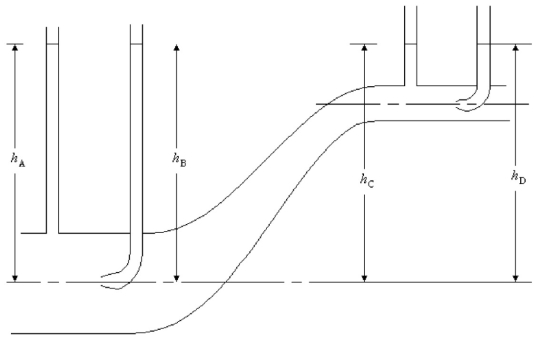 -Water flows in a pipe as shown in Figure 15-9. The pipe is horizontal at points A and B, where it has a diameter of 3.00 cm and the water is moving at 2.00 m/s. The pipe then rises 2.00 m in elevation while decreasing in diameter and is again horizontal at points C and D, where it has a diameter of 2.00 cm. Vertical tubes, open at the top, are connected to the pipe at A and C, flush with the edge of the pipe. The vertical tubes at B and D are also open at the top, but these enter the pipe and bend at right angles along the centerline of the pipe with their mouths facing the flow (these are Pitot tubes). Water enters the Pitot tube and rises until the hydrostatic pressure in the tube balances the pressure at the mouth of the tube. Because no more water enters the tube, the speed of the water just outside the mouth of the tube is zero m/s. The pressure in the pipe is unaffected by the Pitot tube. What is the difference in elevation (hD - hA)?
 (Multiple Choice)
4.9/5 (72)
(72) Consider ice cubes floating in a glass of water. What will happen to the level of the water as the ice melts?
(Essay)
4.9/5 (86)
(86) To determine gauge pressure, add the atmospheric pressure to the absolute pressure.
(True/False)
4.9/5 (86)
(86) A 1959 penny has a diameter of 19.55 mm, a thickness of 1.55 mm, and a mass of 2.500 g. What is its density?
(Multiple Choice)
4.7/5 (89)
(89) 
Filters
- Essay(0)
- Multiple Choice(0)
- Short Answer(0)
- True False(0)
- Matching(0)