



 Chat with AI
Exam 15: Fluids

Exam 1: Introduction to Physics100 Questions
Exam 2: One-Dimensional Kinematics112 Questions
Exam 3: Vectors in Physics82 Questions
Exam 4: Two-Dimensional Kinematics95 Questions
Exam 5: Newtons Laws of Motion101 Questions
Exam 6: Applications of Newtons Laws105 Questions
Exam 7: Work and Kinetic Energy92 Questions
Exam 8: Potential Energy and Conservation of Energy99 Questions
Exam 9: Linear Momentum and Collisions102 Questions
Exam 10: Rotational Kinematics and Energy102 Questions
Exam 11: Rotational Dynamics and Static Equilibrium97 Questions
Exam 12: Gravity94 Questions
Exam 13: Oscillations About Equilibrium102 Questions
Exam 14: Waves and Sound104 Questions
Exam 15: Fluids107 Questions
Exam 16: Temperature and Heat103 Questions
Exam 17: Phases and Phase Changes100 Questions
Exam 18: The Laws of Thermodynamics97 Questions
Exam 19: Electric Charges, Forces, and Fields88 Questions
Exam 20: Electric Potential and Electric Potential Energy99 Questions
Exam 21: Electric Current and Direct-Current Circuits99 Questions
Exam 22: Magnetism101 Questions
Exam 23: Magnetic Flux and Faradays Law of Induction99 Questions
Exam 24: Alternating-Current Circuits93 Questions
Exam 25: Electromagnetic Waves90 Questions
Exam 26: Geometrical Optics92 Questions
Exam 27: Optical Instruments102 Questions
Exam 28: Physical Optics: Interference and Diffraction93 Questions
Exam 29: Relativity100 Questions
Exam 30: Quantum Physics100 Questions
Exam 31: Atomic Physics75 Questions
Exam 32: Nuclear Physics and Nuclear Radiation89 Questions
Select questions type


The buoyant force acting on an object is equal to the weight of the object.
(True/False)
4.8/5  (78)
(78) The weight of a 1200-kg car is supported equally by the four tires, which are inflated to the same gauge pressure. What gauge pressure is required so the area of contact of each tire with the road is 100 cm2?
(Multiple Choice)
4.8/5 (85)
(85) A fluid is flowing with an average speed of 1.50 m/s through a tube that has a radius of 2.00 mm and is 18 cm long. The drop in pressure is 967 Pa. What is the viscosity of the fluid?
(Multiple Choice)
4.9/5 (75)
(75) FIGURE 15-1  -Each of the three containers shown in Figure 15-1 weighs the same amount and is filled with water to the same level. All three have the same surface area in contact with the table. Which of the following statements are true?
I. The pressure at the bottom surface of the container is the same for all three containers.
II. The force exerted by the water on the bottom surface of the container is the same
For all three containers.
III. The force exerted by the container on the table is the same for all three containers.
-Each of the three containers shown in Figure 15-1 weighs the same amount and is filled with water to the same level. All three have the same surface area in contact with the table. Which of the following statements are true?
I. The pressure at the bottom surface of the container is the same for all three containers.
II. The force exerted by the water on the bottom surface of the container is the same
For all three containers.
III. The force exerted by the container on the table is the same for all three containers. (Multiple Choice)
5.0/5 (75)
(75) FIGURE 15-8  -A cylinder, semicircular in cross-section, 10.0 m long and 5.00 m in radius, is completely submerged, with its flat 5.00 m × 10.0 m side horizontal and 8,00 m below the water surface, as shown in Figure 15-8. What is the force on the curved surface of the half-cylinder? Neglect atmospheric pressure.
 (Multiple Choice)
4.8/5 (82)
(82) A boat loaded with ice is floating in a swimming pool. If the ice is thrown into the pool, the water level in the pool, once the ice stops bobbing and floats steadily,
(Multiple Choice)
4.9/5 (72)
(72) FIGURE 15-12 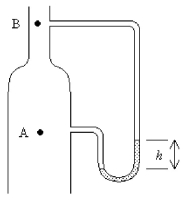 -Water flows in the vertical pipe shown in Figure 15-12. At A the area is 25.0 cm2 and the speed of the water is 3.30 m/s. At B the area is 16.0 cm2. The fluid in the manometer is mercury, which has a density of 13,600 kg/m3. What is the manometer reading h?
 (Multiple Choice)
4.7/5 (82)
(82) Consider three drinking glasses. All three have the same area base, and all three are filled to the same depth with water. Glass A is cylindrical. Glass B is wider at the top than at the bottom, and so holds more water than A. Glass C is narrower at the top than at the bottom, and so holds less water than A. Which glass has the greatest liquid pressure at the bottom?
(Multiple Choice)
4.9/5 (72)
(72) Salt water is more dense than fresh water. A ship floats in both fresh water and salt water. Compared to the fresh water, the volume of water displaced in the salt water is
(Multiple Choice)
4.8/5 (81)
(81) The flow of water emerging from a hole in a container is best described in terms of
(Multiple Choice)
4.9/5 (87)
(87) When atmospheric pressure changes, what happens to the absolute pressure at the bottom of a pool?
(Multiple Choice)
4.9/5 (67)
(67) A U-tube is open to the atmosphere at both ends. Water is poured into the tube until the water rises part-way along the straight sides, and then some oil with a density of 920 kg/m3 is poured into one end. This causes the water surface on that side of the tube to go down by 5.50 mm and the surface on the other side to go up by the same amount. How much higher is the top surface of the oil on that side of the tube compared with the surface of the water on the other side of the tube?
(Multiple Choice)
4.8/5 (92)
(92) Motor oil, with a viscosity of 0.250 Ns/m2, is flowing through a tube that has a radius of 3.00 mm and is 1.00 m long. The drop in pressure is 200 kPa. What is the average speed of the oil?
(Multiple Choice)
4.7/5 (73)
(73) FIGURE 15-10 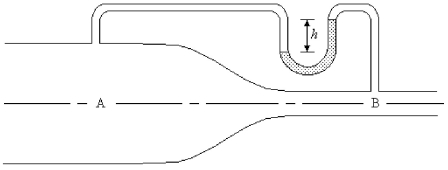 -Water flows in the horizontal pipe shown in Figure 15-10. At A the area is 25.0 cm2 and the speed of the water is 2.80 m/s. At B the area is 16.0 cm2. The fluid in the manometer is mercury, which has a density of 13,600 kg/m3. What is the manometer reading h?
 (Multiple Choice)
4.9/5 (84)
(84) FIGURE 15-2  -Water flows in a pipe as shown in Figure 15-2. The pipe is horizontal at points A and B, then rises in elevation while decreasing in diameter and is again horizontal at points C and D. The vertical tubes at B and D are open at the top, but they enter the pipe and bend at right angles along the centerline of the pipe with their mouths facing the flow (these are Pitot tubes). Water enters the Pitot tube and rises until the hydrostatic pressure in the tube balances the pressure at the mouth of the tube. Because no more water enters the tube, the speed of the water just outside the mouth of the tube is zero m/s. The pressure in the pipe is unaffected by the Pitot tube. Which of the following statements is correct?
 (Multiple Choice)
4.8/5 (75)
(75) The buoyant force acts through the center of mass of the displaced fluid.
(True/False)
4.8/5 (99)
(99) The pressure drop in a tube carrying a viscous fluid is described by
(Multiple Choice)
4.8/5 (81)
(81) The density of air is 1.29 kg/m3. What is the mass of the air inside a room 4.0 m × 3.0 m × 2.0 m?
(Multiple Choice)
4.7/5 (91)
(91) 
Filters
- Essay(0)
- Multiple Choice(0)
- Short Answer(0)
- True False(0)
- Matching(0)