



 Chat with AI
Exam 15: Fluids

Exam 1: Introduction to Physics100 Questions
Exam 2: One-Dimensional Kinematics112 Questions
Exam 3: Vectors in Physics82 Questions
Exam 4: Two-Dimensional Kinematics95 Questions
Exam 5: Newtons Laws of Motion101 Questions
Exam 6: Applications of Newtons Laws105 Questions
Exam 7: Work and Kinetic Energy92 Questions
Exam 8: Potential Energy and Conservation of Energy99 Questions
Exam 9: Linear Momentum and Collisions102 Questions
Exam 10: Rotational Kinematics and Energy102 Questions
Exam 11: Rotational Dynamics and Static Equilibrium97 Questions
Exam 12: Gravity94 Questions
Exam 13: Oscillations About Equilibrium102 Questions
Exam 14: Waves and Sound104 Questions
Exam 15: Fluids107 Questions
Exam 16: Temperature and Heat103 Questions
Exam 17: Phases and Phase Changes100 Questions
Exam 18: The Laws of Thermodynamics97 Questions
Exam 19: Electric Charges, Forces, and Fields88 Questions
Exam 20: Electric Potential and Electric Potential Energy99 Questions
Exam 21: Electric Current and Direct-Current Circuits99 Questions
Exam 22: Magnetism101 Questions
Exam 23: Magnetic Flux and Faradays Law of Induction99 Questions
Exam 24: Alternating-Current Circuits93 Questions
Exam 25: Electromagnetic Waves90 Questions
Exam 26: Geometrical Optics92 Questions
Exam 27: Optical Instruments102 Questions
Exam 28: Physical Optics: Interference and Diffraction93 Questions
Exam 29: Relativity100 Questions
Exam 30: Quantum Physics100 Questions
Exam 31: Atomic Physics75 Questions
Exam 32: Nuclear Physics and Nuclear Radiation89 Questions
Select questions type


Salt water has greater density than fresh water. A boat floats in both fresh water and in salt water. Where is the buoyant force greater on the boat?
(Multiple Choice)
4.9/5  (71)
(71) A 12,000-N car is raised using a hydraulic lift, which consists of a U-tube with arms of unequal areas, filled with oil with a density of 800 kg/m3 and capped at both ends with tight-fitting pistons. The wider arm of the U-tube has a radius of 18.0 cm and the narrower arm has a radius of 5.00 cm. The car rests on the piston on the wider arm of the U-tube. The pistons are initially at the same level. What is the force that must be applied to the smaller piston in order to lift the car after it has been raised 1.20 m? For purposes of this problem, neglect the weight of the pistons.
(Multiple Choice)
4.7/5 (80)
(80) The Aswan High Dam is 111 m high. What is the water pressure at the foot of the dam?
(Multiple Choice)
4.9/5 (93)
(93) An object floats on a fluid if its density is less than that of the fluid.
(True/False)
4.9/5 (87)
(87) A person weighting 700 N stands in the middle of an otherwise empty 4 m x 5 m x 3 m room. How does the weight of the person compare with the weight of the air (the density of air is 1.29 kg/m3) in the room?
(Multiple Choice)
4.9/5 (81)
(81) An airplane is flying in air with a density of 1.29 kg/m3. A pressure gauge measures the difference in pressure between a point on the nose of the airplane and a point on the fuselage. The pressure on the nose is higher by 60.0 kPa. What is the speed of the plane relative to the air?
(Multiple Choice)
4.8/5 (79)
(79) What is the difference between the pressures inside and outside a tire called?
(Multiple Choice)
4.8/5 (89)
(89) Air is flowing through a rocket nozzle. Inside the rocket the air has a density of 5.25 kg/m3 and a speed of 1.20 m/s. The interior diameter of the rocket is 15.0 cm. At the nozzle exit, the diameter is 2.50 cm and the density is 1.29 kg/m3. What is the speed of the air when it leaves the nozzle?
(Multiple Choice)
4.9/5 (87)
(87) FIGURE 15-3  -The U-tube shown in Figure 15-3 contains mercury with a density of 13,600 kg/m3. It is open on one end and the other end is connected to a boiler, which contains water at high pressure. The water from the boiler pushes directly on the mercury column. What is the gauge pressure at point A in the boiler?
 (Multiple Choice)
4.8/5 (82)
(82) FIGURE 15-11 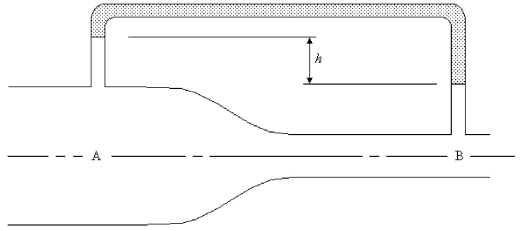 -Water flows in the horizontal pipe shown in Figure 15-11. At A the diameter is 6.00 cm and at B the diameter is 5.00 cm. The fluid in the manometer is oil, which has a density of 800 kg/m3. The manometer reading h is 10.0 cm. What is the speed of the water at B?
 (Multiple Choice)
4.8/5 (79)
(79) FIGURE 15-17 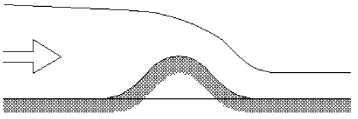 -Water flows over the overflow structure shown in Figure 15-17. The depth of water upstream is 2.00 m and downstream it is 50.0 cm. What volume of water flows over the structure per second per meter of width?
 (Multiple Choice)
4.9/5 (66)
(66) When soup gets cold, it often tastes greasy. This "greasy" taste seems to be associated with oil spreading out all over the surface of the soup, instead of staying in little globules. This is readily explained in terms of
(Multiple Choice)
4.7/5 (90)
(90) FIGURE 15-18 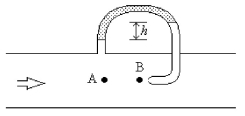 -Water flows through the 30.0-cm diameter pipe shown in Figure 15-18. An open tube is flush with an opening in the pipe at A and enters the pipe at B and is bent along the centerline of the pipe to face the oncoming flow, as shown in the figure. Water enters the tube and rises until the hydrostatic pressure in the tube balances the pressure at the mouth of the tube. Because no more water enters the tube, the speed of the water just outside the mouth of the tube is zero m/s. What is the speed of the water in the pipe if the manometer reading is 8.50 cm? The manometer fluid is oil with a density of 800 kg/m3.
 (Multiple Choice)
4.7/5 (75)
(75) FIGURE 15-10 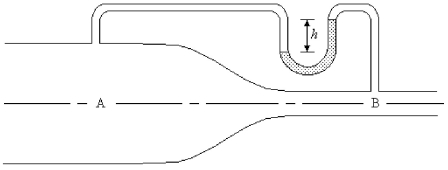 -Water flows in the horizontal pipe shown in Figure 15-10. At A the diameter is 5.00 cm and at B the diameter is 4.00 cm. The fluid in the manometer is mercury, which has a density of 13,600 kg/m3. The manometer reading h is 3.60 cm. What volume of water is flowing through the pipe per second?
 (Multiple Choice)
4.9/5 (81)
(81) Water is flowing in a drainage channel of rectangular cross-section. At one point, the width of the channel is 12 m, the depth of water is 6.0 m, and the speed of the flow is 2.5 m/s. At a point downstream, the width has narrowed to 9.0 m, and the depth of water is 8.0 m. What is the speed of the flow at the second point?
(Multiple Choice)
4.8/5 (83)
(83) A barge is 10.0 m wide and 60.0 m long and has vertical sides. The bottom of the hull is 1.20 m below the water surface. What is the weight of the barge and its cargo, if it is floating in fresh water?
(Multiple Choice)
4.8/5 (79)
(79) The pressure differential across a wing cross section due to the difference in air flow is explained by
(Multiple Choice)
5.0/5 (78)
(78) 
Filters
- Essay(0)
- Multiple Choice(0)
- Short Answer(0)
- True False(0)
- Matching(0)