



 Chat with AI
Exam 15: Fluids

Exam 1: Introduction to Physics100 Questions
Exam 2: One-Dimensional Kinematics112 Questions
Exam 3: Vectors in Physics82 Questions
Exam 4: Two-Dimensional Kinematics95 Questions
Exam 5: Newtons Laws of Motion101 Questions
Exam 6: Applications of Newtons Laws105 Questions
Exam 7: Work and Kinetic Energy92 Questions
Exam 8: Potential Energy and Conservation of Energy99 Questions
Exam 9: Linear Momentum and Collisions102 Questions
Exam 10: Rotational Kinematics and Energy102 Questions
Exam 11: Rotational Dynamics and Static Equilibrium97 Questions
Exam 12: Gravity94 Questions
Exam 13: Oscillations About Equilibrium102 Questions
Exam 14: Waves and Sound104 Questions
Exam 15: Fluids107 Questions
Exam 16: Temperature and Heat103 Questions
Exam 17: Phases and Phase Changes100 Questions
Exam 18: The Laws of Thermodynamics97 Questions
Exam 19: Electric Charges, Forces, and Fields88 Questions
Exam 20: Electric Potential and Electric Potential Energy99 Questions
Exam 21: Electric Current and Direct-Current Circuits99 Questions
Exam 22: Magnetism101 Questions
Exam 23: Magnetic Flux and Faradays Law of Induction99 Questions
Exam 24: Alternating-Current Circuits93 Questions
Exam 25: Electromagnetic Waves90 Questions
Exam 26: Geometrical Optics92 Questions
Exam 27: Optical Instruments102 Questions
Exam 28: Physical Optics: Interference and Diffraction93 Questions
Exam 29: Relativity100 Questions
Exam 30: Quantum Physics100 Questions
Exam 31: Atomic Physics75 Questions
Exam 32: Nuclear Physics and Nuclear Radiation89 Questions
Select questions type


FIGURE 15-12 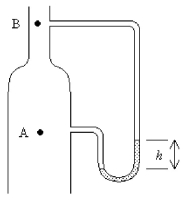 -Water flows in the vertical pipe shown in Figure 15-12. At A the diameter is 5.00 cm and at B the diameter is 4.00 cm. The fluid in the manometer is mercury, which has a density of 13,600 kg/m3. The manometer reading h is 4.50 cm. What volume of water is flowing through the pipe per second?
 (Multiple Choice)
4.9/5  (77)
(77) The upward pressure on the bottom surface of a submerged object is less than the downward pressure on its top surface.
(True/False)
4.8/5 (70)
(70) FIGURE 15-5  -A reservoir manometer consists of a U-tube in which the two arms have different diameters, as shown in Figure 15-5. The diameter on the narrow side is 10.0 mm and the diameter on the reservoir side is 25.0 mm. The liquid in the manometer is oil with a density of 830 kg/m3 and the fluids in contact with the oil are gases of negligible density. The dotted line indicates the level of the oil when the pressures p1 and p2 are equal. What is the value of h when p1 - p2 = 1000 Pa?
 (Multiple Choice)
4.9/5 (81)
(81) Substance A has a density of 3.0 g/cm3 and substance B has a density of 4.0 g/cm3. In order to obtain equal masses of these two substances, the ratio of the volume of A to the volume of B will be equal to
(Multiple Choice)
4.9/5 (96)
(96) "An external pressure applied to an enclosed fluid is transmitted unchanged to every point within the fluid" is known as
(Multiple Choice)
4.8/5 (67)
(67) When you blow some air above a paper strip, the paper rises. This is because
(Multiple Choice)
4.9/5 (83)
(83) The small piston of a hydraulic lift has a diameter of 8.0 cm, and its large piston has a diameter of 40 cm. The lift raises a load of 15,000 N.
(a) Determine the force that must be applied to the small piston.
(b) Determine the pressure applied to the fluid in the lift.
(Short Answer)
4.8/5 (83)
(83) The bathyscaphe Trieste consists of a cylindrical hull, 15.2 m long and 3.66 m in diameter, filled with gasoline with a density of 880 kg/m3 to make it buoyant. If it is totally submerged in salt water with a density of 1025 kg/m3 and neither rising nor sinking, what is the weight of the craft?
(Multiple Choice)
4.9/5 (71)
(71) Glycerin, with a viscosity of 1.50 Ns/m2, is flowing with an average speed of 1.20 m/s through a tube that has a radius of 5.00 mm and is 25.0 cm long. What is the drop in pressure?
(Multiple Choice)
4.8/5 (79)
(79) FIGURE 15-13 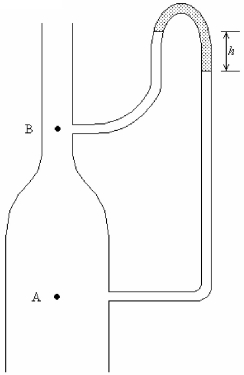 -Water flows in the vertical pipe shown in Figure 15-13. At A the area is 25.0 cm2 and the speed of the water is 0.750 m/s. At B the area is 16.0 cm2. The fluid in the manometer is oil, which has a density of 800 kg/m3. What is the manometer reading h?
 (Multiple Choice)
4.9/5 (73)
(73) A flask of water rests on a scale. If you dip your finger into the water, without touching the flask, the reading on the scale will
(Multiple Choice)
4.7/5 (72)
(72) FIGURE 15-11 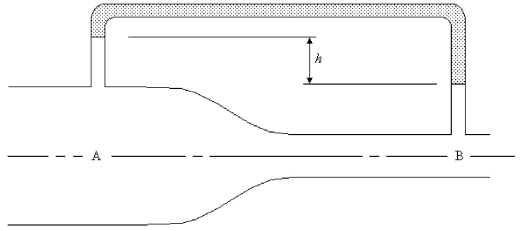 -Water flows in the horizontal pipe shown in Figure 15-11. At A the diameter is 6.00 cm and at B the diameter is 5.00 cm. The fluid in the manometer is oil, which has a density of 800 kg/m3. The manometer reading h is 9.00 cm. What volume of water is flowing through the pipe per second?
 (Multiple Choice)
4.8/5 (69)
(69) At any depth in a fluid at rest, the pressure is the same in all directions at the given depth.
(True/False)
4.7/5 (91)
(91) FIGURE 15-6  -The two water reservoirs shown in Figure 15-6 are open to the atmosphere. The manometer contains mercury with a density of 13,600 kg/m3. What is the difference in elevation h if the manometer reading m is25.0 cm?
 (Multiple Choice)
4.9/5 (81)
(81) The circular pipes shown in Figure 15-4 both contain water, but there is a pressure difference between them, (PB - PA) = 1000 Pa. They are connected by means of an upside-down U-tube, which contains oil with a density of 800 kg/m3. The heights are: hA = 5.0 cm and hB = 40.0 cm. What is hC?
(Multiple Choice)
5.0/5 (84)
(84) The fact that a pin placed carefully on the surface of the water can remain there without sinking is best explained by
(Multiple Choice)
4.8/5 (77)
(77) 
Filters
- Essay(0)
- Multiple Choice(0)
- Short Answer(0)
- True False(0)
- Matching(0)