



 Chat with AI
Exam 15: International Trade Policy

Exam 1: What Is Economics?479 Questions
Exam 2: The Economic Problem440 Questions
Exam 3: Demand and Supply515 Questions
Exam 4: Measuring GDP and Economic Growth395 Questions
Exam 5: Monitoring Jobs and Inflation407 Questions
Exam 6: Economic Growth353 Questions
Exam 7: Finance, Saving, and Investment225 Questions
Exam 8: Money, the Price Level, and Inflation578 Questions
Exam 9: The Exchange Rate and the Balance of Payments492 Questions
Exam 10: Aggregate Supply and Aggregate Demand428 Questions
Exam 11: Expenditure Multipliers469 Questions
Exam 12: The Business Cycle, Inflation, and Deflation410 Questions
Exam 13: Fiscal Policy263 Questions
Exam 14: Monetary Policy227 Questions
Exam 15: International Trade Policy200 Questions
Select questions type


Explain how governments restrict international trade and who benefits as well as who loses from the restrictions.
(Essay)
4.8/5  (75)
(75) Dumping occurs when a foreign firm sells its exports at a lower price than it costs to produce them.
(True/False)
4.9/5 (70)
(70) The idea of dynamic (i.e. changing)comparative advantage is the basis for which of the following arguments for protection from foreign competition?
(Multiple Choice)
4.8/5 (87)
(87) The reason that average labor costs are higher in the United States than in Haiti is that
(Multiple Choice)
4.9/5 (73)
(73) During the first 6 months of 2008, the United States imported more than 1.6 billion pounds of coffee. Suppose the United States is considering placing trade restrictions on the importation of coffee. What would be a potential consequence of such a trade restriction?
(Multiple Choice)
4.9/5 (80)
(80) The most efficient way to encourage the growth of an infant-industry is through a
(Multiple Choice)
4.7/5 (79)
(79) Prior to international trade, if country A has a lower price of good X than does country B, then we know definitely that
(Multiple Choice)
5.0/5 (82)
(82) The U.S.-Colombia Trade Promotion Agreement was signed on November 22, 2006, in Washington, D.C. This comprehensive trade agreement eliminated tariffs and other barriers to goods and services. Colombia will immediately eliminate tariffs on wheat, barley, peanuts, and many other products in which Columbia does not have a comparative advantage. This policy means that the price of peanuts in Columbia will become
(Multiple Choice)
4.9/5 (88)
(88) The United States imports cars from Japan. If the United States imposes a tariff on cars imported from Japan, American
(Multiple Choice)
4.8/5 (73)
(73) Increasing a tariff will ________ the domestic quantity consumed of the good, while ________ the domestic production of the good.
(Multiple Choice)
4.8/5 (68)
(68)  The figure shows the market for helicopters in the United States, where D is the domestic demand curve and S is the domestic supply curve. The United States trades helicopters with the rest of the world at a price of $36 million per helicopter.
-In the figure above, with international trade U.S. companies buy ________ helicopters per year.
The figure shows the market for helicopters in the United States, where D is the domestic demand curve and S is the domestic supply curve. The United States trades helicopters with the rest of the world at a price of $36 million per helicopter.
-In the figure above, with international trade U.S. companies buy ________ helicopters per year. (Multiple Choice)
4.8/5 (77)
(77) The United States imposes a tariff on foreign limes. How does the tariff affect the U.S. price of a lime and the production of limes in the United States?
(Essay)
4.9/5 (66)
(66) 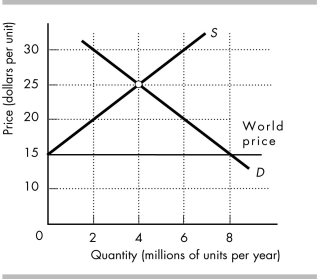 -The above figure shows the domestic supply of and domestic demand for an imported good. The world price is $15 per unit.
a)At the world price of $15 per unit, what is the domestic consumption and domestic production?
b)At the world price of $15 per unit, what is the quantity imported?
c)If the government imposes a tariff of $5 per unit, what is the domestic consumption and domestic production?
d)With the $5 per unit tariff, what is the quantity imported?
e)How much revenue does the government collect with a tariff of $5 per unit?
-The above figure shows the domestic supply of and domestic demand for an imported good. The world price is $15 per unit.
a)At the world price of $15 per unit, what is the domestic consumption and domestic production?
b)At the world price of $15 per unit, what is the quantity imported?
c)If the government imposes a tariff of $5 per unit, what is the domestic consumption and domestic production?
d)With the $5 per unit tariff, what is the quantity imported?
e)How much revenue does the government collect with a tariff of $5 per unit? (Essay)
4.9/5 (78)
(78) Reducing a tariff will ________ the domestic production of the good and ________ the total domestic consumption of the good.
(Multiple Choice)
4.8/5 (69)
(69) 
Filters
- Essay(0)
- Multiple Choice(0)
- Short Answer(0)
- True False(0)
- Matching(0)