



 Chat with AI
Exam 15: International Trade Policy

Exam 1: What Is Economics?479 Questions
Exam 2: The Economic Problem440 Questions
Exam 3: Demand and Supply515 Questions
Exam 4: Measuring GDP and Economic Growth395 Questions
Exam 5: Monitoring Jobs and Inflation407 Questions
Exam 6: Economic Growth353 Questions
Exam 7: Finance, Saving, and Investment225 Questions
Exam 8: Money, the Price Level, and Inflation578 Questions
Exam 9: The Exchange Rate and the Balance of Payments492 Questions
Exam 10: Aggregate Supply and Aggregate Demand428 Questions
Exam 11: Expenditure Multipliers469 Questions
Exam 12: The Business Cycle, Inflation, and Deflation410 Questions
Exam 13: Fiscal Policy263 Questions
Exam 14: Monetary Policy227 Questions
Exam 15: International Trade Policy200 Questions
Select questions type


 The figure shows the market for shirts in the United States, where D is the domestic demand curve and S is the domestic supply curve. The world price is $20 per shirt. The United States imposes a tariff on imported shirts, $4 per shirt.
-In the figure above, with the tariff Americans buy ________ million shirts per year.
The figure shows the market for shirts in the United States, where D is the domestic demand curve and S is the domestic supply curve. The world price is $20 per shirt. The United States imposes a tariff on imported shirts, $4 per shirt.
-In the figure above, with the tariff Americans buy ________ million shirts per year. (Multiple Choice)
4.9/5  (62)
(62) Which of the following are valid reasons advanced by almost all economists? Protectionism
(Multiple Choice)
4.9/5 (83)
(83) When a firms "dumps" some of its products in another country, it
(Multiple Choice)
4.9/5 (86)
(86) When a group lobbies for the prevention of free trade, the most likely reason is
(Multiple Choice)
4.9/5 (93)
(93) Using calculations of the cost to Americans per job saved in protected industries, it can be concluded that
(Multiple Choice)
4.8/5 (83)
(83) Economics demonstrates that opening up unrestricted free international trade is beneficial to all nations. However, are there any losers from such a policy change?
(Essay)
4.9/5 (87)
(87) If the United States imposes a tariff on imported steel, the tariff will
(Multiple Choice)
4.9/5 (58)
(58)
The figure shows the market for shirts in the United States, where D is the domestic demand curve and S is the domestic supply curve. The world price is $20 per shirt. The United States imposes a tariff on imported shirts, $4 per shirt.
-In the figure above, the tariff ________ the domestic production of shirts in the United States by ________ per year.
The figure shows the market for shirts in the United States, where D is the domestic demand curve and S is the domestic supply curve. The world price is $20 per shirt. The United States imposes a tariff on imported shirts, $4 per shirt.
-In the figure above, the tariff ________ the domestic production of shirts in the United States by ________ per year. (Multiple Choice)
4.9/5 (71)
(71) Suppose the country of Atlantica imposes a tariff on foreign-produced cars. As a result of the tariff
(Multiple Choice)
4.7/5 (90)
(90) Suppose that the country of Pacifica sold its cars in Atlantica for less than it costs to produce the cars. Pacifica could be accused of
(Multiple Choice)
5.0/5 (89)
(89) In 2006, the European Union (EU)threatened to ban imports of long-grain rice because traces of genetically modified rice were found mixed in to commercial supplies. Instead of a ban, suppose the EU placed a tariff on the import of long-grain rice. Which of the following would be an outcome of this tariff?
(Multiple Choice)
4.8/5 (81)
(81) The gains from free trade are enjoyed by a ________ number of people and the costs of free trade are imposed by a ________ number of people.
(Multiple Choice)
4.8/5 (76)
(76) A tariff imposed by the United States on Japanese cars ________ the price of cars in the United States and ________ the quantity of Japanese cars imported into the United States.
(Multiple Choice)
4.9/5 (84)
(84) In 2007, European Union (EU)negotiators have offered to cut tariffs for Latin American bananas to avoid "banana wars." What are the effects of a cut in tariffs?
(Multiple Choice)
4.7/5 (83)
(83) 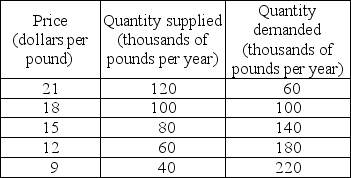 -The United States imports cheese from a variety of countries. The table above gives the domestic supply of, and demand for, cheese in the United States. The world price of cheese is $12 per pound, and trade is unrestricted.
a)How many pounds of cheese are consumed in the United States?
b)How many pounds of cheese are produced in the United States?
c)How many pounds of cheese are imported into the United States?
If a $3 per pound tariff is imposed,
d)How many pounds of cheese are consumed in the United States?
e)How many pounds of cheese are produced in the United States?
f)How many pounds of cheese are imported into the United States?
g)How much will the U.S. government collect in tariff revenue?
h)Who benefits from the tariff? Who loses?
-The United States imports cheese from a variety of countries. The table above gives the domestic supply of, and demand for, cheese in the United States. The world price of cheese is $12 per pound, and trade is unrestricted.
a)How many pounds of cheese are consumed in the United States?
b)How many pounds of cheese are produced in the United States?
c)How many pounds of cheese are imported into the United States?
If a $3 per pound tariff is imposed,
d)How many pounds of cheese are consumed in the United States?
e)How many pounds of cheese are produced in the United States?
f)How many pounds of cheese are imported into the United States?
g)How much will the U.S. government collect in tariff revenue?
h)Who benefits from the tariff? Who loses? (Essay)
4.9/5 (84)
(84) In 2013 the United States was considering imposing a tariff on solar panels imported from China. Which of the following groups would gain from this tariff?
I. U.S. consumers of solar panels
II. U.S. producers of solar panels
III. Chinese producers of solar panels
(Multiple Choice)
4.9/5 (75)
(75) 
Filters
- Essay(0)
- Multiple Choice(0)
- Short Answer(0)
- True False(0)
- Matching(0)