



 Chat with AI
Exam 15: International Trade Policy

Exam 1: What Is Economics?479 Questions
Exam 2: The Economic Problem440 Questions
Exam 3: Demand and Supply515 Questions
Exam 4: Measuring GDP and Economic Growth395 Questions
Exam 5: Monitoring Jobs and Inflation407 Questions
Exam 6: Economic Growth353 Questions
Exam 7: Finance, Saving, and Investment225 Questions
Exam 8: Money, the Price Level, and Inflation578 Questions
Exam 9: The Exchange Rate and the Balance of Payments492 Questions
Exam 10: Aggregate Supply and Aggregate Demand428 Questions
Exam 11: Expenditure Multipliers469 Questions
Exam 12: The Business Cycle, Inflation, and Deflation410 Questions
Exam 13: Fiscal Policy263 Questions
Exam 14: Monetary Policy227 Questions
Exam 15: International Trade Policy200 Questions
Select questions type


Usually the removal of trade barriers affecting a particular good benefits ________ people domestically, each of whom gains a ________.
(Multiple Choice)
4.9/5  (82)
(82) In 2006, European Union tariff on imported bananas from Latin America was €176 a ton. Suppose 2.5 million tons of bananas were imported in 2006 but then the tariff decreased to €152 a ton in 2007 and as a result, 3 million tons were imported in 2007. What is the change in tariff revenue between 2006 and 2007?
(Multiple Choice)
4.9/5 (79)
(79) In a market open to international trade, at the world price the quantity demanded is 150 and quantity supplied is 200. This country will
(Multiple Choice)
4.8/5 (85)
(85) Which of the following best describes the history of tariffs in the United States over the past 70 years?
(Multiple Choice)
4.7/5 (66)
(66) Import quotas ________ the price of imported goods and ________ the quantity consumed in the nation imposing the quota.
(Multiple Choice)
4.8/5 (74)
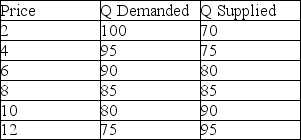
(74) Based on the table below, at what world price would the country import the good?
(Multiple Choice)
4.8/5 (81)
(81) In developing countries, there is more reliance on ________ as opposed to ________ for government revenue.
(Multiple Choice)
4.8/5 (75)
(75) 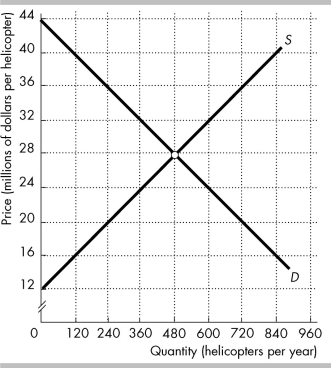 The figure shows the market for helicopters in the United States, where D is the domestic demand curve and S is the domestic supply curve. The United States trades helicopters with the rest of the world at a price of $36 million per helicopter.
-In the figure above, with international trade ________ helicopters per year are produced in the United States.
The figure shows the market for helicopters in the United States, where D is the domestic demand curve and S is the domestic supply curve. The United States trades helicopters with the rest of the world at a price of $36 million per helicopter.
-In the figure above, with international trade ________ helicopters per year are produced in the United States. (Multiple Choice)
4.8/5 (74)
(74) An import quota directly restricts ________ and are designed to protect domestic ________.
(Multiple Choice)
4.9/5 (75)
(75) A U.S. tariff on textiles would ________ U.S. prices on clothing and ________ the number of jobs in the U.S. textile industry.
(Multiple Choice)
4.8/5 (69)
(69) Which of the following is an explanation for the existence of trade restrictions?
(Multiple Choice)
5.0/5 (90)
(90) If the United States imposes a tariff on imported cars, the
(Multiple Choice)
4.8/5 (72)
(72) During 2010, as oil and gas prices continued to increase, a growing number of Americans called for the United States to become less reliant on Middle-Eastern oil. Would it make sense for the United States to try to become totally self-reliant in the production of oil? Why or why not?
(Essay)
4.8/5 (92)
(92) Which of the following is an effective counter argument to the claim that protectionism saves domestic jobs?
(Multiple Choice)
5.0/5 (82)
(82) Japan was accused of dumping in the steel industry within the United States when it
(Multiple Choice)
4.9/5 (78)
(78) Define comparative advantage and discuss its role in international trade.
(Essay)
5.0/5 (79)
(79) In 2012 the U.S. government reduced the quantity of sugar that can be imported from other nations. This action ________ the price of sugar in the United States and ________ the quantity consumed in the United States.
(Multiple Choice)
4.8/5 (81)
(81) 
Filters
- Essay(0)
- Multiple Choice(0)
- Short Answer(0)
- True False(0)
- Matching(0)