



 Chat with AI
Exam 15: International Trade Policy

Exam 1: What Is Economics?479 Questions
Exam 2: The Economic Problem440 Questions
Exam 3: Demand and Supply515 Questions
Exam 4: Measuring GDP and Economic Growth395 Questions
Exam 5: Monitoring Jobs and Inflation407 Questions
Exam 6: Economic Growth353 Questions
Exam 7: Finance, Saving, and Investment225 Questions
Exam 8: Money, the Price Level, and Inflation578 Questions
Exam 9: The Exchange Rate and the Balance of Payments492 Questions
Exam 10: Aggregate Supply and Aggregate Demand428 Questions
Exam 11: Expenditure Multipliers469 Questions
Exam 12: The Business Cycle, Inflation, and Deflation410 Questions
Exam 13: Fiscal Policy263 Questions
Exam 14: Monetary Policy227 Questions
Exam 15: International Trade Policy200 Questions
Select questions type


in 2013 the U.S. government imposed a tariff on Chinese solar panels. The group that lobbied for this tariff was

Free
(Multiple Choice)
4.8/5  (65)
(65) Correct Answer: Verified
B
In 2013 the U.S. government removed its tariff on imported ethanol. Removing the tariff benefited ________ of ethanol, each of whom gained a ________.
Free
(Multiple Choice)
4.9/5 (79)
(79) Correct Answer:Verified
VerifiedC
Some people assert that protection from foreign competition prevents rich countries from exploiting developing countries. What is this argument in more detail and what is its flaw?
Free
(Essay)
4.9/5 (79)
(79) Correct Answer:Verified
VerifiedThe argument claims that rich nations will exploit poor nations by importing goods from the poor nations and that the workers in the poor nations are paid slave wages to produce these goods. This argument has a truly fatal flaw. Free trade increases the demand for the goods produced by workers in developing countries. Thus in order to produce more of these goods, the firms must hire more workers. Hence the demand for the labor used to produce the goods increases, which means that the wage rates paid the workers in the developing countries rises. Thus rather than exploiting the workers in the poor nations, free international trade is one of their few hopes for better lives!
Which of the following are TRUE regarding the argument that trade barriers protect U.S. workers from cheap foreign labor?
I.Low-wage foreigners are just as productive as U.S. workers.
II.U.S. workers have a comparative advantage in low-wage jobs.
(Multiple Choice)
5.0/5 (86)
(86) During the first 6 months of 2008, the United States imported 1,655,740,870 pounds of coffee. Suppose the United States is considering placing trade restrictions on the importation of coffee. If the United States has a goal of raising tax revenue from coffee imports, what policy should they pursue?
(Multiple Choice)
4.7/5 (74)
(74) If the United States imposes a tariff of $1 per imported shirt, the higher tariff
(Multiple Choice)
4.8/5 (85)
(85) Some observers opposing free trade argue that when we buy shoes from Brazil or shirts from Taiwan, U.S. workers lose their jobs. The fact of the matter is that
(Multiple Choice)
4.8/5 (73)
(73) In poorer countries, free trade ________ the demand for labor in these countries and ________ the wages paid in these countries.
(Multiple Choice)
4.7/5 (90)
(90) Because wage rates are so low in Africa, why don't Microsoft, Cisco and other major corporations close down their American operations and move to Africa?
(Essay)
4.8/5 (76)
(76) Currently Belize, a country in Central America, has a small coffee industry but does not export any coffee. Suppose the government of Belize, in order to protect the new coffee industry to enable it to grow into a mature industry that can compete in world markets, places a tariff on the importation of coffee. What is the argument for placing the tariff on coffee?
(Multiple Choice)
4.9/5 (73)
(73) Average tariff levels in the United States in the last decade are
(Multiple Choice)
4.7/5 (73)
(73) 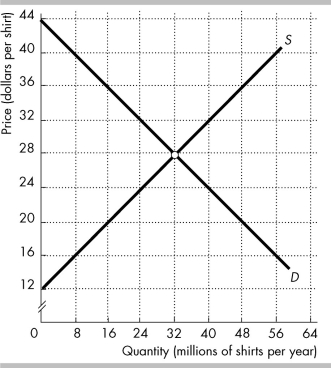 The figure shows the market for shirts in the United States, where D is the domestic demand curve and S is the domestic supply curve. The world price is $20 per shirt.
-In the figure above, with international trade ________ million shirts per year are produced in the United States.
The figure shows the market for shirts in the United States, where D is the domestic demand curve and S is the domestic supply curve. The world price is $20 per shirt.
-In the figure above, with international trade ________ million shirts per year are produced in the United States. (Multiple Choice)
4.7/5 (76)
(76) A country specializes in the production of goods for which it has a comparative advantage. We find that
(Multiple Choice)
5.0/5 (90)
(90) 
Filters
- Essay(0)
- Multiple Choice(0)
- Short Answer(0)
- True False(0)
- Matching(0)