



 Chat with AI
Exam 4: Income From Employment

Exam 1: Taxation-Its Role in Decision Making10 Questions
Exam 2: Fundamentals of Tax Planning10 Questions
Exam 3: Liability for Tax, Income Determination, and Administration of the Income Tax System9 Questions
Exam 4: Income From Employment9 Questions
Exam 5: Income From Business10 Questions
Exam 6: The Acquisition, Use, and Disposal of Depreciable Property10 Questions
Exam 7: Income From Property9 Questions
Exam 8: Gains and Losses on the Disposition of Capital Propertycapital Gains10 Questions
Exam 9: Other Income, Other Deductions, and Special Rules for Completing Net Income for Tax Purposes10 Questions
Exam 10: Individuals: Determination of Taxable Income and Taxes Payable10 Questions
Exam 11: Corporationsan Introduction10 Questions
Exam 12: Organization, Capital Structures, and Income Distributions of Corporations10 Questions
Exam 13: The Canadian-Controlled Private Corporation8 Questions
Exam 14: Multiple Corporations and Their Reorganization8 Questions
Exam 15: Partnerships8 Questions
Exam 16: Limited Partnerships and Joint Ventures8 Questions
Exam 17: Trusts8 Questions
Exam 18: Business Acquisitions and Divestituresassets Versus Shares8 Questions
Exam 19: Business Acquisitions and Divestiturestax-Deferred Sales8 Questions
Exam 20: Domestic and International Business Expansion7 Questions
Exam 21: Tax Aspects of Corporate Financing8 Questions
Exam 22: Gsthst Overview8 Questions
Select questions type


Kate Bell was employed by The Tea Shop Ltd.(a Canadian controlled private corporation)from January to December of 20x4.She earned a gross salary of $72,000.
The following were deducted from her pay during the year:
 The following amounts were paid by The Tea Shop Ltd.in 20x4 on Kate's behalf:
 Additional information:
On January 15,20x2,Kate was given an option to purchase 500 shares of The Tea Shop for $5.00 per share.The market value of the shares on that date was $5.50.Kate exercised her option on June 1,20x3 when the shares were valued at $7.00.She then sold the shares on March 17,20x4 when the market value was $8.00 per share.
Kate pays $50 a month for her cell phone which she uses to keep in touch with friends and family.She also pays $80 a month to dry-clean her suits,and she purchases a new suit valued at $200 every three months.Kate purchased $300 worth of merchandise (at cost)from her employer during the year.The retail value of the merchandise was $500.
Kate contributed $1,000 to her RRSP during the year.
Required:
A)Calculate Kate's minimum net income for tax purposes for 20x4,in accordance with Section 3 of the Income Tax Act.Identify items that have been omitted in your calculations.(Kate minimizes her tax liability whenever possible.)
B)Will Kate be able to deduct the stock option deduction to arrive at her taxable income? Why or why not?
The following amounts were paid by The Tea Shop Ltd.in 20x4 on Kate's behalf:
Additional information:
On January 15,20x2,Kate was given an option to purchase 500 shares of The Tea Shop for $5.00 per share.The market value of the shares on that date was $5.50.Kate exercised her option on June 1,20x3 when the shares were valued at $7.00.She then sold the shares on March 17,20x4 when the market value was $8.00 per share.
Kate pays $50 a month for her cell phone which she uses to keep in touch with friends and family.She also pays $80 a month to dry-clean her suits,and she purchases a new suit valued at $200 every three months.Kate purchased $300 worth of merchandise (at cost)from her employer during the year.The retail value of the merchandise was $500.
Kate contributed $1,000 to her RRSP during the year.
Required:
A)Calculate Kate's minimum net income for tax purposes for 20x4,in accordance with Section 3 of the Income Tax Act.Identify items that have been omitted in your calculations.(Kate minimizes her tax liability whenever possible.)
B)Will Kate be able to deduct the stock option deduction to arrive at her taxable income? Why or why not?
Free
(Essay)
4.9/5  (73)
(73) Correct Answer: Verified
A)
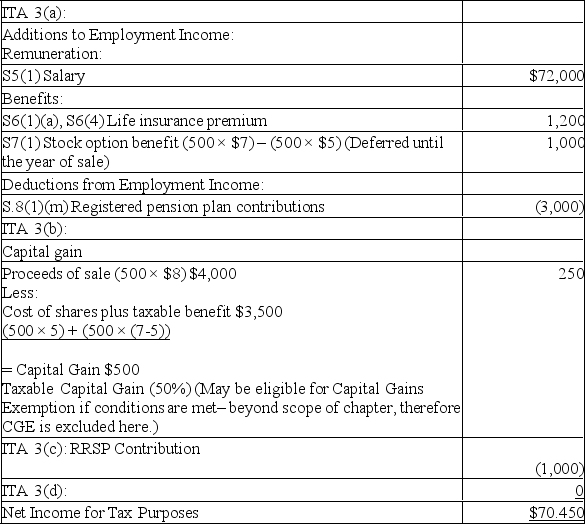 Omitted items:
Employer's portion of CPP,EI
Income tax deducted
Employer's contribution to RPP - specifically exempt
Kate's CPP,EI - deduction not allowed,eligible for non-refundable tax credit
Cell phone,dry-cleaning,suits - not deductible - personal expenses
Merchandise at cost-tax-exempt benefit
B)The shares are from a Canadian controlled private corporation.Therefore,Kate either has to hold the shares for two years after acquisition,or the option price must be equal to or greater than the fair market value at the option date.Neither of these requirements has been met.Therefore,Kate will not be able to deduct the stock option deduction in arriving at her taxable income.
Which of the following,when provided by an employer,is NOT a tax-deferred or tax-free benefit for the employee?
Free
(Multiple Choice)
4.9/5 (85)
(85) Correct Answer:Verified
VerifiedD
Andy worked for High Speed Bikes Inc.from March 1st to December 31st during 20x1.He earned a monthly base salary of $4,000,plus 1% commission on all of his sales.During 20x1,Andy's sales totaled $800,000.Andy was required by his employer to pay for his employment expenses.He traveled out of his city most days in order to sell to customers in surrounding towns.He received a monthly allowance of $500 to cover his traveling costs (which has been accurately recognized as 'unreasonable').Andy and his employer each contributed $2,000 to the company's registered pension plan in 20x1
Andy provided you with the following receipts for 20x1:
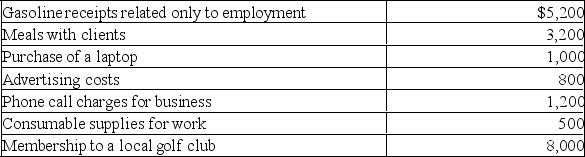 Andy purchased a new vehicle for work during the year,and drove it a total of 25,000 kms while employed at High Speed Bikes.12,000 of these kilometres were for business.The vehicle cost Andy $32,000 plus GST of 5% and PST of 5%.Work-related interest payments on the car loan totaled $200 per month.
Required:
Calculate Andy's employment income for 20x1 in accordance with Section 3 of the Income Tax Act
Andy purchased a new vehicle for work during the year,and drove it a total of 25,000 kms while employed at High Speed Bikes.12,000 of these kilometres were for business.The vehicle cost Andy $32,000 plus GST of 5% and PST of 5%.Work-related interest payments on the car loan totaled $200 per month.
Required:
Calculate Andy's employment income for 20x1 in accordance with Section 3 of the Income Tax ActFree
(Essay)
4.9/5 (94)
(94) Correct Answer:Verified
Verified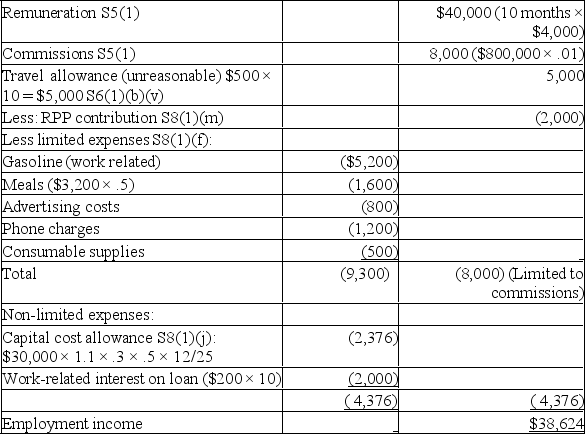
Which of the following factors are used by the courts in order to determine a taxpayer's status as an employee or a self-employed contractor?
(Multiple Choice)
4.9/5 (83)
(83) Susan was provided with a company car to drive from March 1st to December 31st of the current year.The car cost the company $22,000,plus GST (5%)and PST (6%).Susan drove the car a total of 15,000 kilometres during the year.11,000 kilometres were for business purposes and the other 4,000 kilometres were for personal use.Susan's employer pays for all of the vehicle's operating costs which totaled $1,100.What is the minimum amount that Susan will report in total taxable benefits as a result of the above information? (Round your answer to the nearest dollar.)
(Multiple Choice)
4.8/5 (76)
(76) Steven is employed by Big Rigs Inc.,a Canadian controlled private corporation.Steven earned $85,000 in 20x1.During the year,the following occurred:
A cash bonus of $8,000 was announced on December 3rd,to be paid to Steven on January 10th of the following year.
Steven was provided with a company car which he drove all year.The cost of the car (including taxes)was $40,000.All operating costs were paid by the employer.Steven drove the car 21,000 kilometres in 20x1,of which 10,000 kilometres were for personal use.
Steven and Big Rigs each contributed $5,000 towards Steven's registered pension plan.
Steven was presented with a watch from Big Rigs,valued at $200,on his birthday.
The company provided Steven with a $200 cell phone to be used for business purposes.
In January of 20x1,Big Rigs loaned Steven $15,000 at a rate of 1% interest.The CRA's prescribed rate of interest during the year was 3%.
In January,Steven was offered a stock option to purchase 2000 shares in Big Rigs at a cost of $8.00 per share.At that time,the fair market value per share was $9.00.Steven exercised his option in February when the market value had risen to $9.50 per share.At the end of the year,Steven had not sold any of the shares,and he was hoping to purchase more shares in the company in the upcoming year.
Big Rigs provided Steven with a $25 meal allowance every week due to the two hours of overtime that he was required to work each Wednesday immediately following his eight hours of regular work.
Steven's annual union dues totaled $850,which was deducted from his pay.
Required:
A)Calculate Steven's minimum employment income for tax purposes in accordance with Section 3 of the Income Tax Act.
B)Identify any items that have been omitted in your calculations,and briefly explain why.
(Essay)
4.9/5 (77)
(77) An individual has the option to receive a $1000 annual bonus and invest the after-tax amount for 25 years,or receive $1000 per annum in a registered pension plan for the next 25 years.Assuming a constant rate of return of 8% and a tax rate of 40%,what will be the total after-tax difference between the two plans? Show all of your work.
(Essay)
4.8/5 (87)
(87) Sarah borrowed $25,000 from her employer at a rate of 1% interest.At the time the loan was made,CRA's prescribed rate of interest was 3%.Sarah is in a 40% income tax bracket.What is the actual cost (rate)of Sarah's loan? (Assume there are no fluctuations in the prescribed rate of interest.)
(Multiple Choice)
4.9/5 (95)
(95) Cindy works for Sky Manufacturers Ltd.,which is a public corporation.In 20x1 she was offered an option to purchase shares at $15 per share from her employer.The fair market value on that day was $17 per share.The option had a four year exercise time-limit.Cindy exercised her option in 20x3 and purchased 500 shares.The fair market value at that time was $21 per share.What is Cindy's tax treatment of this option on her 20x3 tax return?
(Multiple Choice)
4.9/5 (75)
(75) 
Filters
- Essay(0)
- Multiple Choice(0)
- Short Answer(0)
- True False(0)
- Matching(0)