



 Chat with AI
Exam 11: Corporationsan Introduction

Exam 1: Taxation-Its Role in Decision Making10 Questions
Exam 2: Fundamentals of Tax Planning10 Questions
Exam 3: Liability for Tax, Income Determination, and Administration of the Income Tax System9 Questions
Exam 4: Income From Employment9 Questions
Exam 5: Income From Business10 Questions
Exam 6: The Acquisition, Use, and Disposal of Depreciable Property10 Questions
Exam 7: Income From Property9 Questions
Exam 8: Gains and Losses on the Disposition of Capital Propertycapital Gains10 Questions
Exam 9: Other Income, Other Deductions, and Special Rules for Completing Net Income for Tax Purposes10 Questions
Exam 10: Individuals: Determination of Taxable Income and Taxes Payable10 Questions
Exam 11: Corporationsan Introduction10 Questions
Exam 12: Organization, Capital Structures, and Income Distributions of Corporations10 Questions
Exam 13: The Canadian-Controlled Private Corporation8 Questions
Exam 14: Multiple Corporations and Their Reorganization8 Questions
Exam 15: Partnerships8 Questions
Exam 16: Limited Partnerships and Joint Ventures8 Questions
Exam 17: Trusts8 Questions
Exam 18: Business Acquisitions and Divestituresassets Versus Shares8 Questions
Exam 19: Business Acquisitions and Divestiturestax-Deferred Sales8 Questions
Exam 20: Domestic and International Business Expansion7 Questions
Exam 21: Tax Aspects of Corporate Financing8 Questions
Exam 22: Gsthst Overview8 Questions
Select questions type


Which of the following scenarios is not allowed?

Free
(Multiple Choice)
4.9/5  (68)
(68) Correct Answer: Verified
B
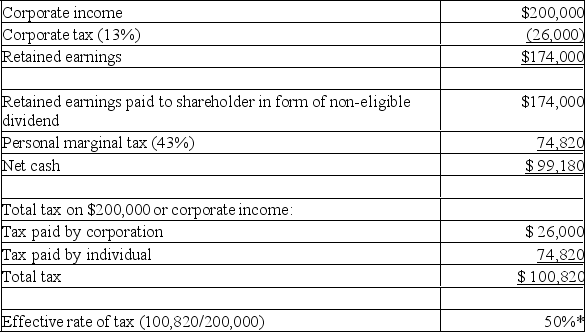
The Canadian tax system practices integration between corporations and individuals.Using the data in Table 1 and assumed rates,illustrate and explain the concept of integration.
Table 1

Free
(Essay)
4.9/5 (85)
(85) Correct Answer:Verified
Verified*Rounded
The concept of integration illustrated here shows that as income flows through a corporation and ultimately to an individual,the total tax paid on that income is relatively equivalent to the amount that the individual would have paid had he/she received the income directly,rather than through a corporation.Thus,double taxation is avoided.[However,this example is based on set tax rates which may differ in varying circumstances,and double taxation may occur in some scenarios.]
Bride and Groom Co.is a Canadian controlled private corporation with active business income of $750,000 in 20x9.Dividends were received during 20x9 from a taxable Canadian corporation in the amount of $80,000.The company recognized a $50,000 capital gain during 20x9.The company's year-end is December 31st.
Additional information is as follows:
Net capital loss carry-over from 20x8 is $30,000.
Non capital loss carry-over from 20x8 is $70,000.
Required:
Calculate the following for the company for the 20x8 tax year:
A)Net income for tax purposes
B)Taxable income
C)Part I Federal tax
(Use tax rates and amounts applicable for 2019 for each of the above.)
Free
(Essay)
4.8/5 (78)
(78) Correct Answer:Verified
Verified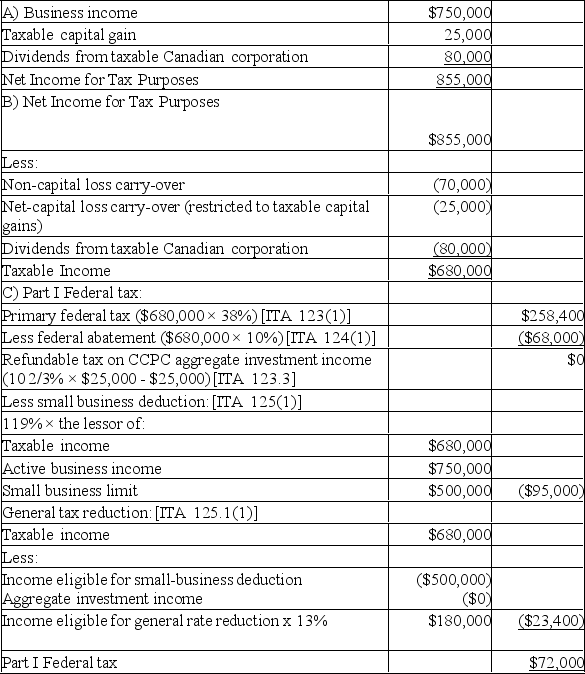
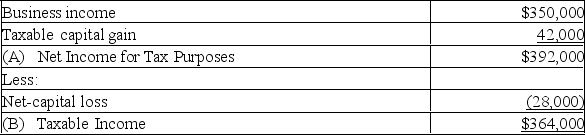
Johnson Co.is a CCPC with active business income of $350,000 in 20xx.The company engages in retail and wholesale activities.Capital gains recognized by the company in 20xx totaled $84,000.
Johnson Co.will utilize a net capital loss carry-over of $28,000 on its 20xx tax return.
Required:
Applying tax rates and amounts for 2019,calculate the following for Johnson Co.for 20xx:
a)Net Income for Tax Purposes
b)Taxable Income
c)Federal Tax
(Essay)
4.9/5 (79)
(79) Coffee Co.began operations in 20x0 and recognized $37,000 in business income and $1,000 in taxable capital gains that year.In 20x1,the company incurred a business loss of $25,000,a taxable capital gain of $2,000,and an allowable capital loss of $5,000.Business income for 20x2 was $50,000,taxable capital gains were $4,000,and the company received $10,000 in dividends from a taxable Canadian corporation.Coffee Co.utilizes any unused losses in the earliest years possible,Which of the following taxable incomes are correct after all carry-over adjustments have been made?
(Multiple Choice)
4.8/5 (90)
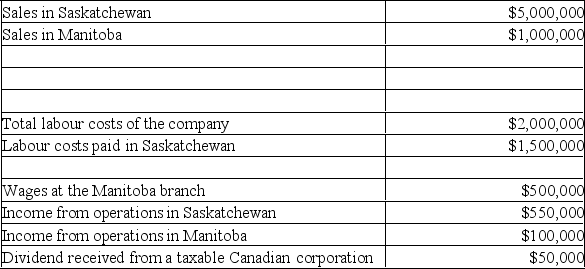
(90) Steven Co.is a public Canadian corporation which was established five years ago.The company's head office is located in Saskatchewan.In 2018,a small branch was established in Manitoba.
In 2019,the company's books included the following:
 Required:
A)Calculate the company's net income for tax purposes for 2019.
B)Calculate the company's taxable income,both federal and provincial.(Round all amounts to two decimal places.)
C)Calculate Steven Co.'s Part I federal tax liability.(Round all numbers to zero decimal points.)
(Use tax rates and amounts applicable for 2019 for each of the above.)
Required:
A)Calculate the company's net income for tax purposes for 2019.
B)Calculate the company's taxable income,both federal and provincial.(Round all amounts to two decimal places.)
C)Calculate Steven Co.'s Part I federal tax liability.(Round all numbers to zero decimal points.)
(Use tax rates and amounts applicable for 2019 for each of the above.) (Essay)
4.8/5 (67)
(67) Using general terms,explain how a change in control of a corporation can affect the net-capital losses and the non-capital losses.
(Essay)
4.8/5 (88)
(88) When shares are transferred from one group of shareholders to another and there is a change in control,which of the following applies?
(Multiple Choice)
4.8/5 (84)
(84) Which of the following statements accurately describes the tax treatment of Canadian corporations?
(Multiple Choice)
5.0/5 (82)
(82) Many corporations carry on business in more than one province.Assuming a corporation from Province A wishes to conduct business in Province B,the corporation will not have to pay tax in Province B if
(Multiple Choice)
4.9/5 (92)
(92) 
Filters
- Essay(0)
- Multiple Choice(0)
- Short Answer(0)
- True False(0)
- Matching(0)